
Microchip’s latest 64-bit microprocessor units (MPUs) are engineered to fortify systems against the impending threats posed by quantum computing. These MPUs integrate advanced security features, including post-quantum cryptography, to ensure data integrity and confidentiality in mission-critical applications.
How Do Microchip’s 64-bit MPUs Address Post-Quantum Security?
Microchip’s 64-bit MPUs incorporate post-quantum cryptographic algorithms, such as NIST-standardized FIPS 203 (ML-KEM) and FIPS 204 (ML-DSA), to safeguard systems against potential quantum computing threats.
What Are the Key Features of Microchip’s 64-bit MPUs?
The 64-bit MPUs offer features like multi-core processing, advanced AI/ML capabilities, and integrated Time-Sensitive Networking (TSN) Ethernet connectivity. These features enhance performance and reliability in complex applications.
Which Industries Benefit from Microchip’s 64-bit MPUs?
Industries such as aerospace, defense, automotive, and industrial sectors benefit from these MPUs, as they require high-performance computing with robust security measures.
Why Is Post-Quantum Security Crucial for Future Systems?
As quantum computing evolves, traditional encryption methods may become vulnerable. Implementing post-quantum security ensures that systems remain secure against future computational advancements.
How Do Microchip’s 64-bit MPUs Enhance System Reliability?
These MPUs feature a dedicated system controller for runtime monitoring and fault management, along with WorldGuard architecture for workload isolation, ensuring system resilience.
Buying Tips for Microchip’s 64-bit MPUs
When purchasing Microchip’s 64-bit MPUs, consider the following:
-
Compatibility: Ensure the MPU meets the specific requirements of your application.
-
Security Features: Verify the inclusion of post-quantum cryptographic algorithms.
-
Performance Specifications: Check for multi-core processing capabilities and AI/ML support.
-
Industry Certifications: Confirm compliance with relevant industry standards.
Fly-Wing Technology (HK) Co., Limited offers a range of Microchip’s MPUs, providing competitive pricing and reliable sourcing solutions.
Electronic Components Expert Views
“Microchip’s 64-bit MPUs represent a significant advancement in securing systems against the evolving threats of quantum computing,” says an industry expert. “Their integration of post-quantum cryptography and advanced processing capabilities positions them as a critical component in future-proofing mission-critical applications.”
FAQ
Q: What is post-quantum security?
A: Post-quantum security involves implementing cryptographic algorithms that are resistant to attacks from quantum computers.
Q: Which industries require post-quantum security?
A: Industries like aerospace, defense, automotive, and industrial sectors require post-quantum security due to their reliance on secure data transmission and processing.
Q: How do Microchip’s MPUs enhance system performance?
A: Microchip’s MPUs enhance system performance through multi-core processing, advanced AI/ML capabilities, and integrated TSN Ethernet connectivity.
Q: Why is it important to implement post-quantum security now?
A: Implementing post-quantum security now ensures that systems remain secure against future threats posed by quantum computing advancements.
Microchip tapped SiFive’s RISC-V CPUs for its new mission-critical processors.
Microchip Technology has unveiled the PIC64HX1000 series, a new line of quantum-resistant 64-bit RISC-V processors engineered to tackle the evolving demands of artificial intelligence, real-time computation, and quantum-resistant cybersecurity.
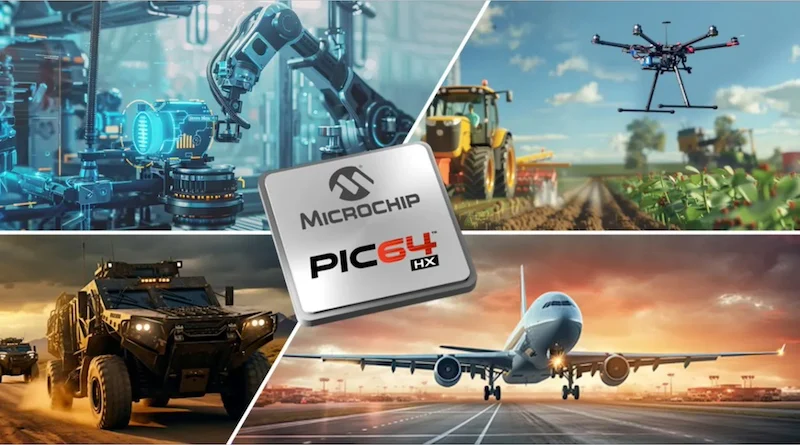
The PIC64HX1000 series
The rapid evolution of computing architecture has entered a new phase, with industries facing unprecedented security challenges and computational demands. Traditional processor designs, while powerful, struggle to meet the security requirements in mission-critical sectors such as aerospace, defense, and automotive, where any computational vulnerability could have severe consequences. Meanwhile, the looming threat of quantum computing has pushed manufacturers to fundamentally rethink their security approaches, as current encryption methods may become obsolete in the coming decades.
To address these sensitive use cases, Microchip has optimized the PIC64HX1000 series’ architecture for AI/ML capabilities, real-time processing, and robust security features.
Microchip’s New Security-Focused RISC-V Processor
The PIC64HX1000 integrates eight 64-bit SiFive X280 RISC-V CPU cores, capable of supporting vector extensions and operating up to 1 GHz to deliver 26K DMIPS scalar performance. The decoupled vector pipeline also enables 512-bit vector operations, resulting in up to 1 TFLOP processing power for AI/ML workloads. The supporting memory architecture includes dual DDR4-3200 interfaces with up to 32 GB per interface and ECC for fault-tolerant data integrity.
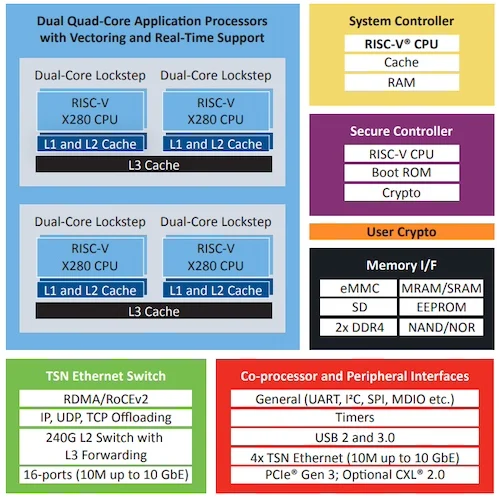
PIC64HX1000 family block diagram
The PIC64HX1000 notably features a dedicated system controller with a 64-bit SiFive S7 core operating at 500 MHz. This controller handles mission-critical tasks such as runtime monitoring and fault management. Meanwhile, the integrated WorldGuard architecture provides spatial partitioning across cores, cache, memory, and interconnect, supporting up to 32 domains for workload isolation. Post-quantum cryptography, anti-tamper mechanisms, and a secure enclave for secure boot and platform integrity enhance defense-grade security.
The MPUs Leverage SiFive’s X280 RISC-V CPU
Central to the PIC64HX1000 series is the SiFive Intelligence X280 processor, a 64-bit RISC-V vector processor optimized for AI and ML workloads. This processor features a scalable multi-core and multi-cluster design with up to eight cores. Architecturally, the design integrates an eight-stage dual-issue scalar pipeline with a decoupled vector ALU pipeline. Its RISC-V, 512-bit vector length (VLEN) vector supports dynamic variable vector length operations, while the 256-bit-wide vector ALU and load/store architecture enable efficient data processing. The system’s architecture also includes a shared memory subsystem with a scalable L3 coherent cache of up to 8 MB.
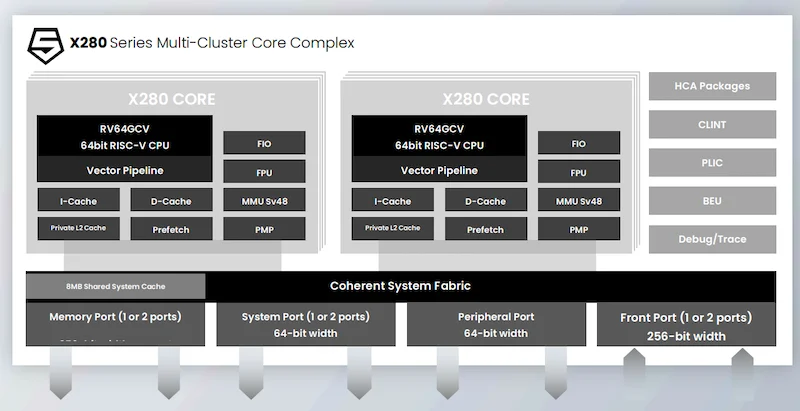
The X280 series multi-cluster core complex
Microchip enhanced the X280’s AI/ML performance using SiFive’s Intelligence Extensions, which enable the processor to achieve up to 2.25 TFLOPs (bfloat16 MatMul) or 4.6 TOPS (INT8 MatMul). These custom extensions are tightly integrated with the RISC-V vector extension to accelerate machine learning inference. The vector pipeline supports data types like FP64, FP32, and INT8, making it versatile for various workloads. Additionally, the X280 supports vector length multipliers (LMUL) up to 8x, allowing vector operations with lengths up to 4096 bits.
For flexibility, the X280 offers multiple data ports, including 256-bit memory ports and 64-bit system ports. A decoupled scalar and vector pipeline offers parallel execution, and the design supports virtual memory with up to 48-bit addressing.
The Intersection of HPC and Security
The PIC64HX1000 series arrives at an intersection of market demands, where post-quantum security meets the need for high-performance computing in mission-critical applications. Integrating post-quantum cryptography into a high-performance RISC-V platform makes the PIC64HX1000 series a solid option for future-proof designs before quantum computers become a reality—and potentially a threat.
