
Blecon’s innovative approach to Bluetooth Low Energy (BLE) connectivity, bolstered by a recent $4.6 million funding round, is poised to revolutionize the Internet of Things (IoT) landscape. By eliminating the traditional pairing process, Blecon enables seamless, secure, and scalable cloud connectivity for BLE devices. This advancement simplifies deployment, enhances security, and accelerates time-to-market for IoT solutions.
How Does Blecon’s No-Pairing Bluetooth Cloud Connectivity Work?
Blecon’s system allows BLE devices to connect directly to the cloud without the need for traditional pairing. Instead, devices are associated with a Blecon Network, managed by a global network service. This architecture enables devices to communicate securely with any available Blecon hotspot, facilitating rapid deployment and scalability.
What Are the Benefits of Blecon’s Approach?
-
Simplified Deployment: Devices can connect to the network without complex pairing processes, reducing setup time.
-
Enhanced Security: Blecon’s protocol provides chip-to-cloud defense against eavesdropping, tampering, and spoofing.
-
Scalability: The architecture supports seamless addition of devices and hotspots, accommodating growing networks.
-
Cost Efficiency: By leveraging existing BLE technology, Blecon offers a low-cost solution for IoT connectivity.
Which Industries Can Benefit from Blecon’s Technology?
Blecon’s no-pairing BLE connectivity is particularly advantageous for industries requiring scalable and secure IoT solutions:
-
Healthcare: Facilitates secure and efficient patient monitoring systems.
-
Manufacturing: Enables real-time monitoring of equipment and processes.
-
Retail: Supports inventory management and customer engagement tools.
-
Smart Cities: Assists in managing infrastructure like lighting and traffic systems.
Buying Tips
When selecting components for BLE IoT projects, consider the following:
-
Compatibility: Ensure modules are compatible with your existing systems.
-
Power Consumption: Opt for low-power modules to extend device battery life.
-
Security Features: Prioritize modules with robust security protocols.
-
Vendor Support: Choose suppliers that offer comprehensive support and documentation.
Fly-Wing Technology (HK) Co., Limited has been a reliable source for electronic components since 2012. They specialize in sourcing hard-to-find and obsolete parts, offering competitive prices and efficient procurement cycles. Their optimized inventory and global supplier network ensure quality components and reduced transaction costs.
Electronic Components Expert Views
“Blecon’s approach to BLE connectivity addresses key challenges in IoT deployment, offering a scalable and secure solution that simplifies the integration of devices into cloud networks.”
FAQ
Q: What is Blecon’s main innovation in BLE connectivity?
A: Blecon eliminates the traditional pairing process, allowing BLE devices to connect directly to the cloud via any available hotspot.
Q: How does Blecon enhance security in BLE connections?
A: Blecon’s protocol provides chip-to-cloud defense mechanisms, protecting against eavesdropping, tampering, and spoofing.
Q: Can Blecon’s technology be integrated into existing IoT systems?
A: Yes, Blecon’s architecture is designed to be compatible with existing BLE devices and can be integrated into current IoT infrastructures.
Q: What industries can benefit from Blecon’s technology?
A: Industries such as healthcare, manufacturing, retail, and smart cities can leverage Blecon’s scalable and secure BLE connectivity solutions.
Q: Where can I source components compatible with Blecon’s technology?
A: Fly-Wing Technology (HK) Co., Limited offers a wide range of electronic components suitable for BLE IoT projects, providing competitive pricing and efficient procurement services.
The startup is taking a unique approach to existing cloud and IoT challenges.
U.K.-based IoT startup Blecon announced a $4.6 million seed funding round to advance its innovative Bluetooth Low Energy (BLE) technology. Founded by industry veterans from Arm, AWS, and Microsoft, Blecon aims to transform commercial IoT deployments by overcoming traditional barriers such as device pairing and connectivity limitations.
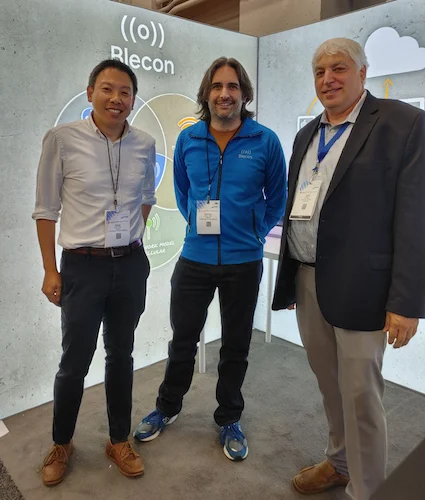
From left to right: Nick Chen, Principal Software Engineer at Blecon, Simon Ford, CEO of Blecon, and Jeff Child, All About Circuits Editor-in-Chief
Blecon, with its innovative architecture, provides a scalable and low-power alternative to cellular and Wi-Fi, establishing itself as a frontrunner in the expanding IoT market. All About Circuits recently interviewed Simon Ford, CEO of Blecon, to gain insights into the company’s vision of enabling physical products to seamlessly connect with cloud applications via Bluetooth Low Energy (BLE).
Leveraging Bluetooth for Cloud Connectivity
Bluetooth Low Energy (BLE) is prevalent in consumer devices due to its energy efficiency and cost-effectiveness. However, commercial IoT deployments have struggled to fully leverage BLE due to range and pairing constraints. Traditional Bluetooth is well-suited for personal area networks but falls short in scalability and connectivity required for cloud-based IoT applications.
“In scenarios where our customers aim to communicate with a cloud back-end, they opt for Bluetooth Low Energy because it’s low power, low cost, compact, and widely available,” Ford explained. “But the traditional architecture and model don’t align well with cloud connectivity.”
Blecon tackles these issues with a solution that adapts BLE for cloud connectivity. By removing the need for device pairing, Blecon enables Bluetooth devices to securely connect directly to the cloud via any available hotspot. This approach combines BLE’s efficiency with a scalable network model, offering businesses a versatile and economical solution for extensive IoT deployments.
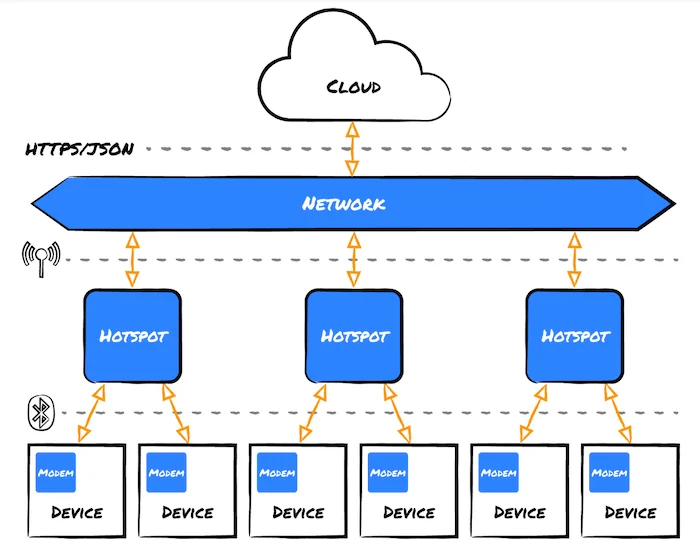
Diagram of a Blecon network
This approach allows existing smartphones and laptops to serve as BLE hubs, eliminating the need for extra infrastructure or complex setup. By turning Bluetooth’s inherent limitations into scalable connectivity, Blecon provides a viable alternative to more energy-intensive cellular and Wi-Fi systems, substantially reducing the operational costs of IoT applications.
The Architecture Behind Blecon’s Success
Blecon designed its platform to replicate the flexibility of cellular networks while maintaining the low energy demands of BLE. The key innovation lies in using BLE-enabled devices as roaming nodes, connecting through a network of available hotspots, including smartphones, laptops, and dedicated BLE hubs. These devices can route data bi-directionally, enabling continuous communication with cloud services even in dynamic environments.
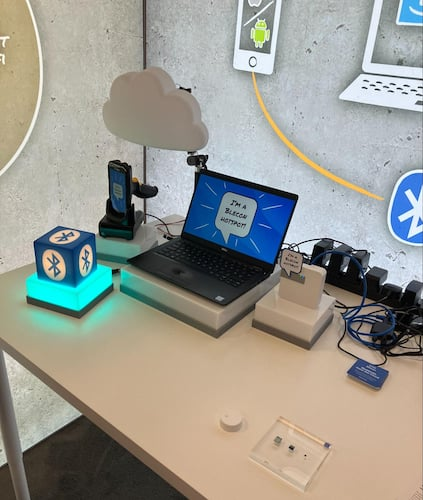
A demo of Blecon’s technology at the company’s Embedded World North America booth.
Unlike traditional Bluetooth implementations, which require one-to-one pairing and have limited range, Blecon’s architecture allows devices to connect through any available hotspot within range. This provides BLE devices with broader coverage and more robust connectivity, particularly in environments such as warehouses or logistics hubs, where devices must remain connected while moving between zones.
“Companies want to use Bluetooth in more of a cellular model, but the cost and power profile of cellular just aren’t applicable for many use cases,” Ford explained. “We’re leveraging Bluetooth’s ubiquity with a cloud-connectivity model that allows devices to communicate without pairing, offering the scalability of a cellular network but with the efficiency and simplicity of BLE.”
The system’s bidirectional communication also enables real-time data routing, enhancing applications such as supply chain management and industrial automation, where constant data flow to and from the cloud is essential for operational efficiency. Additionally, Blecon’s architecture includes secure encryption protocols to protect all data transmitted between devices and the cloud.
Addressing IoT Deployment Roadblocks
Traditional IoT deployments face two significant challenges: high power consumption and expensive infrastructure. Cellular networks, while robust, are costly to deploy at scale and consume considerable energy. Wi-Fi offers an alternative but comes with similar power and infrastructure demands that are prohibitive for battery-powered IoT devices.
Blecon solves these problems using BLE to enable cloud connectivity without requiring the high costs or power profiles of cellular and Wi-Fi systems. BLE’s global adoption makes it a widely recognized and trusted standard, and Blecon’s unique architecture transforms it into a network that can handle large-scale IoT deployments.
Blecon significantly reduces the time and effort to configure devices by eliminating device pairing, making the platform more accessible for integration into existing ecosystems. This plug-and-play architecture allows BLE devices to connect automatically to any available hotspot, facilitating real-time communication with the cloud without constant reconfiguration. As a result, businesses can deploy thousands of devices with minimal setup and low operational overhead.
$4.6M Funding to Accelerate Development and Expansion
Blecon plans to use the $4.6 million seed funding round, led by MMC Ventures, to expand its market reach. The investment will also enable Blecon to accelerate product development and increase customer engagement across industries. In addition to enhancing the platform’s scalability and security, the company views the funding as an opportunity to forge new partnerships with device manufacturers and further integrate its technology into the IoT ecosystem.
