
Introduction
Electronic circuits are vulnerable to overvoltage events. A sudden voltage spike can damage power semiconductors, microcontrollers, power supplies and communication interface. Designers always use protection circuits to avoid such failures and keep operating the circuit under safe operating conditions. Zener diode and Transient Voltage Suppression (TVS) diodes are among the most commonly used components in protection circuits.
Both diodes operate in reverse breakdown; however, they serve different purposes in protection circuits. A Zener diode commonly used for reference generation and voltage regulation whereas a TVS is mainly designed to absorb high-energy transients.
This article compares both diodes in terms of operating principle, applications, performance, and design considerations. This article serves as an initial guide for designers to choose the best diode for their protection circuit design.
What is a Zener Diode?
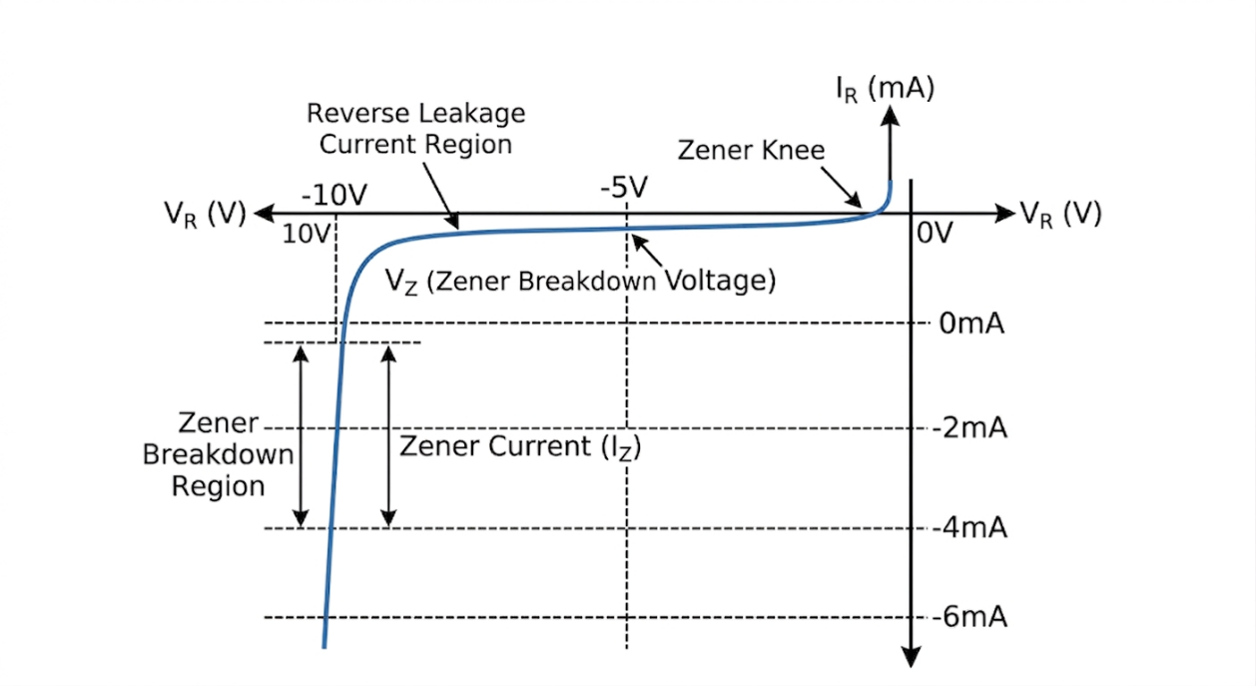
A Zener diode is a semiconductor device designed to operate in a reverse bias. Unlike conventional diodes that block current in the reverse direction, Zener diodes can enter in reverse breakdown when reverse voltage reaches specified voltages also known as Zener voltages (See Fig-1).
The diode maintains a nearly constant voltages across its terminal during the reverse breakdown operation. For example, a 5.2V Zener diode maintains the 5.2V across the load even when input voltage varies.
This feature of Zener diode makes them useful for several applications such as voltage regulation, signal clipping and clamping, overvoltage protection (low voltage), and voltage reference circuits. For example, devices such as the MMSZ4684 Zener diode are commonly used in low-power voltage regulation and signal protection circuits.
What is a TVS Diode?
A TVS diode is a protection device used to absorb transient voltage spikes. During the normal circuit operation, the device does not conduct. However, as soon as a transient spike exceeds the breakdown voltage, the device instantly enters avalanche mode and diverts surge current away from sensitive circuitry.
These diodes are generally used to handle high peak currents and high energy transients (such as SMBJ24CA). Their applications include industrial equipment, automotive electronics, power supply protections, communication interface, lightning surge protection, etc.
Zener Diode vs TVS Diode: Performance Comparison
Zener Diode vs TVS Diode: Continuous vs Transient
The primary difference between these two devices is not rehow they enter in breakdown, but how long they are designed to stay there.
As shown in Fig-1, Zener diodes are capable of operating continuously in the reverse breakdown region (VZ). While TVS diode act as an open circuit during the normal operating conditions. It activates when a sudden transient spikes above its breakdown threshold.
Thermally, Zener diode design focuses on continuous power dissipation because of their continuous operation. They feature smaller and highly doped junctions suitable for stable voltage references. The power dissipation equation for Zener diode is given as follows.
\[P_{continuous}=V_Z \times I_Z\]
Where, VZ and IZ represents Zener voltage and current, respectively.
In contrast, TVS is rated for Peak Pulse Power (Ppp) as given by equation below. They feature a massive PN junction area to absorb large energy shocks without melting.
\[P_{PP}=V_C \times I_{PP}\]
Where, VC is clamping voltage during the surge event and IPP is peak pulse current through the TVS diode during the transient.
Response Time
Protection circuits are designed to protect the sensitive devices. A delayed response allows transients to reach sensitive components, potentially causing damage. Hence, protection devices must react quickly to voltage spikes.
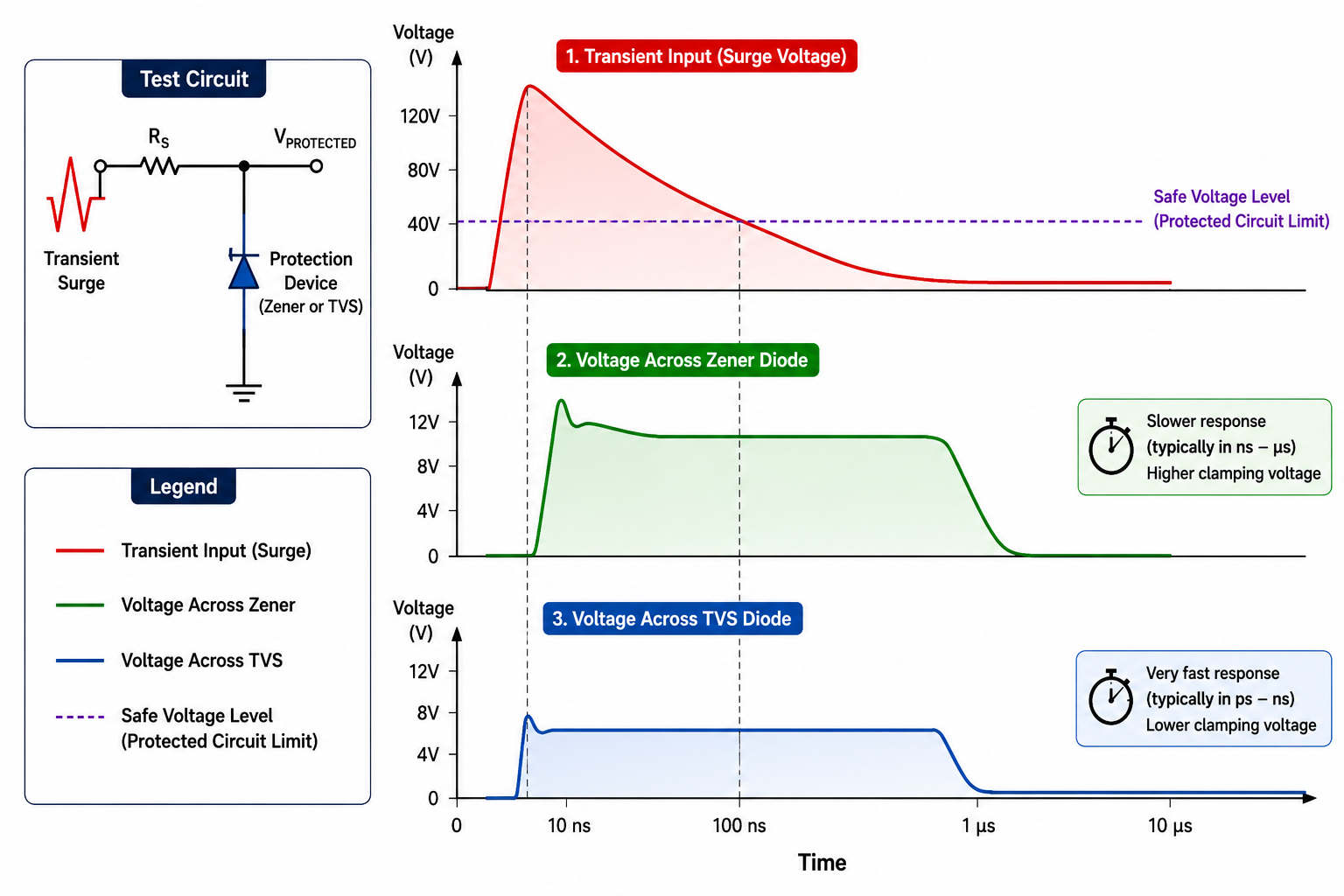
Modern TVS diodes are extremely fast such that they can respond within picoseconds to nanoseconds (see Fig-2). This feature makes them ideal for protecting high-speed electronics and communication interfaces.
On the other hand, Zener diode also responds quickly however they are not ideal for suppressing fast transient events. Applications where response speed is critical TVS diode is the preferred choice.
Power Handling Capability
The power handling capability of these devices differs significantly. A typical Zener diode may be rated for 500mW-5W, while TVS diodes are commonly rated for 400W-3000W.
Due to this, Zener diodes are generally used for low-energy protection applications such as voltage reference circuits and signal lines. In contrast, TVS diodes are more suitable for high-speed high-power protections.
For example, a lightening-induced surge on industrial cable can generate enough current to destroy the Zener diode immediately, whereas TVS diode (if selected properly) can easily divert the current away from sensitive components.
Zener Diode vs TVS Diode: Key Differences
The main difference between Zener diode and TVS diode is that Zener diode regulates voltage continuously while TVS diode remains inactive until a transient event occurs. The other differences are shown in table below.
| Parameter | Zener Diode | TVS Diode |
| Primary Function | Voltage regulation | Transient suppression |
| Response Time | Fast | Extremely fast |
| Power Handling | Low to moderate | Very high |
| Surge Capability | Limited | Excellent |
| Energy Absorption | Low | High |
| Cost | Lower | Higher |
| Typical Application | Voltage references | Surge protection |
Zener Diode vs TVS Diode: Understanding the Datasheet Specs
Engineers need to evaluate several parameters when selecting a TVS or Zener diode. The table below demonstrates the most important datasheet parameters along with their significance.
| Device | Parameter | Symbol | Definition | Why It Matters |
| TVS Diode | Reverse Stand-Off Voltage | VRWM | Maximum continuous operating voltage at which the TVS remains off and exhibits minimal leakage current. | Must be higher than the normal operating voltage to prevent unwanted conduction. |
| TVS Diode | Breakdown Voltage | VBR | Voltage at which the TVS begins to conduct and enter avalanche breakdown. | Determines when surge protection becomes active. |
| TVS Diode | Clamping Voltage | VC | Maximum voltage that appears across the TVS during a surge event. | Represents the actual voltage experienced by the protected circuit during a transient. Lower values provide better protection. |
| Zener Diode | Zener Voltage | VZ | Nominal reverse breakdown voltage specified at a particular test current. | Determines the regulated voltage level of the circuit. |
| Zener Diode | Maximum Zener Current | IZM | Maximum continuous current that can flow through the Zener diode without damage. | Exceeding this limit can lead to overheating and device failure. |
| Zener Diode | Zener Impedance | ZZT | Dynamic resistance of the Zener diode measured at the specified test current. | Lower impedance improves voltage regulation accuracy and produces a sharper breakdown characteristic. |
Case Study 1: Protection for a 3.3V Microcontroller Input
Task Condition
A designer needs to develop a sensor interface board using a 3.3V microcontroller. The sensor cable is short and located inside a controlled environment. Overvoltage conditions are possible due to wiring errors.
Solution
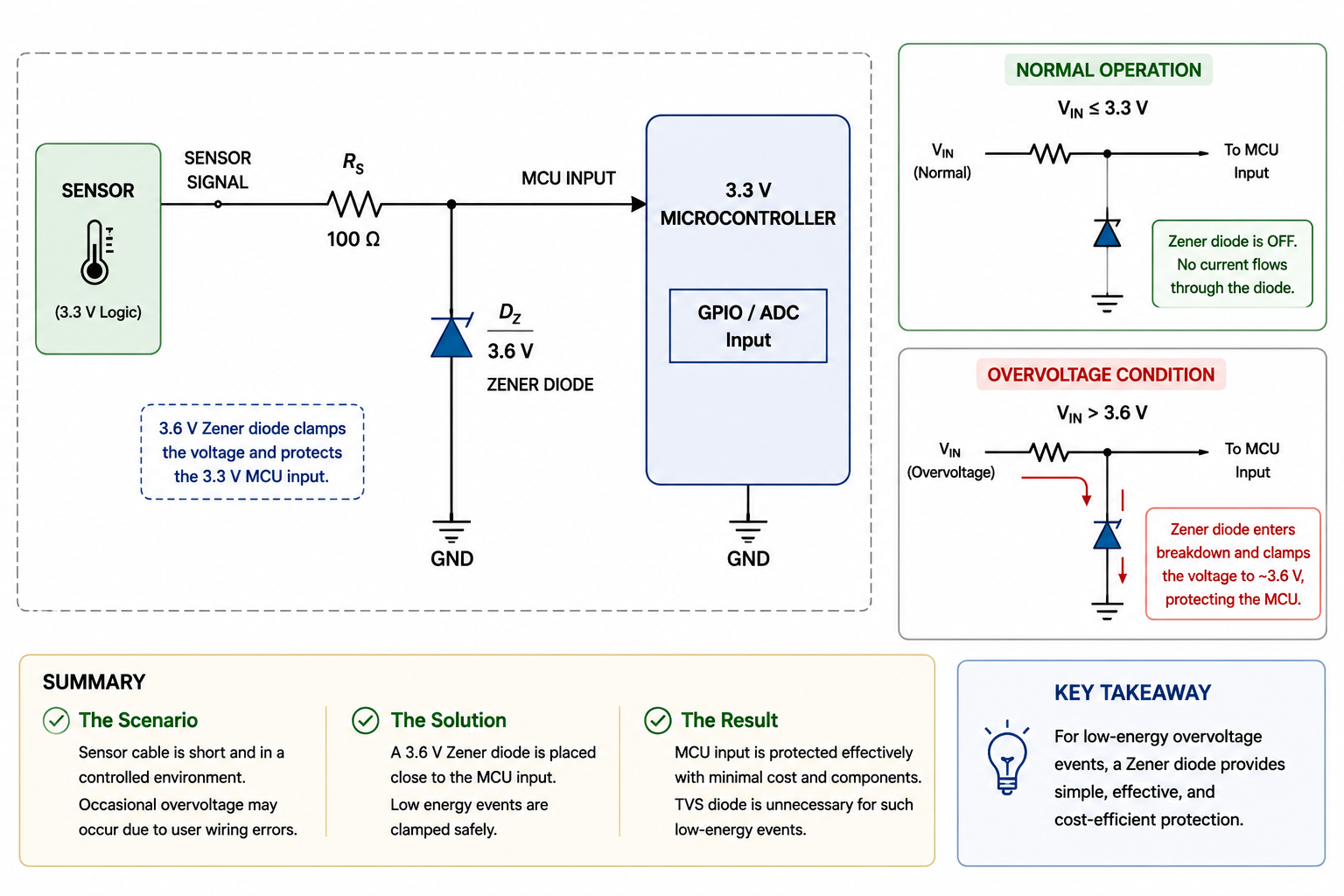
As provided, the expected energy level is low, the Zener diode is better choice in this case. A low-power Zener diode such as 1N5226B can be connected between the signal and ground (see Fig-3).
Zener diode remains inactive during the normal operation. While during the fault condition, if input voltage exceeds the safe operating range, the Zener diode goes into breakdown and limits the input voltage to microcontroller.
In this way, the circuit receives protection without additional components keeping the total cost lower.

Case Study 2: Protection for a 24V Industrial Controller
Task Condition
An industrial controller interfaces with sensors. The sensors are placed several meters away. The installation environment consists of contactors, motors, and inductive loads.
Solution
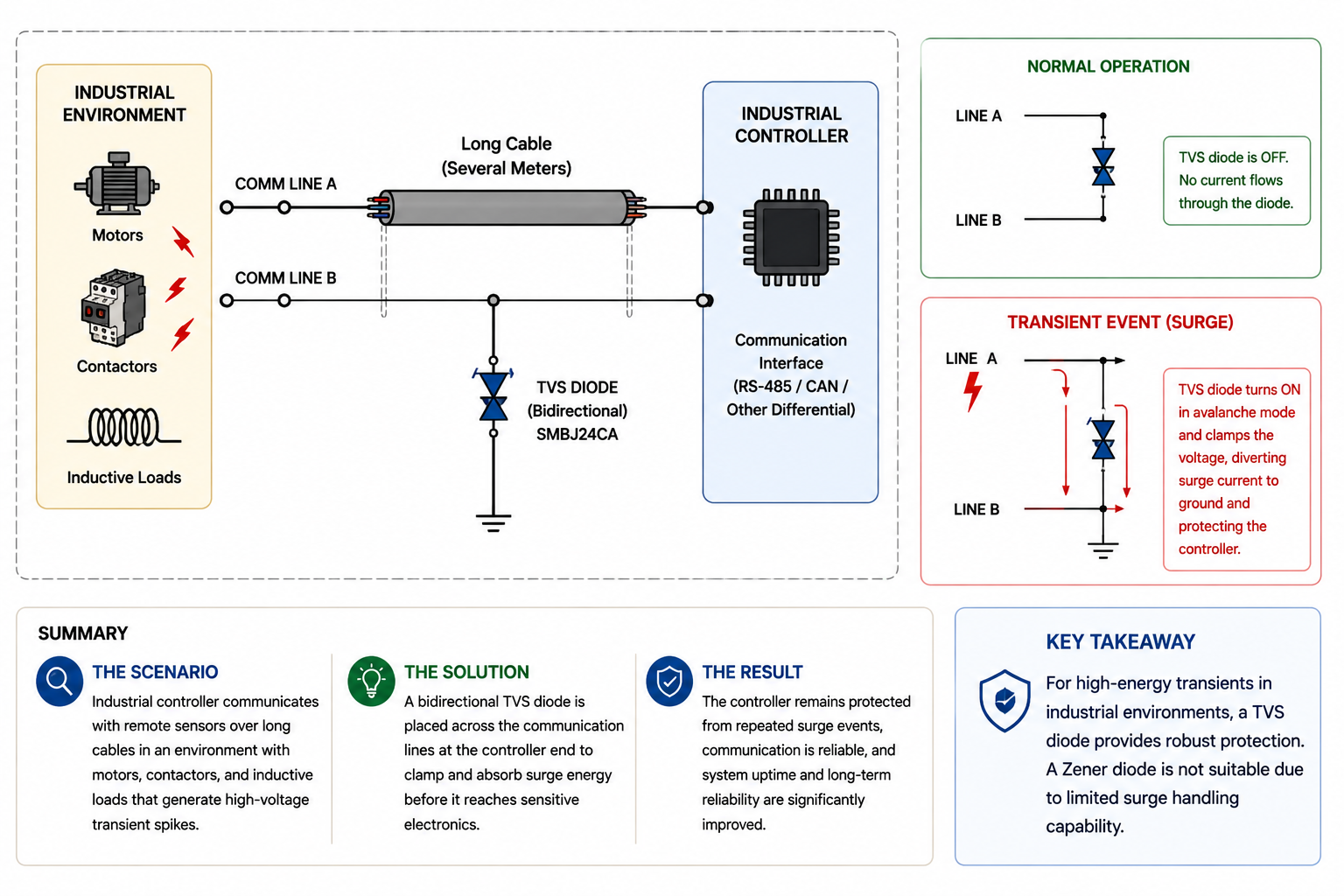
The presence of motors and inductive loads in installation environment can generate large transient spikes during the switching events. Hence, using Zener diode would fail due to insufficient surge handling capability.
Using TVS diode is a practicle solution in this case. The TVS diode (For example, P6KE24CA) can be installed across the communication interface. During the transient condition, TVS diode goes into avalanche mode and diverts the surge current away from the sensitive devices (see Fig-4).
Zener Diode vs TVS Diode: How to Select Right Protection Device
Understanding the application requirements is essential to select the appropriate device for the protection circuitry. In case of choice between the Zener and TVS diode, following steps should be followed.
- First step is to determine normal operating voltage. The breakdown voltage of selected device should exceed the maximum operating voltage.
- Understanding the level of transient spike reflect the choice of device. Such as low-energy events can allow using the Zener diode while high-energy events normally require a TVS diode.
- The next step is check for power ratings. The selected device must withstand the expected transients.
- Finally, response time and environmental constraints are considered. Such as industrial applications may require more robust solutions.
Zener Diode vs TVS Diode: Common Design Mistakes
| Common design mistake | Problems | Recommended Practice |
| Choosing an Excessively Low Breakdown Voltage | The protection device may conduct during normal operation, causing unnecessary power dissipation, increased leakage current, and potential reliability issues. | Ensure the breakdown voltage is higher than the maximum normal operating voltage of the circuit. |
| Using a Zener Diode for High-Energy Surges | Zener diodes are not designed to absorb large surge energy from lightning strikes, load dumps, or inductive switching events. Excessive energy can permanently damage the device. | Use a properly rated TVS diode for surge protection applications involving high transient energy. |
| Selecting a TVS Diode Based Only on Breakdown Voltage | Breakdown voltage alone does not determine protection performance. Ignoring clamping voltage and pulse power rating may leave sensitive electronics exposed to excessive voltage. | Evaluate breakdown voltage, clamping voltage, peak pulse current, and pulse power rating together. |
| Ignoring Peak Pulse Current Ratings | A TVS diode that cannot handle the expected surge current may fail during a transient event, leaving the circuit unprotected. | Select a protection device with a peak pulse current rating greater than the expected surge current. |
Conclusions
This article provided a foundation for choosing a suitable diode (Zener or TVS) for protection circuitry. Although both diodes operate in reverse breakdown mode, however they serve different purposes.
A TVS diode is designed to absorb high-energy transients and activates only in case of transient voltage exceeding breakdown voltage. In contrast, a Zener diode is primarily a voltage regulation and reference device that can handle low-energy overvoltage conditions.
If the goal is to survive ESD events, automotive transient, or high voltage switching spikes, a TVS diode is often the right choice. However, if circuit needs voltage regulation, low power protection, or signal clamping Zener diode provides a significantly robust solution.
Finally, selecting the appropriate device depends on response requirements, operating voltages, and long-term reliability expectations.
Frequently Asked Questions (FAQs)
Not always. A TVS diode is designed to suppress short-duration voltage spikes, whereas a Zener diode is commonly used for voltage regulation and low-energy protection. If the circuit requires a stable reference voltage, a Zener diode is usually the better choice. For surge and ESD protection, a TVS diode is generally more effective.
TVS diodes are specifically designed to react extremely quickly and absorb large amounts of transient energy. This allows them to clamp dangerous voltage spikes before they can damage sensitive electronic components.
Yes. A Zener diode can protect microcontroller inputs from low-energy overvoltage conditions when combined with an appropriate current-limiting resistor. However, it may not survive high-energy surge events that are better handled by a TVS diode.
The reverse stand-off voltage should be higher than the maximum normal operating voltage of the circuit. At the same time, the clamping voltage must remain below the maximum voltage that the protected component can tolerate.
A protection device with an excessively low breakdown voltage may conduct during normal operation. This can increase power dissipation, generate unnecessary heat, and reduce overall system efficiency.
Yes. TVS diodes are widely used in automotive, industrial, and communication equipment because these environments are frequently exposed to transient events caused by inductive switching, electrostatic discharge, and long cable runs.

COMMENTS