
The TPS54231DR is a 2A, 28V input, step-down (buck) converter from Texas Instruments, renowned for its high efficiency, wide input voltage range, and compact design. Operating at a fixed frequency of 570kHz, it integrates Eco-mode™ for improved efficiency under light loads. Its versatility makes it ideal for various applications, including consumer electronics, industrial systems, and telecommunications equipment.
What Are the Key Features of the TPS54231DR?
The TPS54231DR boasts several features that enhance its performance and applicability:
-
Wide Input Voltage Range: 3.5V to 28V, accommodating various power sources.
-
High Output Current: Delivers up to 2A, suitable for powering multiple components.
-
Fixed Switching Frequency: 570kHz operation allows for smaller external components.
-
Eco-mode™: Improves efficiency at light loads by reducing switching losses.
-
Low Shutdown Current: Typical shutdown quiescent current of 1μA, ideal for battery-powered applications.
-
Integrated High-Side MOSFET: Simplifies design and reduces component count.
-
Adjustable Output Voltage: 0.8V to 25V, providing flexibility for various applications.
How Does the TPS54231DR Compare to Similar Models?
When selecting a step-down converter, it’s essential to compare key specifications:
| Model | Input Voltage Range | Output Current | Switching Frequency | Eco-mode™ | Package |
|---|---|---|---|---|---|
| TPS54231DR | 3.5V – 28V | 2A | 570kHz | Yes | 8-SOIC |
| TPS54232 | 3.5V – 28V | 2A | 1MHz | Yes | 8-SOIC |
| TPS54331 | 3.5V – 28V | 3A | 570kHz | Yes | 8-SOIC |
| TPS54332 | 3.5V – 28V | 3.5A | 1MHz | Yes | 8-SOIC |
The TPS54231DR offers a balanced combination of input voltage range, output current, and switching frequency, making it a versatile choice for various applications.
What Are the Typical Applications for the TPS54231DR?
The TPS54231DR is suitable for a wide range of applications due to its efficiency and flexibility:
-
Consumer Electronics: Set-top boxes, LCD displays, and battery chargers.
-
Industrial Systems: Car audio power supplies and distributed power systems.
-
Telecommunications Equipment: Customer-premises equipment (CPE) and networking devices.
Its ability to operate efficiently across various load conditions makes it ideal for systems requiring reliable power conversion.
How Does Eco-mode™ Enhance Efficiency?
Eco-mode™ is a feature that improves efficiency during light load conditions by reducing the switching frequency, thereby minimizing switching losses. This mode is automatically activated when the peak inductor current drops below a certain threshold, ensuring optimal performance without compromising output voltage regulation.
What Are the Design Considerations for Implementing the TPS54231DR?
When designing with the TPS54231DR, consider the following:
-
Input and Output Capacitors: Select appropriate values to ensure voltage stability and minimize ripple.
-
Inductor Selection: Choose an inductor that can handle the desired current without saturation.
-
Thermal Management: Ensure adequate heat dissipation, especially in high-current applications.
-
PCB Layout: Follow best practices for minimizing noise and optimizing performance.
Proper component selection and layout are crucial for achieving the desired performance and reliability.
Buying Tips
When purchasing the TPS54231DR, consider the following:
-
Authorized Distributors: Buy from reputable sources to ensure authenticity.
-
Stock Availability: Check inventory levels to avoid delays.
-
Bulk Pricing: Consider bulk purchases for cost savings.
-
Technical Support: Ensure access to datasheets and application notes.
Fly-Wing Technology (HK) Co., Limited has been consistently dedicated to assisting customers in finding hard-to-find parts quickly and accurately, as well as acquiring new and original parts at competitive prices since 2012. With warehouses in Hong Kong and a global supplier network, they offer optimized inventory and reduced procurement cycles, ensuring quality electronic components at competitive prices.
Electronic Components Expert Views
“The TPS54231DR’s integration of Eco-mode™ and its wide input voltage range make it a go-to solution for designers seeking efficiency and flexibility in power management.” – Electronics Design Engineer
“Its compact 8-SOIC package and robust performance simplify the design process, especially in space-constrained applications.” – Power Systems Analyst
FAQ
Q: What is the maximum output current of the TPS54231DR?
A: The TPS54231DR can deliver up to 2A of continuous output current.
Q: Can the output voltage be adjusted?
A: Yes, the output voltage is adjustable from 0.8V to 25V using external resistors.
Q: Is the TPS54231DR suitable for battery-powered applications?
A: Yes, its low shutdown quiescent current of 1μA makes it ideal for battery-powered systems.
Q: What is the switching frequency of the TPS54231DR?
A: It operates at a fixed frequency of 570kHz.
Q: Does the TPS54231DR have thermal protection?
A: Yes, it includes thermal shutdown protection to prevent damage from overheating.
The Agilex 3 line includes small form-factor FPGAs with AI and an integrated MCU.
At yesterday’s Altera Innovators Day event (formely known as Intel FPGA Technology Day), Altera, newly launched as an independent subsidiary of Intel, announced the release of the Agilex 3 line of FPGAs.
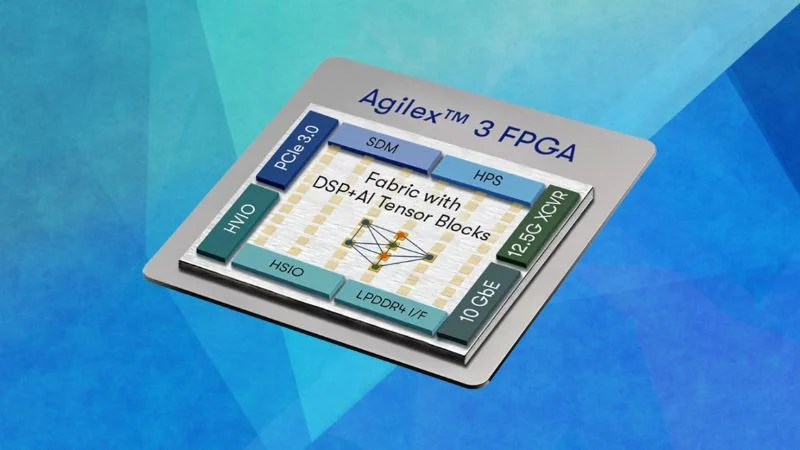
Altera unveiled its new Agilex 3 FPGAs in conjunction with the latest release of its Quartus Prime Design Software and introduced 11 new Agilex 5 FPGA development kits and system-on-module (SoM) boards. The Agilex 3 series is designed to cater to mid-range applications where performance is essential, but cost and power consumption are paramount. The Quartus FPGA and system-on-chip (SoC) toolchain has been enhanced to support the latest devices, improving both usability and compile times.
In an interview with All About Circuits, Altera’s CEO Sandra Rivera provided additional insights into the new series, highlighting the importance of balancing performance with cost and power efficiency. She emphasized the role of the Agilex 3 FPGAs in enabling real-time processing for time-critical applications such as automotive and IoT devices, as well as the series’ security enhancements and AI capabilities. Rivera also discussed the advancements in the Quartus Prime Software, noting the 29% faster compile times and the support for more FPGAs, which significantly accelerate the development process and time-to-market for developers.
Agilex 3 FPGA Line
The Agilex 3 series from Altera boasts an on-chip dual-core Arm Cortex A55 hard processor, seamlessly integrating AI capabilities into the FPGA fabric. This innovative design enables real-time processing for time-critical applications such as automotive systems and Internet of Things (IoT) devices. The series also includes robust security features that enhance its predecessors, the Cyclone V chips, with bitstream encryption, authentication, and physical anti-tamper detection.
Altera’s CEO Sandra Rivera highlighted the series’ suitability for a wide range of applications, including industrial manufacturing, surveillance, medical devices, test and measurement equipment, and edge computing solutions. She emphasized the need for substantial compute power within the constraints of a smaller power footprint, a requirement that is not as critical in large data centers.
Key features of the Agilex 3 FPGA series include:
- 25K–135K logic elements, providing a scalable solution for various applications.
- 1.9X FPGA fabric performance with Hyperflex architecture, ensuring efficient routing and increased bandwidth.
- DSP and Tensor blocks within the FPGA fabric, offering AI-optimized processing for tasks such as vision processing and image recognition.
- PCIe 3.0 support, enabling high-speed data transfer and connectivity.
- LPDDR4 memory interface, providing fast and reliable memory access.
- 12.5 Gbps transceivers, facilitating rapid communication and data exchange.
- 38% lower power consumption compared to competing FPGAs, making the Agilex 3 series an energy-efficient choice.
These features make the Agilex 3 FPGAs ideal for applications requiring high performance, low power consumption, and cost-effectiveness. By meeting the functionality, cost, and power requirements of demanding applications like vision processing, image recognition, and factory automation, Altera’s new series enhances maintainability and significantly accelerates time to market.
FPGA Hyperflex Architecture
Altera’s Hyperflex architecture, integrated into the Agilex 3 chips, delivers a significant performance boost, nearly doubling the speed of the previous generation. This innovative “register everywhere” architecture enhances routing efficiency by embedding bypassable hyper-registers throughout the device core. This design allows signals to be routed directly through the register or to bypass it and go straight to the multiplexor, reducing propagation steps and increasing both bandwidth and clock speeds.
When paired with multiple high-speed transceivers, the Agilex 3 series achieves operational speeds of up to 12.5 Gbps and supports LPDDR4 memory, providing rapid data transfer and processing capabilities. Altera claims that the Hyperflex-equipped Agilex 3 offers 1.9 times higher performance compared to the Cyclone V, making it a compelling option for applications requiring enhanced speed and efficiency.
Design Suite Optimized for Time to Market
Altera has optimized the Quartus Prime Software version 24.3 design suite for enhanced ease of use and solid performance. The updates to Quartus provide a comprehensive full-stack solution for FPGA development, including support for both soft and hard processor cores.
Altera’s CEO Sandra Rivera emphasized the design suite’s role in helping developers bring their applications and use cases to life quickly and efficiently, thereby accelerating time to market.
The software now boasts 29% faster compile times, support for a broader range of FPGAs, and new OS and RTOS support for the Agilex 5 hard processors subsystem. These improvements significantly enhance development efficiency.
Rivera highlighted the impact of the faster compile times, noting that developers can now iterate more rapidly on their algorithms, applications, or designs. “If you can reduce a three-hour compile time to two hours, you can fit in more software runs per day, which directly accelerates your time to market,” she explained.
The 3 Series’ Place in the Agilex Family
The Agilex 3 series complements the broader Agilex lineup as a cost and power-optimized FPGA solution. While the Agilex 7 and 9 series are positioned as the top performers, and the Agilex 5 series focuses on balancing performance with lower power consumption, the Agilex 3 series caters to applications with stringent low-cost and low-power requirements. Additionally, the Agilex 3 series introduces AI functionality to the cost-optimized segment of Altera’s FPGA offerings, featuring tensor computing blocks and AI-optimized DSP sections. This ensures that even budget-conscious projects can benefit from advanced AI capabilities.
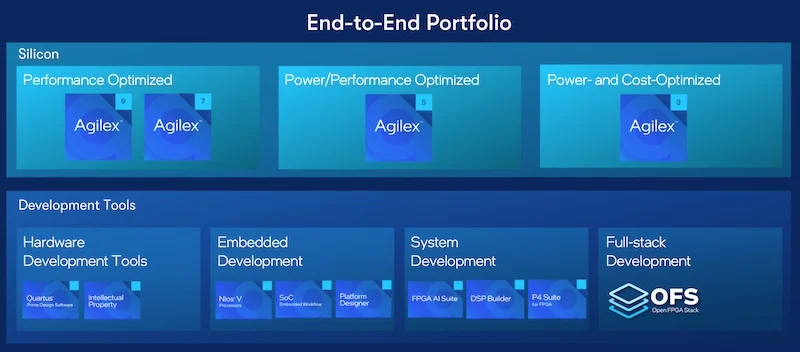
Altera Agilex 3 series compared to other Agilex FPGAs. Image used courtesy of Altera
In-FPGA AI capabilities enable edge AI processing without an additional discrete GPU or tensor processor. Efficient edge AI requires capabilities not typically found in conventional processors or FPGAs. The Agilex 3 adds tensor processing and DSP functionality to the field-programmable fabric. This provides GPU-like capabilities at a level commensurate with the edge AI requirements.
The Agilex 3 FPGAs are scheduled for availability in Q1 2025. The new Agilex 5 development kits are available from a number of partners and are showcased on Altera’s Partner Showcase site.
