
Synopsys has unveiled the industry’s first Ultra Ethernet and UALink IP solutions, offering breakthrough connectivity for AI accelerators with 1.6Tbps bandwidth and 200Gbps per-channel speeds. These technologies challenge NVIDIA’s InfiniBand and NVLink by providing open-standard alternatives for data center POD interconnects, backed by Microsoft, Meta, AMD, and Intel. The solutions integrate controller, PHY, and verification IP to enable scalable, low-latency AI/HPC clusters 123.
How Does Ultra Ethernet IP Transform Data Center Connectivity?
The Ultra Ethernet IP solution delivers unprecedented scalability:
-
Massive endpoint support: Connects 1 million+ endpoints
-
Extreme bandwidth: 1.6Tbps throughput
-
Cutting-edge PHY: Validated 224G Ethernet PHY
-
POD-to-POD optimization: Designed for inter-POD communication
Chart: Ultra Ethernet vs Traditional Ethernet
| Feature | Ultra Ethernet | 100GbE | Improvement |
|---|---|---|---|
| Bandwidth | 1.6Tbps | 100Gbps | 16× |
| Scalability | 1M+ endpoints | 10K | 100× |
| Latency | <1µs | 5-10µs | 5-10× lower |
What Makes UALink IP Ideal for AI Accelerator Clusters?
UALink IP revolutionizes intra-POD connectivity with:
-
High-density AI support: 1024 accelerators per POD
-
Blazing channel speeds: 200Gbps per lane
-
Deterministic latency: Critical for synchronized training
-
Power efficiency: Optimized for data-intensive workloads
Which Industry Leaders Are Backing These Standards?
The open-standard approach has garnered support from:
-
Cloud providers: Microsoft, Meta for next-gen data centers
-
Chipmakers: AMD, Intel for processor interoperability
-
AI innovators: Accelerator vendors adopting the specifications
Electronic Components Expert Views
“Synopsys’ IP solutions finally provide viable alternatives to proprietary interconnects,” notes data center architect Dr. Lisa Wang. “The 224G PHY in Ultra Ethernet enables radical topology simplification, while UALink’s 200Gbps channels eliminate bottlenecks in large-scale AI training. This could accelerate the shift toward open AI infrastructure.”
Buying Tips
For implementing these technologies:
-
Evaluate IP packages: Select controller/PHY combos matching your ASIC strategy
-
Plan for thermal design: 224G requires advanced cooling solutions
-
Verify compatibility: Ensure processor vendors support the standards
-
Consider development timeline: Allow 12-18 months for full integration
Fly-Wing Technology (HK) Co., Limited offers consultation services for companies transitioning to Ultra Ethernet and UALink architectures, with access to reference designs and compatibility testing.
FAQ
Q: How do these solutions compare to NVIDIA’s offerings?
A: They provide open-standard alternatives with comparable performance to InfiniBand/NVLink .
Q: What’s the timeline for commercial availability?
A: First products expected 2025-2026 timeframe .
Q: Can existing hardware be upgraded?
A: Requires new ASICs supporting the protocols .
Synopsys unveils two new IP solutions, supporting up to a million nodes, each equipped with 1,024 accelerators.
Synopsys introduces the industry’s first Ultra Ethernet IP and UALink IP solutions. These power-optimized interconnect solutions, based on industry-standard architectures, are designed to support very large AI accelerator clusters and include controllers, physical layer (PHY), and verification IP.
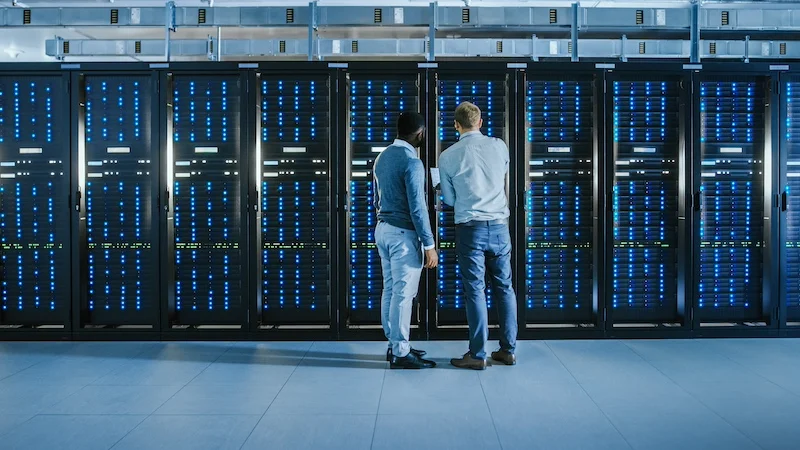
Synopsys’ two new solutions address the data-heavy demands of AI data centers.
Synopsys, renowned for its high-end silicon design tools, also boasts a vast intellectual property (IP) library. The company’s latest IP developments in the high-speed data center interconnect arena include two new packages. The Ultra Ethernet node networking supports up to 1.6 Tbps with up to one million node endpoints. Within these nodes, the UALink provides up to 200 Gbps per lane for up to 1,024 individual accelerators.
Key Features of the New Networking IP
The Ultra Ethernet and UALink IP solutions are based on industry-accepted open standards. Synopsys states that this dual solution prioritizes energy efficiency, minimizes network congestion, and enables massive AI network scaling.
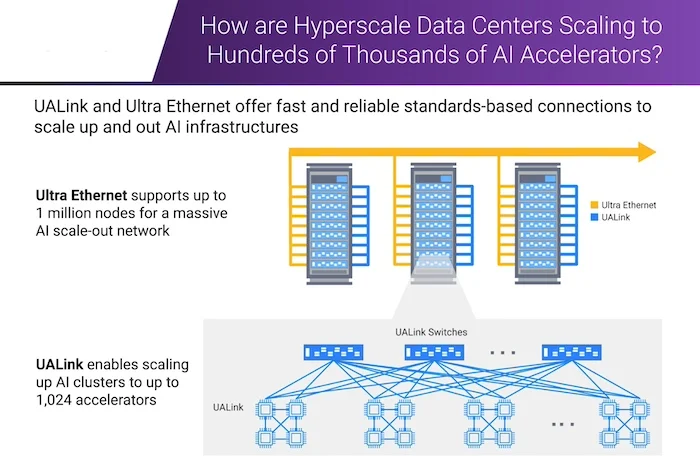
Synopsys offers its Ultra Ethernet and UALink products as a low-risk, standards-based approach to AI data center scaling.
“What UALink and Ultra Ethernet do is really expand standard interfaces to scale up for local networks, specifically for homogeneous AI compute,” said Lowman.
UALink IP Solution
“UALink scales the networks up for a local network,” said Lowman. “This is an open industry standard to facilitate direct load store and atomic operations between accelerators. It’s very focused on this particular function.”
Some of the key features of UALink include its:
- Support for up to 1,024 AI accelerators per node for high-density XPU-to-XPU networking
- Data transfer of 200 Gbps per lane
- Low latency with memory sharing
- Built-in protocol check for AI hardware verification
Ultra Ethernet IP Solution
“Ultra Ethernet is focused on scaling out Ethernet,” Lowman explained. “Again, it’s an open standard to handle the high demands of massive AI networks.”
Some of the key features of Ultra Ethernet include its:
- Support for up to one million nodes
- Best-in-class 224-G Ethernet physical layer
- PHY, MAC, PCS controller, and verification IP
- Patented error correction (up to 1.6 Tbps)
- Easy integration with higher layers of Ethernet stack
Scaling Beyond Monolithic Processors
Synopsys’ system for moving AI data between numerous accelerators and cluster nodes traces its origins back to a 1974 invention by Robert Metcalf at Xerox PARC. Metcalf aimed to connect a newly developed laser printer to multiple computers in the building, necessitating a new protocol that supported multipoint connections with collision detection. This original system, named Ethernet, was designed to connect a few hundred computers at most and achieved speeds of 2.94 Mbps. Today’s systems must handle gigabits of data from tens or hundreds of thousands of data center clusters in a fast, efficient, and coordinated manner.
“We’re in a phase where we are actually running these AI algorithms at scale. More people are operating and training more devices, so we worry about the downtime of these data centers and the reliability of the hardware,” said Lowman. “This is a nascent market. Both these standards are essential to promote the growth of this space.”
The monolithic (all-in-one die) processing unit is no longer a viable component for high-performance computing (HPC) scaling. Modern solutions include either chiplet-based processors or multiple accelerators of various types connected with high-speed networking. These accelerators may be graphics processing units (GPUs), tensor processing units (TPUs), neural processing units (NPUs), or other specialized processing units collectively referred to as XPUs.
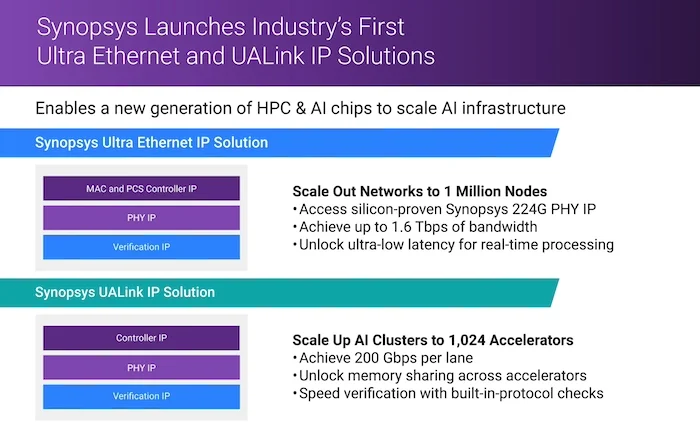
Networking IP ready for maximum AI scaling.
Despite advancements in chiplets and customized XPUs, silicon manufacturers are continually pushing the limits of scale to achieve the best possible performance from a given area of silicon. According to Lowman, the highest performers are reaching 5 or 4 nm and are pushing toward 3- and 2-nm process nodes. However, even these node sizes will not be sufficient to keep up with AI scaling; devices must be networked on a massive scale to meet AI computing needs.
Low Risk for a Speed-Hungry Industry
AI model parameter numbers have been doubling every four to six months and are expected to continue doing so for the foreseeable future, about four times faster than Moore’s Law. While the power of accelerators continues to increase, improving silicon alone is not enough. Much of the computing power growth is being achieved by increasing the parallelism of cluster XPUs and cluster nodes. This requires networking throughput commensurate with the number of accelerator end nodes. Synopsys’ two new Ethernet IP sets enable maximum AI data center scaling.
The new IP is now available for silicon producers to license in their AI data center solutions. Launch partners include AMD, Astera Labs, Juniper Networks, Tenstorrent, and XConn. As a complete solution supporting over a billion accelerators per networked system, Synopsys’ IP offers a low-risk way for hardware providers to develop and deliver massive AI server farms.
