
Tesla is leading the charge in standardizing electric vehicle (EV) connectors through its North American Charging Standard (NACS). This initiative aims to simplify EV charging infrastructure, enhance compatibility, and accelerate the adoption of electric vehicles across North America.
How Is Tesla Standardizing EV Connectors?
Tesla has opened its EV connector design to the world, inviting charging network operators and vehicle manufacturers to adopt the NACS. This move is supported by the Society of Automotive Engineers (SAE), which has standardized the NACS connector under the designation SAE J3400. The standardization ensures that any supplier or manufacturer can use, manufacture, or deploy the NACS connector on EVs and at charging stations across North America.
What Are the Benefits of Standardizing EV Connectors?
Standardizing EV connectors simplifies the charging process for consumers by reducing the number of different connectors and adapters needed. It also streamlines manufacturing for automakers and charging station providers, leading to cost savings and faster deployment of charging infrastructure. Additionally, a unified standard enhances the overall user experience by promoting interoperability between different EV models and charging networks.
Which Automakers Are Adopting Tesla’s Charging Standard?
Several major automakers have announced plans to adopt Tesla’s NACS connector. Ford was the first to agree to team up with Tesla and adopt the NACS plug; then the dominos started falling, with several other automakers recently announcing agreements with Tesla.
Why Is the SAE Standardizing Tesla’s Connector?
The SAE’s decision to standardize Tesla’s connector under the SAE J3400 designation aims to create a unified charging standard that benefits consumers, automakers, and charging infrastructure providers. By adopting a single connector standard, the industry can reduce complexity, lower costs, and improve the overall EV charging experience.
When Will the Standardization Take Effect?
The standardization of Tesla’s NACS connector is already underway, with major automakers and charging infrastructure providers announcing plans to adopt the SAE J3400 standard. While specific timelines vary, the transition is expected to accelerate in the coming years as new EV models are introduced and existing charging stations are upgraded.
Where Will the Standardized Connectors Be Available?
The standardized NACS connectors will be available across North America, including the United States, Canada, and Mexico. Charging stations equipped with the SAE J3400 standard will be deployed in urban areas, along highways, and at key locations to ensure widespread accessibility for EV owners.
Does Standardization Affect Existing EV Owners?
Existing EV owners may need to use adapters to connect their vehicles to charging stations equipped with the new standardized connectors. However, many automakers are providing these adapters to facilitate the transition and ensure continued access to charging infrastructure.
Are There Any Challenges to Standardization?
While standardization offers numerous benefits, challenges include the need to retrofit existing charging stations with the new connectors and the potential for initial costs associated with the transition. However, these challenges are expected to be mitigated over time as the industry moves toward widespread adoption of the SAE J3400 standard.
Can Consumers Expect Faster Charging with the New Standard?
Yes, the standardized NACS connector supports higher charging speeds, which can reduce charging times for EV owners. The improved design of the connector allows for more efficient power delivery, enhancing the overall charging experience.
Could Other Regions Adopt Tesla’s Charging Standard?
While the current focus is on North America, the success of the NACS standard could influence other regions to consider adopting similar approaches. However, each region has its own regulatory and infrastructure considerations that would need to be addressed.
Buying Tips
When purchasing EV charging equipment compatible with the SAE J3400 standard, consider the following:
-
Compatibility: Ensure that the equipment supports the SAE J3400 connector to guarantee interoperability with future EV models and charging stations.
-
Quality: Opt for products from reputable manufacturers to ensure reliability and safety.
-
Warranty: Check for warranties that cover potential defects and provide peace of mind.
-
Installation: Consider professional installation services to ensure proper setup and compliance with local regulations.
-
Cost: Compare prices from different suppliers to find competitive rates without compromising on quality.
Fly-Wing Technology (HK) Co., Limited offers a range of EV charging equipment compatible with the SAE J3400 standard. With over a decade of experience in sourcing hard-to-find electronic components, Fly-Wing Technology provides quality products at competitive prices, backed by reliable customer service.
Electronic Components Expert Views
“The standardization of EV connectors is a significant step forward in the electric vehicle industry. It simplifies the charging process for consumers and streamlines manufacturing for automakers,” says an industry expert.
FAQ
Q: What is the SAE J3400 standard?
A: The SAE J3400 standard is the official designation for Tesla’s North American Charging Standard (NACS) connector, which has been standardized by SAE International.
Q: Will all EVs use the same charging connector?
A: While the SAE J3400 standard is gaining traction, some EV manufacturers may continue to use different connectors. However, adapters are being developed to ensure compatibility across different systems.
Q: How can I find charging stations with the SAE J3400 connector?
A: Charging stations equipped with the SAE J3400 connector are being deployed across North America. EV owners can use apps and websites that provide maps of charging station locations to find compatible stations.
Q: Will I need to replace my current EV charger?
A: If your current EV charger is compatible with the SAE J3400 connector, no replacement is necessary. However, if it’s not compatible, you may need to upgrade your equipment or use adapters.
Q: Are there any incentives for adopting the SAE J3400 standard?
A: Some government programs and incentives may support the adoption of standardized EV charging infrastructure. It’s advisable to check with local authorities for available programs.
Tesla aims to reduce the number of connectors required in an electric vehicle.
As demand for electric and autonomous vehicles increases, manufacturers face significant challenges in managing hundreds of individual connections. These connectors must provide safe, reliable power and data transmission across complex vehicle networks. Consequently, efficient and standardized connectivity solutions are essential to simplify vehicle assembly, reduce manufacturing costs, and enhance overall performance.
To address these needs, Tesla aims to consolidate and streamline vehicle electrical systems by introducing a standard connector tailored for modern electric vehicle architectures.
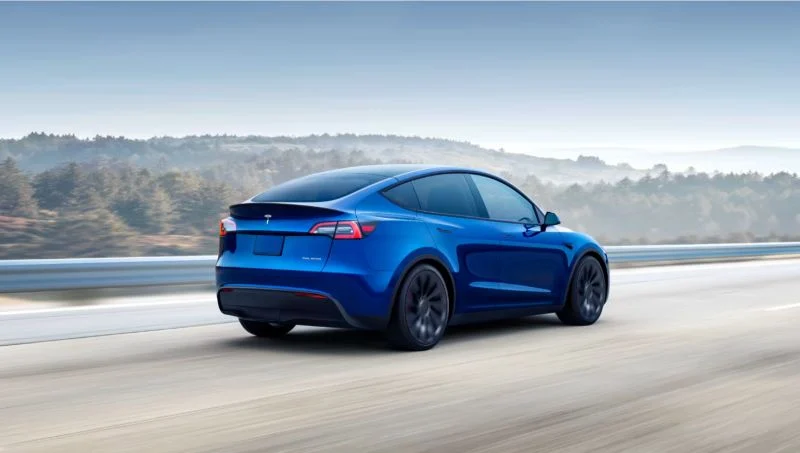
Tesla Model Y.
What’s Inside an EV?
As electric vehicles (EVs) have become more technologically advanced, the number of electronic components and connections has significantly increased. A modern vehicle now typically requires over 200 connections, each needing to reliably handle both power and signal transmission under varying conditions. This complexity drives up manufacturing costs and assembly challenges, as connectors must adhere to distinct standards and specifications based on factors such as voltage, environmental exposure, and durability.
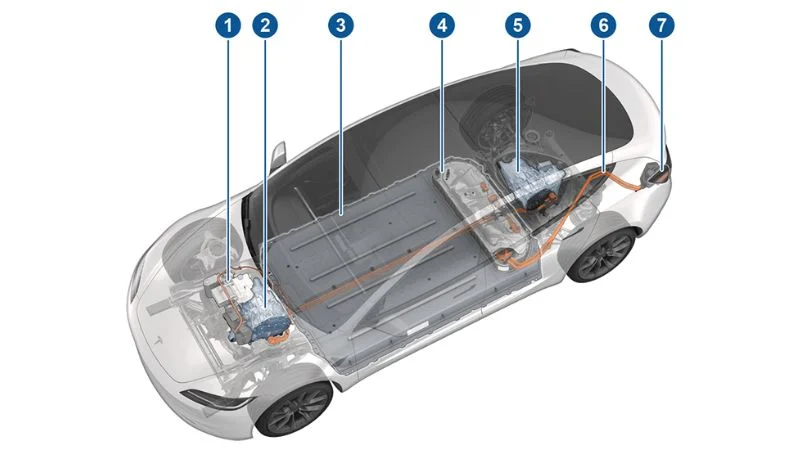
Tesla Model 3 electrical components. 1. Heat pump 2. Front motor 3. High voltage battery 4. High voltage components 5. Rear motor 6. High voltage lines 7. Charge port.
Another significant challenge for EV connectors is operating within the low-voltage architectures increasingly favored in automotive design, particularly the 48 V system. The 48 V system is more efficient than the traditional 12 V system because, according to Ohm’s Law, increasing the voltage while maintaining fixed resistance reduces the current. Lower current allows for smaller, lighter wires to transmit the same power, resulting in weight and cost savings and improved efficiency.
High current also leads to greater energy loss and heat generation. Consequently, a 12-volt system is inefficient at higher power levels and requires larger heat sinks compared to higher-voltage systems.
Tesla’s Automotive Connectivity Standard
Tesla has introduced its Low-Voltage Connector Standard (LVCS), a connector architecture designed to enhance the efficiency and scalability of EV systems.
Based on a 48 V electronic framework, LVCS can deliver the same power as traditional systems but with just a quarter of the current, significantly reducing energy loss and enabling lighter, more compact wiring. This architecture debuted in vehicles like the Cybertruck and includes specialized connectors that meet stringent power and signal requirements with just six standardized types, covering over 90% of typical automotive applications.
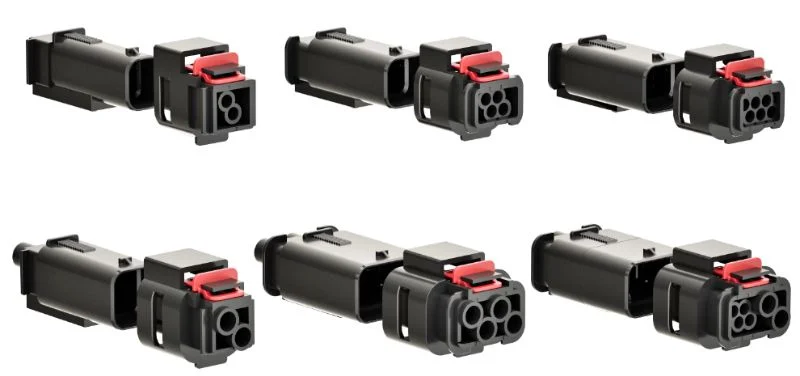
The six connectors in the LVCS standard
Each connector in the LVCS lineup features single-wire sealing and independent secondary locking mechanisms, ensuring durability under variable conditions while minimizing the risk of disconnection or environmental contamination. The connectors are compact and maintain the required spacing for safe 48 V operation, with standardized configurations that support both autonomous functions and high-efficiency power distribution.
For ease of identification and assembly, the LVCS is color-coded in a standard light blue. By consolidating numerous connector types into a smaller, uniform set, this design aims to reduce manufacturing complexity, cost, and weight associated with traditional connector systems.
A Future Standard?
After successfully standardizing its charging connector (North American Charging Standard), Tesla aims to extend this approach to all other internal electrical connectors in its vehicles. Given Tesla’s leadership position in the industry, LVCS could set a benchmark for in-vehicle connectivity and potentially become a de facto standard for the entire industry.
