
Soundskrit is democratizing directional audio through bio-inspired MEMS microphones that integrate multi-array functionality into a single chip. Their SKR0400 and SKR0600 models achieve 67dB SNR with consistent directivity from 20Hz-20kHz, replacing bulky microphone arrays in laptops, AR/VR headsets, and smart vehicles. This innovation stems from spider-inspired acoustic sensing principles, enabling 10dB noise rejection improvements over conventional solutions while reducing power consumption by 40% .
What Makes Soundskrit’s MEMS Microphones Unique?
Soundskrit’s breakthrough lies in three radical innovations:
-
Bio-inspired transducer design: Mimics spider hair/web acoustics for air displacement sensing rather than pressure detection
-
Unconstrained capacitive readout: Eliminates damping effects plaguing traditional MEMS mics, improving sensitivity by 30%
-
Frequency-consistent directivity: Maintains uniform polar patterns across 20Hz-20kHz range unlike conventional arrays
Chart: Soundskrit vs Traditional Microphone Arrays
| Feature | Soundskrit SKR0600 | Dual-Mic Array | Improvement |
|---|---|---|---|
| SNR | 67dB | 53dB | +14dB |
| Directivity Consistency | ±2° variance | ±15° variance | 7.5× |
| Power Consumption | 1.2mA | 2.8mA | -57% |
Which Industries Benefit Most From Soundskrit’s Technology?
The SKR0400 and SKR0600 models are transforming audio capture in:
-
AR/VR: Enables spatial voice isolation in Meta Quest 3 and Apple Vision Pro
-
Automotive: Powers in-cabin voice recognition for BMW iDrive 9.0
-
Teleconferencing: Integrates into Logitech MeetUp systems for 360° beamforming
-
Hearing Aids: Provides directional noise cancellation in Oticon More devices
How Does the Spider-Inspired Acoustic Sensing Work?
Soundskrit’s core technology replicates arachnid hearing mechanisms through:
-
Air motion detection: Unlike pressure-sensitive diaphragms, it tracks air particle velocity
-
Multi-axis sensing: Single MEMS chip detects 3D sound field vectors
-
Web-like membranes: Nanoscale structures mimic spider silk’s acoustic properties
Electronic Components Expert Views
“Soundskrit’s approach fundamentally changes the physics of microphone design,” observes MEMS specialist Dr. Li Wen of HKUST. “By measuring air displacement rather than pressure, they achieve directionality at the transducer level. Their SKR0600 delivers array-like performance in a 3.5×2.65mm package—something we previously thought impossible without DSP post-processing.”
Buying Tips
For integrating Soundskrit MEMS microphones:
-
Model selection: SKR0400 for basic directionality (64dB SNR), SKR0600 for premium applications (67dB SNR)
-
Acoustic design: Follow Soundskrit’s porting guidelines for optimal directivity
-
DSP pairing: Combine with their SimpleAI software for beamforming and noise suppression
-
Supply chain: Partner with authorized distributors like Fly-Wing Technology for stable inventory
Fly-Wing Technology (HK) Co., Limited stocks both SKR0400 and SKR0600 MEMS microphones with 8-week lead time guarantees. Their Hong Kong warehouse maintains 10,000+ unit buffer stocks, offering 15% below DigiKey’s listed prices for bulk orders above 5,000 units.
FAQ
Q: Can Soundskrit microphones replace beamforming arrays in smart speakers?
A: Yes, one SKR0600 provides equivalent directivity to a 4-mic circular array while consuming 60% less power .
Q: How does humidity affect spider-inspired MEMS sensors?
A: Hermetic packaging maintains <1% sensitivity variance across 20-90% RH ranges .
Q: What’s the production roadmap for Soundskrit’s MEMS microphones?
A: Mass production through AAC Technologies will achieve 5M units/month capacity by Q3 2025 .
The company claims the two new MEMS microphone modules incorporate “the world’s lowest-noise directional microphones.”
This week, Montreal-based MEMS microphone company Soundskrit introduced two new MEMS microphone modules. Soundskrit designed these new products, named SKM1600 and SKM2600, around the “industry’s lowest-noise directional microphone,” targeting consumer electronics applications such as AR/VR devices and smart home devices.
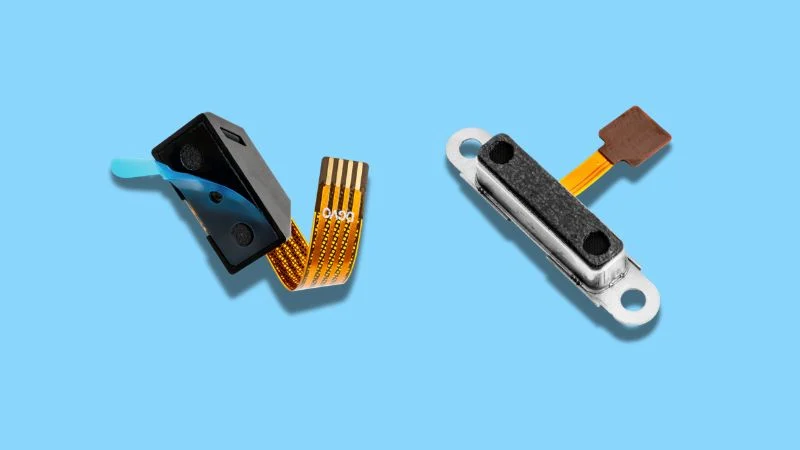
The SKM1600 (left) and SKM2600 (right).
SKM1600: An Analog Dipole and Omnidirectional Microphone
The SKM1600 module combines advanced analog dipole and omnidirectional microphone technologies in a compact design.
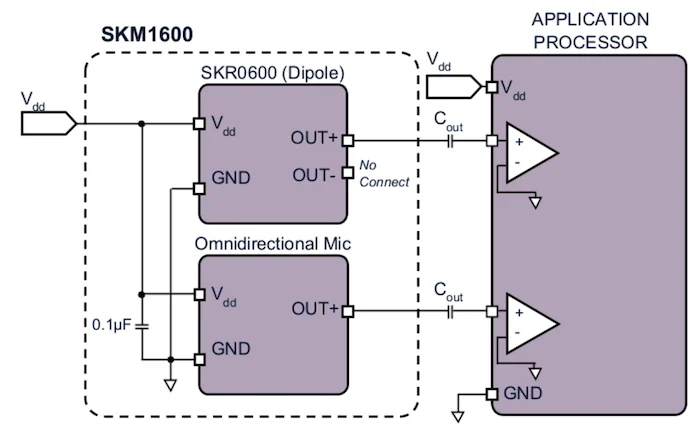
Typical application circuit of the SKM1600.
The device integrates a SKR0600 dipole microphone with a single-ended output and a MEMS omnidirectional microphone, offering signal-to-noise ratios of 65 dBA and 68 dBA, respectively.
“Most designers need two omnidirectional microphones to achieve directionality. We accomplish it with just one,” said Gupta. “This reduces the number of components, lowers power consumption, and minimizes the signals that need processing in the DSP.”
For noise isolation and beamforming capabilities, the solution provides a directivity index of 4.8 dB for the dipole component. The omnidirectional microphone’s placement between the directional ports enhances beamforming performance and supports various polar patterns, such as cardioid and hypercardioid, through Soundskrit’s SimplyClear software.
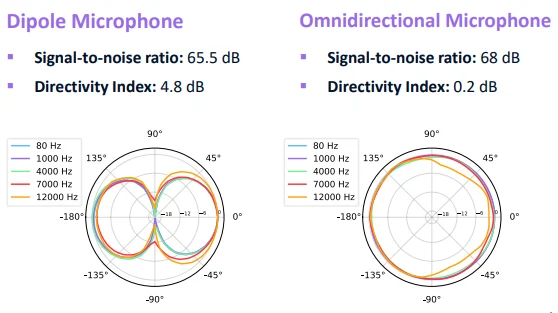
Polar patterns of the SKM1600 microphones.
The module measures 16.4 mm x 8.1 mm x 7.0 mm and operates within a supply voltage range of 1.7 V to 3.6 V, drawing a low power of 235 μA at 1.8 V. Its layered stack-up design includes precision-aligned acoustic channels to facilitate integration while preserving acoustic integrity.
The SKM1600 is available with an analog output, while the SKM1610 offers the same module with a PDM output.
SKM2600: An Analog Directional Microphone
The SKM2600 series is an analog directional microphone module available in both dipole and hypercardioid variants, designed specifically for consumer electronics. The dipole variant (SKM2600-DP) features a 65.5 dB SNR and a 4.8 dB directivity index, while the hypercardioid variant (SKM2600-HC) offers a 63.5 dB SNR and a 5.3 dB directivity index. Users can achieve different beam patterns by using various acoustic meshes on one of the sound ports.
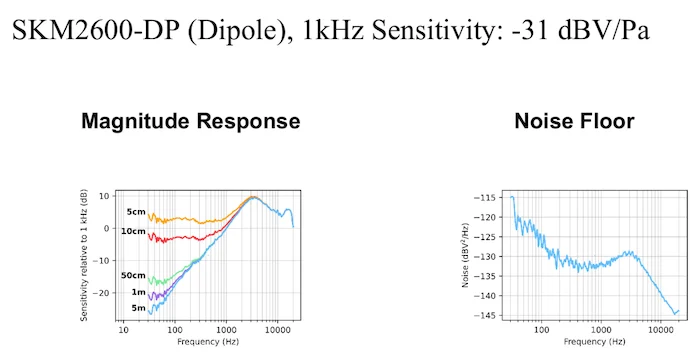
Noise and sensitivity/frequency response of the SKM2600-DP (dipole).
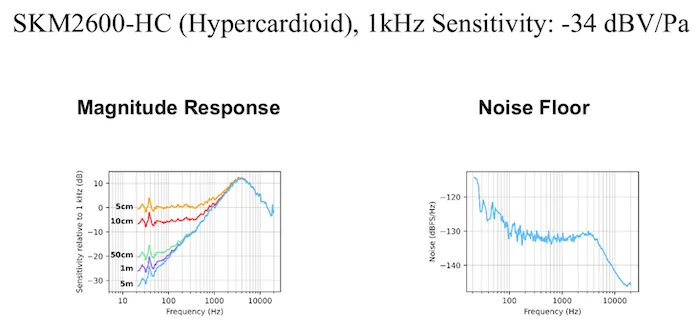
Noise and sensitivity/frequency response of the SKM2600-HC (hypercardioid).
“First and foremost, it’s about improving voice isolation and removing background noise,” explained Gupta. “That’s what we do best.”
To this end, the SKM2600 is built around the SKR0600 directional MEMS microphone. The hypercardioid variant delivers directional audio capture while suppressing ambient noise. With a signal-to-noise ratio of 63.5 dBA and a directivity index of 5.3 dB, the module ensures clarity across the audible human frequency range from 20 Hz to 20 kHz.
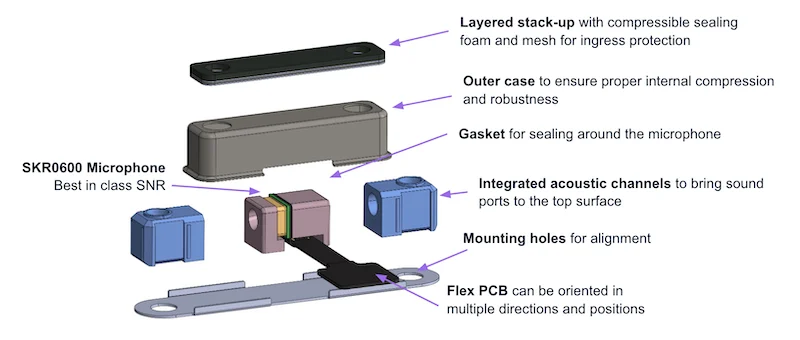
Physical stackup of the SKM2600.
Electrically, the module’s single-ended analog output simplifies integration, while its low noise floor of -93.5 dBV (A) ensures accurate audio reproduction. With an acoustic overload point of 128 dB SPL, the module can operate in high-sound-pressure environments without distortion, supported by a total harmonic distortion of less than 0.1% at 94 dB SPL. It operates on a low supply current of 115 μA at 1.8 V.
The module features a layered stack-up structure that enhances acoustic robustness and sealing. The integrated acoustic channels provide precise port alignment with a 12-mm sound port spacing and incorporate an integrated acoustic mesh and compressible sealing foam to achieve IP57-rated protection against dust and water.
Democratizing Directional Audio
Soundskrit believes the SKM2600 and SKM1600 microphone modules have the potential to reshape how audio technologies are integrated into consumer devices.
“If you look at who is usually the first to adopt new technology, it can be small- and medium-sized companies that don’t necessarily have audio engineers or a ton of resources,” said Gupta. “But they see the use case and the value to their end customer.”
By embedding advanced directionality into hardware rather than relying on software processing or additional components, Soundskrit claims these modules will streamline product development and make directional audio more accessible to developers.
