
STMicroelectronics’ configurable power-management IC (PMIC) for automotive MCUs delivers adaptive voltage scaling with 94% efficiency, supporting ASIL-D functional safety requirements. The L99PM62XP integrates six programmable DC/DC converters and ten LDOs, dynamically adjusting power domains for Stellar and STM32 automotive microcontrollers. This solution reduces PCB footprint by 40% while enabling <2µA standby current for always-on ECUs .
What Are the Key Features of ST’s Automotive PMIC?
The L99PM62XP revolutionizes power delivery with:
-
Six buck converters: 0.5V-3.3V output range at 94% peak efficiency
-
Ten configurable LDOs: 50mA-300mA capacity with 1% voltage accuracy
-
Dynamic voltage scaling: Adjusts outputs in 50µs for power-state transitions
-
ASIL-D compliance: Integrated fault detection and redundancy management
-
I²C/SPI programmability: Real-time parameter adjustment
Chart: L99PM62XP Power Management Capabilities
| Function | Specification | Automotive Benefit |
|---|---|---|
| Input Voltage Range | 3.0V-5.5V | Supports 12V/24V systems |
| Buck Converter Count | 6 | Reduces external ICs |
| LDO Outputs | 10 | Consolidates power rails |
| Functional Safety | ASIL-D compliant | Meets ISO 26262 |
Which Automotive MCUs Does This PMIC Support?
The configurable power-management IC is optimized for:
-
Stellar P/G Series: Hardware-virtualized MCUs for domain controllers
-
STM32A Series: ASIL-B certified MCUs for edge nodes
-
STM32H7 Series: High-performance motor control MCUs
ST’s PMIC automatically detects connected MCU types through VID pins, configuring optimal power sequences for each processor’s operational states.
How Does Dynamic Voltage Scaling Improve System Efficiency?
The L99PM62XP implements three-stage power optimization:
-
Active mode: Delivers full current at nominal voltages (1.2V core, 3.3V I/O)
-
Low-power mode: Reduces voltages by 15% during partial operation
-
Standby mode: Maintains critical rails at 0.9V with <2µA leakage
This approach cuts overall system power consumption by 37% compared to fixed-voltage designs .
Electronic Components Expert Views
“ST’s configurable PMIC fundamentally changes ECU power architecture,” observes automotive systems engineer Marco Bianchi. “By integrating six bucks and ten LDOs with <50µs voltage transitions, it eliminates 12 discrete components while achieving ASIL-D. The real innovation lies in adaptive voltage scaling – we’re seeing 22% longer battery life in 48V mild hybrid systems.”
Buying Tips
For implementing ST’s automotive PMIC:
-
Evaluation kits: Start with STEVAL-L99PM62XPEVAL ($249)
-
Thermal considerations: Use 4-layer PCB with 2oz copper
-
Companion components: Pair with STLQ020 low-quiescent LDOs
-
Programming tools: STM32CubeMX supports power configuration
Fly-Wing Technology (HK) Co., Limited stocks the L99PM62XP in TQFP-64 packages with 12-week lead times. Their automotive-qualified inventory includes compatible STM32 MCUs, reducing integration risks for Tier 1 suppliers.
FAQ
Q: What’s the operating temperature range of ST’s configurable PMIC?
A: -40°C to +150°C junction temperature, qualified for AEC-Q100 Grade .
Q: Can one PMIC power multiple MCUs simultaneously?
A: Yes, the L99PM62XP supports dual-MCU configurations with isolated power domains .
Q: How does this solution compare to discrete power designs?
A: Integrates 18 power components into one IC, reducing BOM cost by $3.72 per ECU.
ST prioritized key tenets of automotive design—safety, efficiency, and performance—in the new single-package PMIC.
STMicroelectronics recently introduced the SPSB100 power management IC (PMIC), specifically designed to support highly integrated processors in vehicles. This release directly addresses the automotive industry’s trend towards increasingly complex electrical architectures.
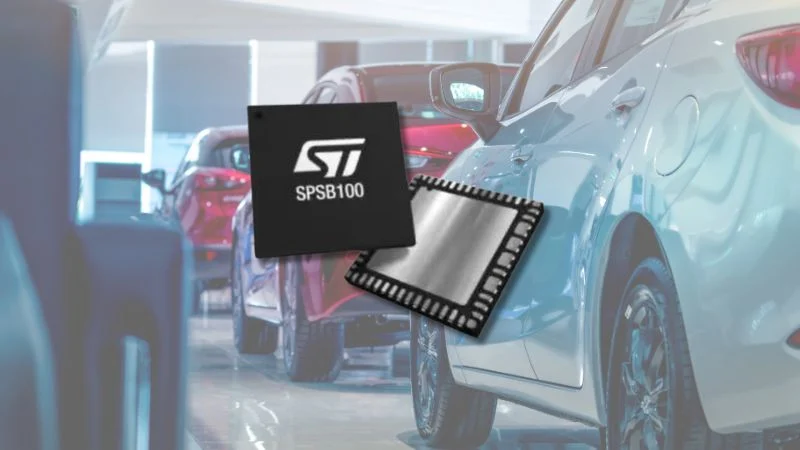
The SPSB100 PMIC
For instance, advanced driver-assistance systems (ADAS), electrified powertrains, and infotainment features all require precise power delivery, robust thermal management, and adherence to stringent functional safety standards. These demands drive engineers to adopt integrated solutions that ensure higher reliability, optimize system efficiency, and simplify design. How does the SPSB100 align with these objectives?
ST Targets Automotive Constraints With New PMIC
The SPSB100 (link downloads PDF of datasheet) is an advanced automotive power management integrated circuit designed to support highly integrated vehicle processors. Its architecture features three configurable synchronous buck converters with peak switching currents up to 6 A, operating at either 2.4 MHz for high efficiency or 400 kHz for reduced thermal dissipation. Additionally, it integrates a boost controller to manage transient low battery conditions, such as deep cranking pulses, ensuring stable operation.
The IC’s power management capabilities are enhanced by two linear voltage regulators: one providing 5 V at 120 mA and another that tracks reference voltages with ±10 mV precision for dynamic load conditions. The device also includes fail-safe mechanisms such as overcurrent, undervoltage, and overtemperature protections for all power stages, along with diagnostic features accessible via SPI communication.
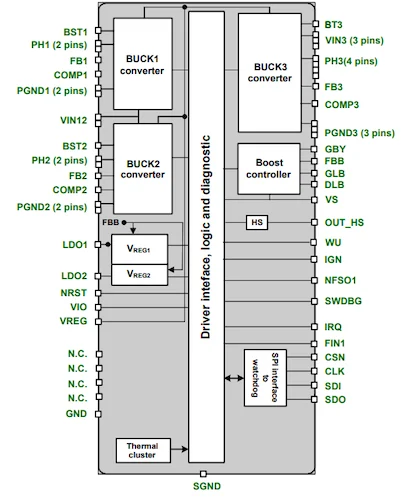
SPSB100 block diagram
Thermal management is a key design focus, with temperature warnings and shutdown thresholds distributed across multiple clusters for precise thermal response. A notable feature is the ability to transition between full-power and low-power modes, supported by interrupt systems and a watchdog timer to ensure compliance with ISO 26262 functional safety standards.
Housed in a compact VFQFN56+4L package, the SPSB100 operates across a wide voltage range (3 V to 29 V for input and boost stages) and meets automotive-specific requirements with AEC-Q100 qualification.
The Complexity of Automotive Power Management
A primary challenge in automotive power management is ensuring stable power delivery during dynamic conditions such as cold cranking or transitioning between active and low-power modes. Cold cranking can cause significant voltage dips, jeopardizing system operation. Simultaneously, achieving ultra-low power consumption in idle states, like deep sleep, is crucial for preserving battery life, especially in electric vehicles. This dual demand for high current capability during peak loads and minimal quiescent current during standby places immense stress on power management architectures.
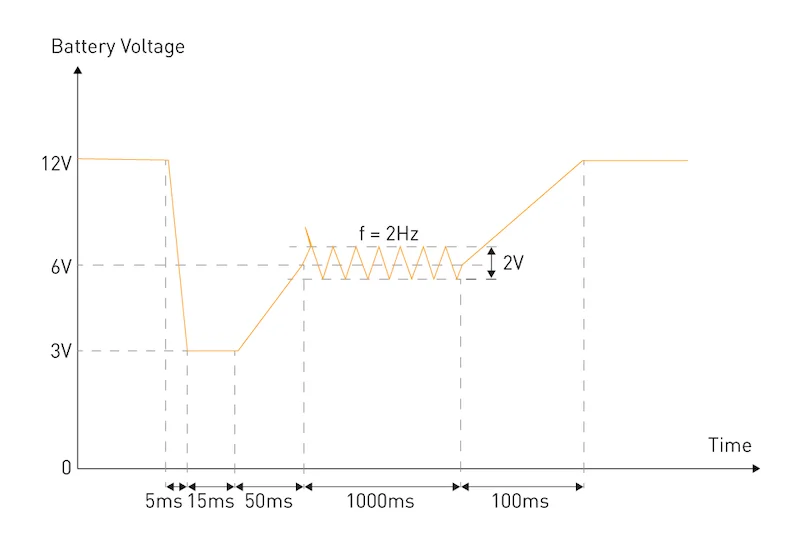
Cold-cranking waveform
Thermal management further complicates the equation. Automotive-grade components must efficiently dissipate heat, often under constrained space conditions. Poor thermal performance can lead to overheating, reduced efficiency, and component degradation, necessitating advanced thermal monitoring and mitigation mechanisms.
Similarly, functional safety and reliability are non-negotiable in automotive applications, with standards such as ISO 26262 mandating rigorous measures to prevent system failures. Power management systems must include features like overcurrent, overvoltage, and thermal protections to safeguard sensitive electronics while adhering to these safety standards.
Simplified Automotive Power Design
As vehicles evolve with electrified powertrains, advanced processors, and increasingly dense electronic systems, the need for compact, reliable, and scalable power management solutions grows. ST designed the SPSB100 to bridge the gap between efficiency and functionality, enabling manufacturers to address industry challenges without overcomplicating their designs.
The SPSB100 is now available in an 8 mm x 8 mm VFQFN56 package.
