
If you’ve ever replaced the battery in a car remote or digital scale, you’ve probably seen two common types: CR2025 and CR2032.
At first glance, they look almost identical, which often leaves people wondering whether they’re really any different. In reality, these small coin cells don’t just differ in name, they also serve slightly different needs.
Both belong to the family of 3V lithium coin batteries that power everyday electronics like fitness trackers, medical devices, watches, and computer motherboards.
They’re known for their reliability, long shelf life, and compact design, which is why manufacturers use them in millions of devices worldwide.
The question of CR2025 vs CR2032 usually comes down to one thing: the balance between space and battery life.
In this guide, we’ll walk through what sets these two batteries apart, where each one works best, and how you can make the right choice when buying or sourcing them for your products.
CR2025 vs CR2032 Quick Overview
If you’re looking for a quick comparison, both CR2025 and CR2032 are 3V lithium coin cells with the same 20 mm diameter.
The cr2025 vs cr2032 difference lies in their thickness and how long they can power a device.

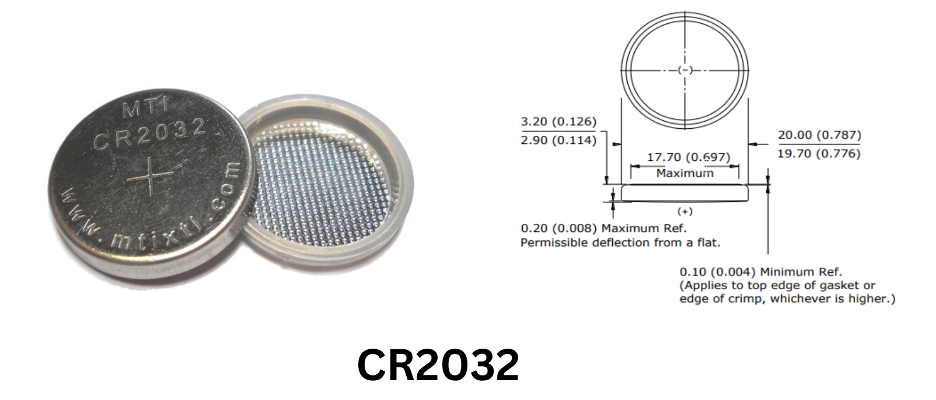
The CR2032 is slightly thicker, measuring about 3.2 mm, while the CR2025 is 2.5 mm. That extra space allows the CR2032 to store more energy. This gives it a longer lifespan in most applications.
The CR2025, on the other hand, is perfect for slim devices such as wearables, calculators, and compact remotes where every millimeter counts.
CR2025 Vs CR2032 Technical Breakdown
A technical comparison of cr2025 vs cr2032 helps explain how two batteries often perform differently.
Their model codes, capacity ratings, and chemistry all follow standardized rules defined by the International Electrotechnical Commission (IEC).
Lets talk about the technical breakdown including size, capacity and voltage.
Model Code Interpretation
The codes CR2025 and CR2032 are not random numbers. They describe both the size and the chemistry of the battery according to IEC naming standards.
- The “CR” prefix stands for lithium manganese dioxide (Li-MnO₂) chemistry.
- The first two digits (20) indicate the diameter in millimeters.
- The last two digits (25 / 32) specify the height in tenths of a millimeter.
So, CR2025 measures 20 mm × 2.5 mm, while CR2032 measures 20 mm × 3.2 mm.
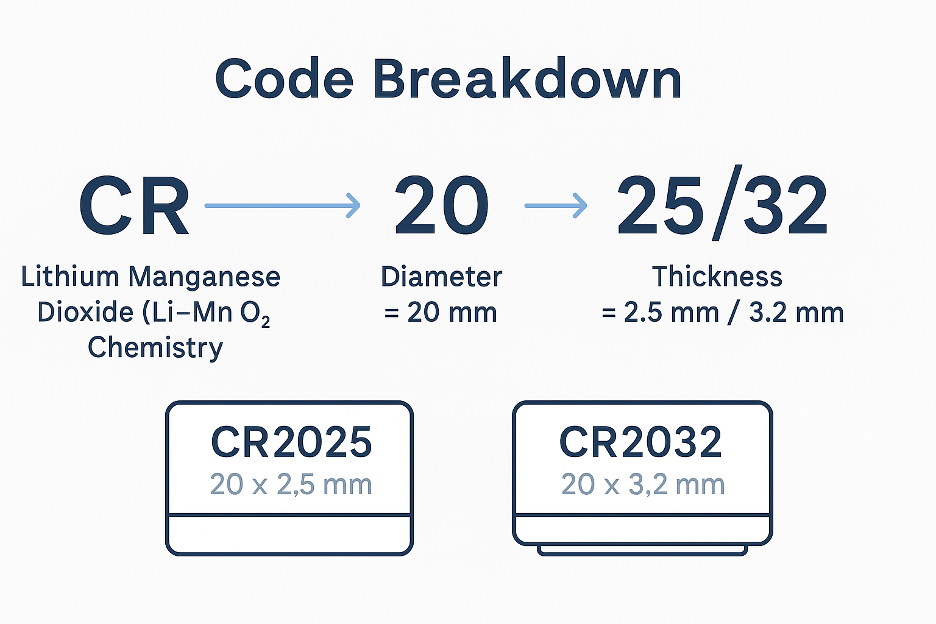
Both share the same diameter, but the CR2032 is 0.7 mm thicker, which may seem minor but provides significantly more space for active material inside.
Inside each cell is a lithium metal anode, a manganese dioxide cathode, and a separator soaked in electrolyte enclosed in a stainless-steel casing.
Capacity Comparison
Capacity, measured in milliamp-hours (mAh), defines how long a battery can deliver power before dropping below its usable voltage.
According to research:
- CR2025: typically 150–170 mAh
- CR2032: typically 210–240 mAh
This gives the CR2032 about 40–50% more capacity under identical test conditions (15 kΩ load at 21 °C down to 2.0 V).
Besides sheer capacity, the thicker CR2032 has lower internal resistance-helpful for wireless transmitters or sensors which operate in pulses.
In short, when space allows, the CR2032 provides a longer lifespan, better current handling, and more stable performance across varied load conditions.
Chemistry and Voltage
Both coin cells rely on the same Li-MnO₂ chemistry, which provides stable voltage and excellent shelf life.
| Parameter | Specification |
| Nominal Voltage | 3.0 V |
| Open-Circuit Voltage (new) | 3.6–3.7 V |
| Cut-off Voltage | ~2.0 V |
| Operating Temperature | −30 °C to +60 °C |
| Self-Discharge Rate | < 1 % per year |
| Rechargeable | No (primary cell) |
This chemistry is known for its flat discharge curve, meaning the voltage stays close to 3 V for most of the cell’s life before dropping rapidly near the end.
That steady voltage makes both batteries ideal for memory retention circuits, sensors, watches, and medical devices that can’t tolerate fluctuations.
Shelf life is another shared advantage. In storage, both CR2025 and CR2032 typically retain more than 90 percent of their charge even after 8–10 years.
Manufacturers like Panasonic, Energizer, and Murata specify less than 1 percent capacity loss per year when stored at room temperature.
While both types deliver identical voltage and chemistry, the CR2032’s larger electrode surface helps it better withstand pulsed or high-current loads, keeping its voltage level more stable under stress.
Case Study: CR2025 vs CR2032 Discharge and Pulse Characteristics
Energizer’s official datasheets for cr2025 vs cr2032 provide a detailed side-by-side look at both cells under identical test conditions.
In this case study, we examine runtime, voltage stability, and pulse behavior of to understand how design differences translate into performance.
Here is the overview of key specifications for cr2025 vs cr2032:
| Specification | CR2025 | CR2032 | Difference / Impact |
| Nominal Voltage | 3.0 V | 3.0 V | Same chemistry (Li/MnO₂) |
| Typical Capacity | 170 mAh (to 2.0 V at 15 kΩ, 21 °C) | 235 mAh (to 2.0 V at 15 kΩ, 21 °C) | CR2032 offers ~38% higher capacity |
| Weight | 2.6 g | 3.0 g | CR2032 is ~15% heavier |
| Volume | 0.8 cm³ | 1.0 cm³ | Slightly larger cell cavity |
| Energy Density | 176 mWh/g (616 mWh/cc) | 198 mWh/g (653 mWh/cc) | CR2032 has higher energy density |
| Lithium Content | 0.078 g | 0.109 g | More active material in CR2032 |
| Operating Temperature | –30 °C to 60 °C | –30 °C to 60 °C | Identical |
| Self-Discharge Rate | ~1 % / year | ~1 % / year | Identical |
| Max Continuous Drain | 0.19 mA | 0.19 mA | Same load test conditions |
When we talk about cr2025 vs cr2032, both batteries share the same 3 V lithium manganese dioxide chemistry, but the CR2032’s extra 0.7 mm thickness provides more lithium and electrolyte volume.
Continuous Discharge Characteristics
At 21 °C and 15 kΩ load:
- CR2032:
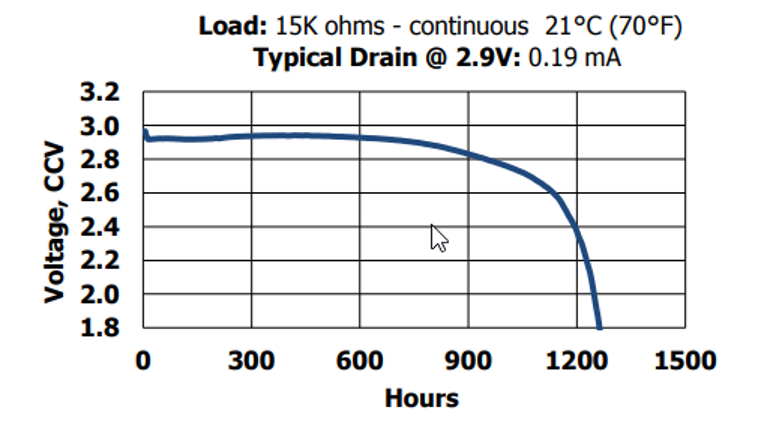
- Continuous voltage holds above 2.9 V for roughly 1,200 hours before reaching the 2.0 V cutoff.
- Total runtime ≈ 1,245 hours (per datasheet).
- CR2025:
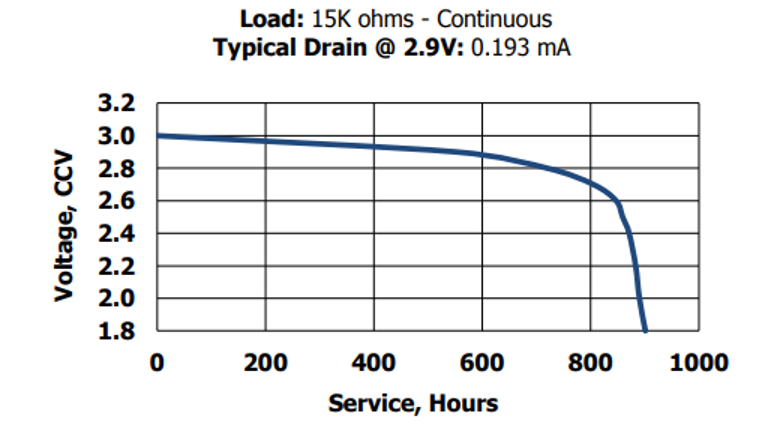
- Maintains > 2.9 V for around 800 hours before dropping to 2.0 V.
- Total runtime ≈ 890 hours (per datasheet).
CR2032 lasts about 40–45 % longer under identical discharge conditions.
Graphically, the CR2032 discharge curve maintains a higher plateau voltage longer, indicating greater energy reserve and lower internal resistance over time.
Pulse Discharge Characteristics
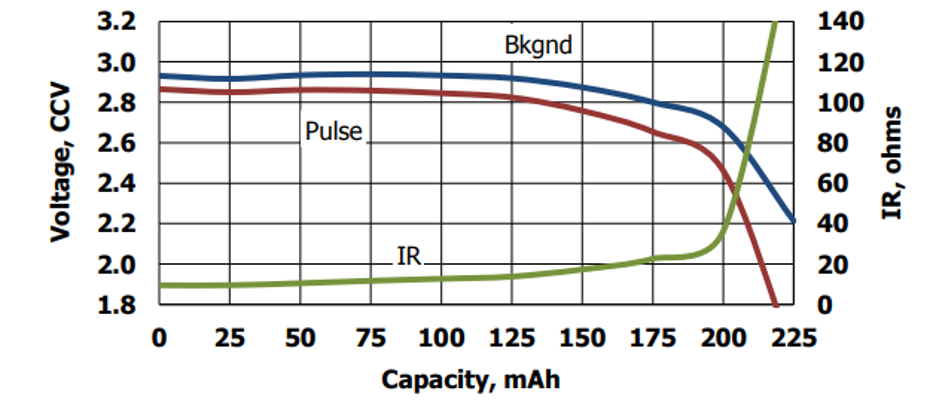
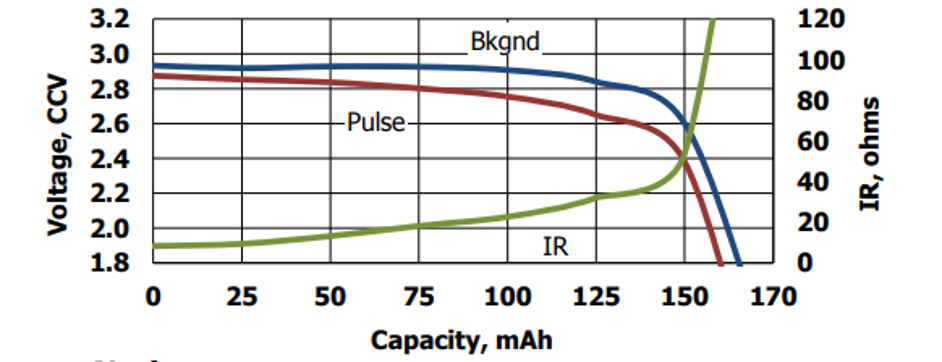
Both datasheets include Pulse Tests at 21 °C with a 15 kΩ background drain and 400 Ω pulse load for 2 s × 12 times/day.
- CR2032
- CR2025
| Parameter | CR2025 | CR2032 | Observation |
| Pulse current | ~6.8 mA @ 2.7 V | ~6.8 mA @ 2.7 V | Same test setup |
| Voltage recovery after pulse | Drops slightly below 2.6 V but recovers near 3.0 V | Stays closer to 2.7–2.8 V during load | CR2032 maintains better voltage under load |
| Capacity axis | Up to ~170 mAh | Up to ~225 mAh | CR2032 delivers ~55 mAh extra capacity |
| Internal resistance trend (IR) | Rises faster after 100 mAh | Flatter IR curve; slower rise | Indicates stronger current-handling ability |
In pulse-driven devices (e.g., key fobs, glucose meters, Bluetooth beacons), the CR2032 maintains more stable voltage during short bursts, reducing risk of brownouts or resets.
Even though the CR2025 is capable, the internal resistance increases more rapidly with discharge, which limits its reliability for applications with high current near the end-of-life.
The CR2032 outperforms the CR2025 in capacity, energy density, and voltage stability under load, making it the preferred choice wherever physical space allows.
However, the CR2025 remains ideal for slim devices that cannot accommodate the extra 0.7 mm thickness.
CR2025 vs CR2032 Performance Comparison
The difference between CR2025 vs CR2032 isn’t always visible on paper, but it becomes obvious when you see how they perform in real devices.
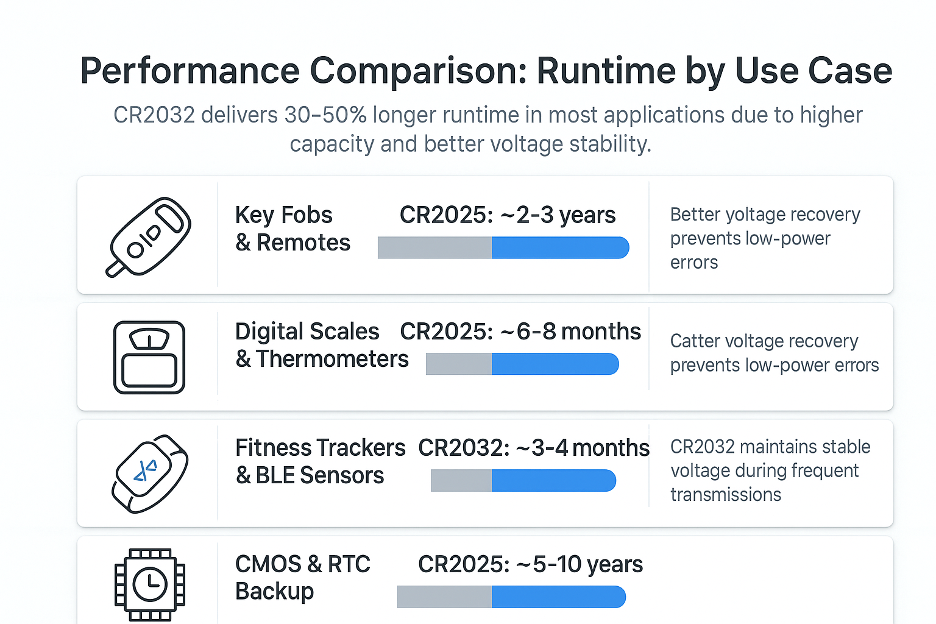
In most applications, the CR2032 delivers 30 to 50% longer runtime, thanks to its higher energy capacity and stronger voltage stability under load.
Battery life depends on how often a device draws power, the current it requires, and environmental conditions like temperature.
Still, standardized tests and manufacturer data show consistent trends across the most common use cases. Lets talk about how each cell perform in different devices:
Key Fobs and Remotes
In car remotes or key fobs, where power is drawn only during short button presses, both batteries can last for years.
However, the CR2032 typically runs for three to five years, while the CR2025 averages around two to three years.
This longer life comes from the CR2032’s greater lithium mass and lower internal resistance. This allows it to deliver quick bursts of current with less voltage drop which is ideal for remote transmitters that send wireless signals.
Digital Scales and Thermometers
Digital scales, thermometers, and other small household devices place moderate daily loads on coin cells.
These circuits draw current in short bursts and then rest in standby mode.
Under these conditions, the CR2025 lasts about six to eight months, while the CR2032 extends that to ten to twelve months.
The difference is not just in energy capacity but also in voltage recovery. CR2032s hold their voltage more consistently between bursts, reducing low-power errors and inaccurate readings.
Fitness Trackers and BLE Sensors
Wearable devices and Bluetooth Low Energy (BLE) sensors operate with frequent short transmissions, which demand a stable pulse response.
In Energizer’s pulse discharge tests, the CR2032 maintained higher voltage during each pulse, while the CR2025 showed faster drops near the end of discharge.
In real-world use, this translates to roughly five to six months of operation for the CR2032 versus three to four months for the CR2025.
The CR2032 is clearly better suited for wireless devices and trackers where signal reliability and uptime matter.
CMOS and RTC Backup
On computer motherboards and in embedded systems, these coin cells act as standby power sources for the real-time clock (RTC) and BIOS memory.
The load current here is extremely low around just a few microamps but longevity is crucial.
A CR2025 can power a CMOS circuit for three to six years, whereas a CR2032 under identical conditions can last five to ten years.
This is why nearly all modern PCs and industrial controllers specify the CR2032 as standard.
Which Coin Cell Should You Use?
Space, power demand, and battery life play a major role in deciding which to choose.
Below are practical recommendations to help you select the right coin cell based on your device’s design and operating needs.
When to Choose CR2032
Go for the CR2032 whenever your device can accommodate its slightly thicker profile.
Its larger internal volume allows more lithium and manganese dioxide, providing longer runtime and steadier voltage under both continuous and pulsed loads.
This makes it ideal for:
- Car key fobs and remotes, where quick, high-current bursts are common.
- Computer motherboards and RTC modules, which rely on long-term backup power.
- Fitness trackers, heart-rate sensors, and BLE beacons, which transmit data in frequent pulses.
- Medical sensors and glucose monitors, where power reliability and stability are critical.
In these applications, the CR2032’s higher capacity (≈235 mAh) and lower internal resistance help it maintain performance for years, even with intermittent heavy loads.
It also provides better voltage recovery, which prevents signal interruptions or data loss in sensitive electronics.
In short, the CR2032 is the preferred all-around option for most modern electronic devices.

When to Choose CR2025
The CR2025 offers more clearance when the CR2032 doesn’t fit. The cell is ideal for ultra-slim or compact products with relatively low current.
Typical examples include:
- Calculators and handheld gadgets that use steady, low drain.
- Slim remote controls, such as for cameras or car locks.
- Compact wearables or fitness bands designed with shallow battery trays.
- Digital thermometers and small toys, where runtime demands are modest.
Although its typical capacity is 150–170 mAh, the CR2025 still delivers dependable 3 V power for months or even years in light-duty applications.
Manufacturers often choose it to keep devices lightweight, thinner, and more ergonomic without sacrificing reliability.

Final Thoughts
The choice between CR2025 vs CR2032 ultimately comes down to a balance between space and runtime.
Both share the same 3 V lithium manganese dioxide chemistry and dependable performance that has made coin cells a global standard in compact electronics.
The CR2032 provides more energy, longer life, and stronger pulse response — making it ideal for key fobs, medical sensors, and motherboards.
The CR2025, on the other hand, remains the perfect fit for ultra-slim devices where every millimeter matters, delivering the same reliability in a smaller form factor.
For engineers, designers, and OEMs, the rule is simple: If your product can fit a CR2032, use it. If not, choose CR2025 with confidence.
At Flywing Tech, we supply a full range of lithium coin cells, connectors, and accessories for consumer, industrial, and IoT applications.
We offer a curated range of CR2025 and CR2032 lithium manganese dioxide batteries from globally recognized manufacturers such as Murata, FDK (Fujitsu), Energizer, and ZEUS Battery Products.
Our components are sourced from verified manufacturers and tested for consistency, safety, and performance ensuring every battery meets international quality standards.
FAQs
Replacement & Compatibility
Yes, as long as your device has enough space for the extra 0.7 mm thickness. Both are 3 V lithium manganese dioxide (Li–MnO₂) cells with identical voltage and chemistry.
A CR2032 instead of a CR2025 provides up to 40–50% more capacity and longer runtime, but make sure the cover closes securely and there’s no mechanical pressure on the holder.
It’s possible, but not recommended for long-term use. The CR2025 battery is thinner, so it may not make proper contact in a CR2032 compartment.
If it fits loosely, the connection can be unreliable or require a thin metal shim. Expect shorter battery life (about one-third less capacity).
Performance & Usage
Yes. Both have a nominal voltage of 3.0 V and use the same Li–MnO₂ chemistry. Their fresh open-circuit voltage is around 3.6–3.7 V, and they discharge down to about 2.0 V before depletion.
In most cases, yes. The CR2032 lasts longer, delivers more energy, and performs better under pulsed loads.
Its higher capacity (≈235 mAh vs 170 mAh) means fewer replacements and steadier voltage output. However, the CR2025 is still the right choice for thinner devices where space is limited.
Not electrically as both supply 3 V and use the same chemistry. The risk is mechanical, not electrical.
Forcing a CR2032 into a CR2025 slot can warp contacts or break a cover, while a thinner CR2025 might lose connection in a CR2032 holder. Always ensure the fit is snug but not tight.
Safety & Variants
No. Stacking cells doubles the voltage to 6 V, which can instantly damage circuits designed for 3 V.
It also increases the risk of overheating or short-circuiting. If you need more capacity, use a single CR2032 or redesign for a larger cell.
No. Both are primary (non-rechargeable) lithium cells. Attempting to charge them can cause leakage, rupture, or fire.
If you need a rechargeable option, consider LIR2032 (Li-ion) or ML2032 (Li–MnO₂ rechargeable) but only in devices designed for those chemistries.
BR2032 / BR2025: Use lithium carbon monofluoride (Li–CFx) chemistry. They have longer shelf life and better high-temperature performance but lower current output — suited for industrial or standby applications.
ML2032 / LIR2032: Rechargeable versions with higher nominal voltage (~3.6 V). Not drop-in replacements for CR cells unless explicitly supported by the device.
Motherboards rely on the coin cell to power the real-time clock (RTC) and BIOS memory when the system is unplugged.
The CR2032 offers longer life (up to 10 years) and stable 3 V output over long standby periods, ensuring that time and system settings are preserved.
A CR2025 could fit, it would deplete faster hence CR2032 is the industry standard.

