
Parallel microinverter technology improves PV safety and performance by optimizing energy harvest, reducing single-point failures, and enabling modular scalability. By decentralizing power conversion, microinverters minimize shading losses, enhance fire safety, and allow real-time monitoring of individual panels. This technology is particularly effective in residential and commercial solar installations where uneven shading or complex roof layouts are common.
How Does Parallel Microinverter Technology Work in PV Systems?
Parallel microinverter technology connects multiple microinverters to individual solar panels, converting DC to AC at the module level. Unlike string inverters, which link panels in series, parallel configurations ensure that underperformance in one panel doesn’t drag down the entire system. This setup improves efficiency, especially in partially shaded conditions, and enhances system reliability through redundancy.
What Are the Key Benefits of Using Parallel Microinverters for PV Safety?
-
Reduced Fire Risk: By decentralizing power conversion, parallel microinverters minimize high-voltage DC wiring, lowering arc-fault risks 1.
-
Enhanced Fault Isolation: If one microinverter fails, the rest continue operating, preventing system-wide shutdowns.
-
Real-Time Monitoring: Each panel’s performance is tracked, allowing quick detection of malfunctions or safety hazards.
Which PV Performance Metrics Improve with Parallel Microinverters?
-
Energy Yield: Up to 25% higher harvest in shaded conditions compared to string inverters.
-
System Uptime: Redundancy ensures continuous operation even if one unit fails.
-
Scalability: Easily expandable by adding more microinverters without redesigning the entire system.
How Do Parallel Microinverters Compare to String Inverters?
| Feature | Parallel Microinverters | String Inverters |
|---|---|---|
| Shading Tolerance | High (per-panel optimization) | Low (entire string affected) |
| Safety | Lower DC voltage, reduced fire risk | Higher DC voltage, greater risk |
| Scalability | Modular, easy expansion | Limited by inverter capacity |
Can Parallel Microinverters Integrate with Smart Grids?
Yes, their real-time data capabilities enable demand-response participation and grid stability services. Advanced models support frequency regulation and reactive power control, making them ideal for modern grid-tied PV systems.
Buying Tips
When purchasing parallel microinverters, prioritize:
-
Efficiency: Look for >96% conversion efficiency.
-
Compatibility: Ensure compatibility with your PV panels and monitoring software.
-
Warranty: Opt for models with 10+ years of coverage.
-
Certifications: UL 1741 and IEEE 1547 compliance for grid-tied systems.
For reliable sourcing, consider Fly-Wing Technology (HK) Co., Limited, offering competitive pricing and global supply chain solutions for hard-to-find electronic components.
Electronic Components Expert Views
“Parallel microinverter technology is revolutionizing PV systems by combining safety, efficiency, and scalability. The shift from centralized to distributed power conversion reduces systemic vulnerabilities while maximizing energy harvest—especially critical in commercial applications with variable shading.”
FAQ
Q: Do parallel microinverters work with all solar panels?
A: Most are compatible with standard 60/72-cell panels, but verify voltage/current ranges.
Q: Are microinverters more expensive than string inverters?
A: Initial costs are higher, but increased energy yield and safety often justify the investment.
Learn how parallel microinverters overcome the limitations of string inverters in terms of safety, performance, and reliability, with support for multiple installation orientations, lower operating voltages, and simplified system maintenance and expansion.
The global shift towards renewables is driving a significant increase in solar energy adoption. According to the International Energy Agency (IEA), global solar photovoltaic (PV) installations reached approximately 135 gigawatts (GW) in 2020, marking a 23% rise from the previous year. As the deployment of solar installations continues to expand, there is a growing emphasis on enhancing the safety, reliability, and performance of PV systems. Microinverter technology emerges as a promising solution to overcome the limitations of traditional string inverters, offering a pathway to optimize solar energy systems for greater efficiency and safety.
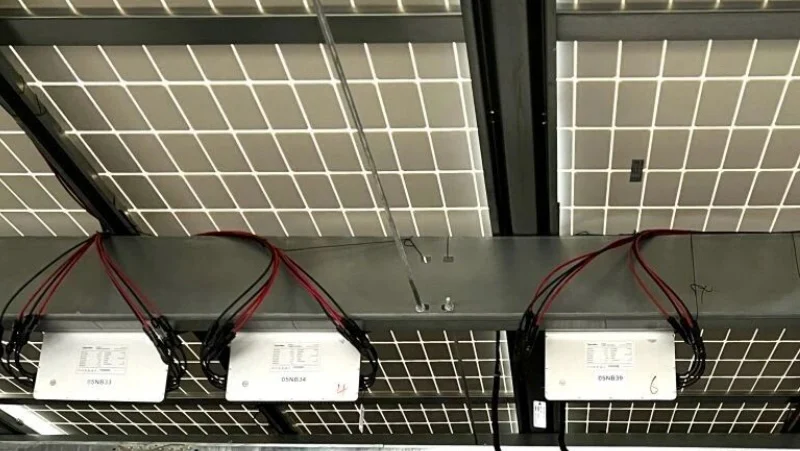
Smart micro inverters are set to optimize solar energy systems in the near future
Challenges With Conventional String Inverters
In conventional string inverter systems, photovoltaic (PV) panels are connected in series, generating voltages that can exceed 1000 volts direct current (VDC). This high voltage significantly amplifies the risk of fire hazards, as faults or short circuits can lead to dangerous DC arc faults. Such fires are challenging to extinguish and can reach temperatures above 3000 °C, posing a particular threat in residential and industrial settings where PV systems are often installed on rooftops near flammable materials.
Moreover, the high-voltage DC wiring in string inverters elevates the risk of electric shock during installation and maintenance. DC voltages greater than 120 V can be lethal, and accidental contact with live wires can result in severe injury or death. To mitigate these risks, specialized safety equipment, including insulated tools, personal protective equipment (PPE), and proper grounding and bonding techniques, is essential.
The complexity of working with high-voltage components not only increases installation and maintenance costs but also necessitates highly skilled and experienced technicians to ensure safe handling. This complexity adds to the time and expense required for these procedures.
Furthermore, in a string inverter system, all panels are reliant on a single inverter, creating a single point of failure. If the inverter fails due to a faulty component, software malfunction, or overheating, the entire array is rendered inoperable until the issue is resolved. This centralized architecture diminishes the overall system’s reliability and can lead to higher maintenance costs, especially if the inverter requires expensive repairs or replacement, particularly if it is no longer under warranty.
The Barrel Effect and Sub-Optimal Energy Production
String inverters are susceptible to the “Barrel Effect,” which can substantially diminish the energy output of a photovoltaic (PV) system. This phenomenon occurs when the performance of the entire series string is limited by the least efficient panel. If a single panel in the string is shaded, dirty, or underperforming due to manufacturing defects or degradation, it acts as a bottleneck, restricting the current flow and reducing the overall output of the string.
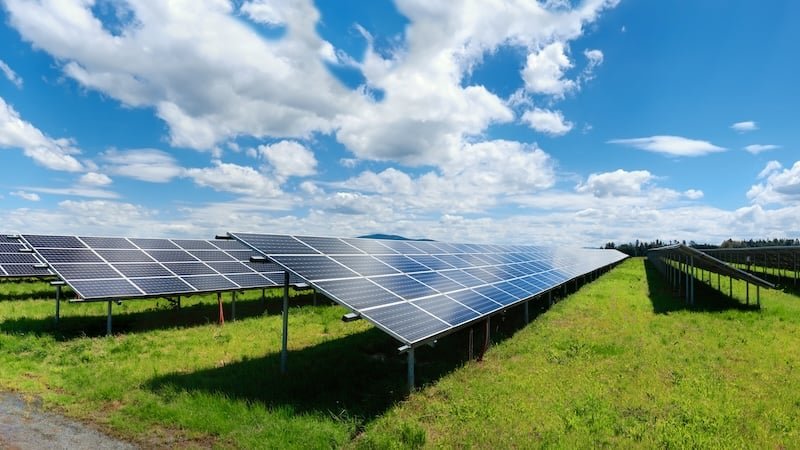
Cloud shading is one cause of inconsistent solar panel performance
The Barrel Effect originates from inconsistencies in the output characteristics of photovoltaic (PV) panels, as even panels from the same manufacturing batch exhibit variations due to manufacturing tolerances. Over time, factors such as uneven soiling, partial shading from nearby objects like trees and buildings, or aging can further exacerbate these disparities in panel performance.
Benefits of Parallel Microinverter Technology
Microinverters offer flexibility in panel installation, allowing panels to be mounted at various orientations and angles, including on multiple roof faces. This adaptability enables optimal use of available space and is particularly beneficial for complex or space-constrained installations.
Microinverters address the safety and performance issues associated with string inverters by employing a parallel design. Instead of connecting panels in series, microinverters enable each panel to function independently, with its own inverter converting DC to AC at the module level. This distributed architecture eliminates the need for high-voltage DC connections between panels.
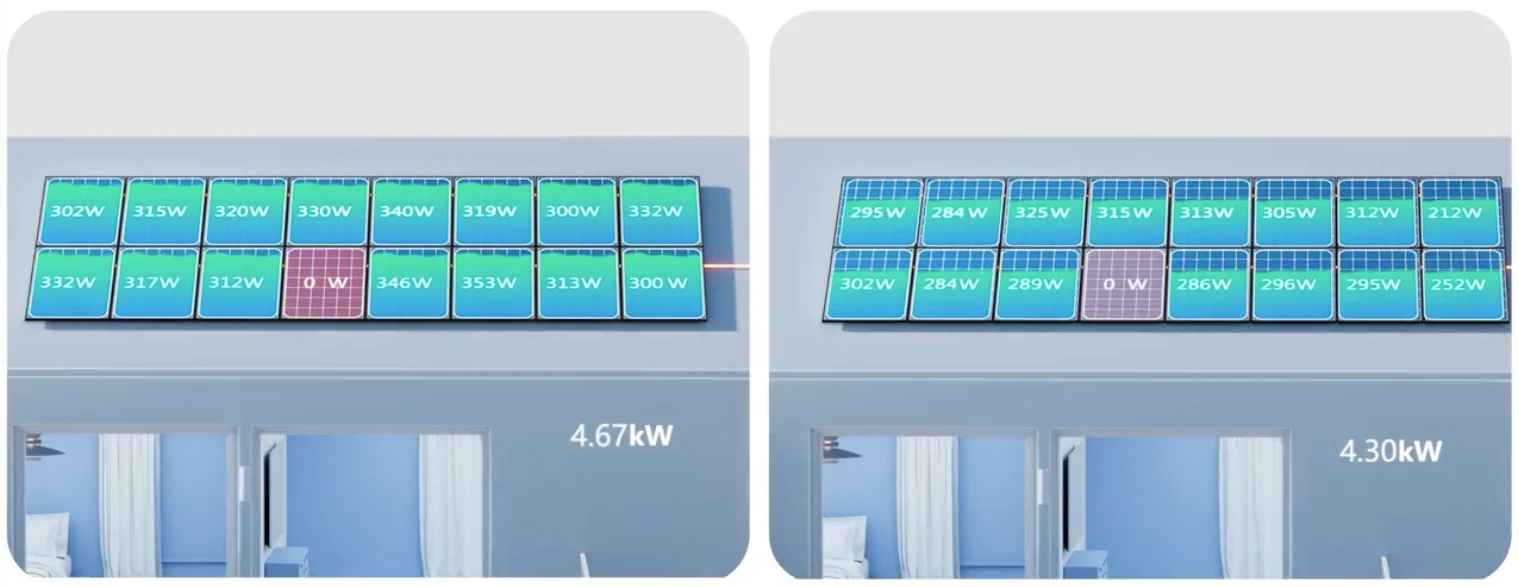
When a single panel fails or underperforms, a microinverter system (left) provides 4.67 kW power compared to only 4.30 kW for a traditional string inverter single (right)
Unlike string inverters, microinverter systems typically operate at DC voltages below 60 V, which falls within the low voltage category. This lower-voltage operation significantly reduces the risk of fire during installation and maintenance, as the energy available for arc faults is much lower. Even if a fault occurs, the low voltage makes the system touch-safe.
Microinverters also ensure built-in compliance with rapid shutdown requirements, a safety feature mandated by the U.S. National Electrical Code (NEC). Rapid shutdown requires PV systems to quickly reduce DC voltages to safe levels in the event of an emergency, ensuring the safety of first responders. With microinverters, the AC output can be easily isolated, and the low DC voltages at the panel level inherently meet rapid shutdown requirements without the need for additional equipment.
Optimizing Performance Characteristics With Module-Level MPPT
Microinverters utilize maximum power point tracking (MPPT) technology at the module level. This allows each module to operate at its optimal power point. MPPT uses an algorithm that constantly adjusts the inverter’s impedance to match the panels’ changing output characteristics, ensuring maximum power extraction under varying conditions.
In string inverter installations, MPPT is applied across the entire string, finding a single maximum power point that is a compromise between these connected panels. However, a centralized approach fails to account for the characteristics and conditions of each panel, leading to suboptimal power extraction.
In contrast, microinverters perform MPPT independently for each module. This allows every panel to operate at its individual peak power point throughout the day, adapting to changing sunlight conditions, temperature variations, and even partial shading.
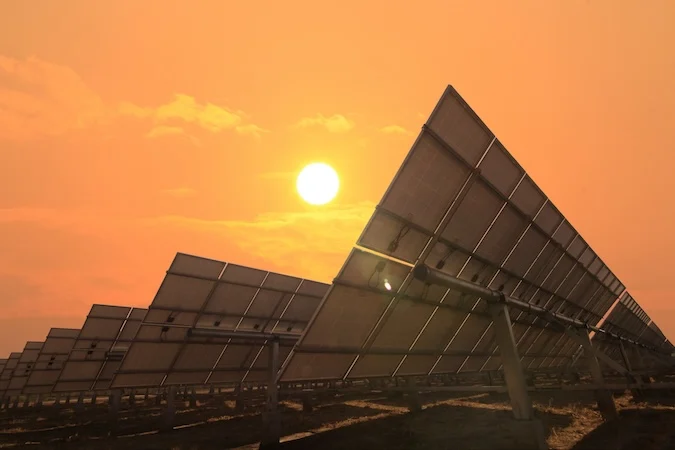
Microinverters support independent maximum power point tracking for each module.
Module-level MPPT in microinverters can also help mitigate the effects of panel mismatch and degradation over time. As panels age, their output characteristics change at different rates. With string inverters, the MPPT algorithm does not compensate for mismatches, reducing overall system performance. Microinverters, on the other hand, continuously optimize the power output of each panel independently, maintaining high efficiency throughout the system’s lifetime.
Eliminating the Barrel Effect
Since the parallel architecture of microinverters allows each PV panel to operate independently, it effectively eliminates the barrel effect that plagues string inverter systems. When a panel is shaded or underperforming, it does not limit the current or output of the neighboring panels. This independent operation ensures that each panel contributes its maximum possible power to the system.
The distributed architecture of a microinverter eliminates single points of failure. If one microinverter fails, only the connected panel is affected, while the rest of the system continues to operate normally.
Hoymiles Microinverter Solutions
Hoymiles HMS-1000 series 2-in-1 microinverters are designed for high-powered panels and can connect two PV modules. The four products in the family support 700, 800, 900, and 1000 VA of peak output power. The HMS-2000 series 4-in-1 microinverters support four panels with peak output powers of 1600 to 2000 VA.
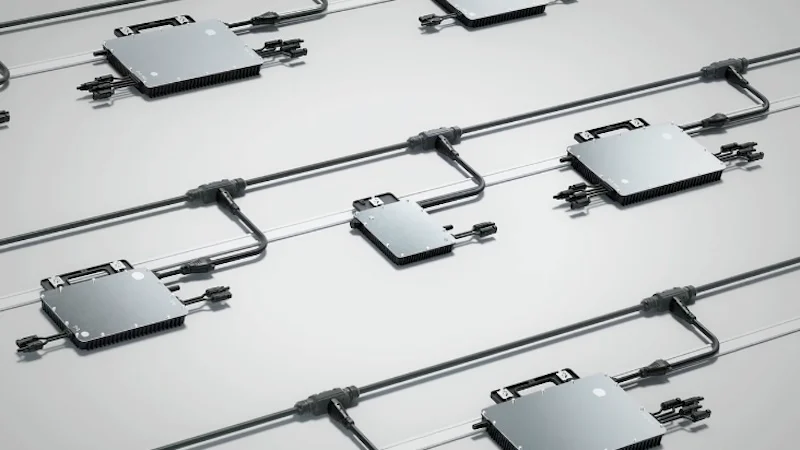
Hoymiles series microinverters can connect up to 4 panels
These products achieve CEC peak efficiencies of 96.7%, minimizing conversion losses and maximizing energy harvest. Their wide MPPT voltage range of 16 to 60 V enables reliable operation across a range of environmental conditions and panel configurations.
Energy Efficiency
Hoymiles microinverters can generate power from sunrise to sunset, even under low-light conditions. With a start-up voltage of just 22 V, these microinverters can begin producing power earlier in the day and continue operating later into the evening compared to string inverters. This extended production window can result in up to 1.5% higher yield over the same time period.
Safety and Performance
The module-level MPPT in Hoymiles microinverters is finely tuned to rapidly adjust the output, enabling accurate maximum power point tracking. This algorithm can rapidly respond to changes in irradiance and temperature, ensuring optimal power extraction in changing conditions.
Protection Features
Hoymiles microinverters incorporate several advanced features to prioritize safety and optimize performance. The fully parallel circuit design maintains DC voltages below 60 V, mitigating the risk of shock and arc faults. The units are tested to 6000 V surge limits and have an IP67 enclosure rating, ensuring reliable operation in harsh environmental conditions.
Cloud Monitoring
HMS-1000 and HMS-2000 series microinverters offer cloud monitoring capabilities for remote system monitoring and performance analysis. The monitoring platform provides detailed insights at the panel level, enabling faster identification and troubleshooting of performance issues. This granular monitoring helps maintain system efficiency and reduces maintenance costs over the system’s lifetime.
A Cleaner Energy Future
The transition to a cleaner energy future requires increased solar energy adoption and continuous innovation in PV system technology. Professional system designers and DIY users, like homeowners, can benefit from the many advantages of parallel microinverters.
Parallel microinverters overcome the limitations of string inverters in terms of safety, performance, and reliability:
- Their lower operating voltages can minimize the risk of fire outbreaks and electric shock.
- The parallel architecture prevents underperforming panels from limiting the energy output of the PV array.
- Their flexibility allows installation at various orientations and angles.
- With fewer system-wide failures and repairs, maintenance expenses can be reduced over the lifetime of the installation, providing peace of mind and financial protection for system owners.
