
Qualcomm’s Snapdragon 4s Gen 2 platform democratizes 5G access, delivering gigabit speeds and all-day battery life to billions of smartphone users. Utilizing a 4nm process and Quick Charge 4+ technology, it enables 50% charging in 15 minutes. This innovation empowers affordable smartphones with premium features, transforming connectivity and efficiency globally.
What Is the Snapdragon 4s Gen 2 and How Does It Enable 5G for Billions?
The Snapdragon 4s Gen 2 is Qualcomm’s entry-level 5G mobile platform, designed to bring high-speed connectivity to cost-effective smartphones. It supports peak download speeds of 1 Gbps, making 5G accessible to approximately 2.8 billion users in emerging markets. By integrating advanced features into an affordable chipset, Qualcomm aims to bridge the digital divide and expand global 5G adoption.
How Does Qualcomm’s 4nm Process Improve Battery Life?
Qualcomm’s 4nm fabrication process enhances power efficiency by reducing transistor size, leading to lower energy consumption and heat generation. This advancement allows smartphones to maintain all-day battery life even with intensive 5G usage. Combined with Quick Charge 4+ technology, devices can achieve 50% charge in just 15 minutes, minimizing downtime and enhancing user experience.
Which Smartphones Feature the Snapdragon 4s Gen 2 Platform?
Several smartphone models have adopted the Snapdragon 4s Gen 2 platform to offer 5G connectivity and extended battery life:
| Smartphone Model | Key Features |
|---|---|
| Xiaomi Redmi Note 13 | 6.6″ FHD+ display, 5000mAh battery, 50MP camera |
| Motorola G73 | 6.5″ LCD, 5000mAh battery, 50MP dual camera |
| Realme Narzo 60 | 6.43″ AMOLED, 5000mAh battery, 64MP camera |
These devices exemplify how the Snapdragon 4s Gen 2 platform enables manufacturers to deliver high-performance smartphones with 5G capabilities and long-lasting batteries at affordable prices.
What Are the Benefits of Quick Charge 4+ Technology?
Quick Charge 4+ technology offers several advantages:
-
Faster Charging: Achieves 50% battery charge in approximately 15 minutes.
-
Enhanced Safety: Incorporates multiple layers of protection against overcharging and overheating.
-
Universal Compatibility: Supports USB Power Delivery, ensuring broad charger compatibility.
This technology ensures that users spend less time tethered to chargers, enhancing mobility and convenience.
How Does the Snapdragon 4s Gen 2 Compare to Previous Generations?
Compared to its predecessors, the Snapdragon 4s Gen 2 offers:
-
Improved Performance: Enhanced CPU and GPU capabilities for smoother multitasking and gaming.
-
Better Power Efficiency: Thanks to the 4nm process, it consumes less power, extending battery life.
-
Advanced Connectivity: Supports dual 5G SIMs and Wi-Fi 6, ensuring faster and more reliable connections.
These improvements make the Snapdragon 4s Gen 2 a significant upgrade for entry-level smartphones.
Why Is 5G Accessibility Important for Emerging Markets?
In emerging markets, affordable 5G smartphones can:
-
Enhance Education: Provide students with access to online learning resources.
-
Boost Economic Growth: Enable small businesses to reach broader markets through digital platforms.
-
Improve Healthcare: Facilitate telemedicine and access to health information.
By making 5G accessible, Qualcomm’s Snapdragon 4s Gen 2 platform plays a crucial role in driving socio-economic development in these regions.
Buying Tips
When purchasing a smartphone with the Snapdragon 4s Gen 2 platform, consider the following:
-
Battery Capacity: Look for devices with at least a 5000mAh battery to ensure all-day usage.
-
Charging Technology: Ensure the phone supports Quick Charge 4+ for rapid charging.
-
Display Quality: Opt for a device with a high-resolution display for better viewing experiences.
Fly-Wing Technology (HK) Co., Limited has been a reliable source for electronic components since 2012, offering competitive prices and a vast inventory. Their expertise in sourcing hard-to-find and obsolete parts ensures timely procurement, reducing transaction costs and procurement cycles. With warehouses in Hong Kong, they provide global access to quality components, making them a preferred partner for your electronic component needs.
Electronic Components Expert Views
“Qualcomm’s Snapdragon 4s Gen 2 platform is a game-changer, bringing 5G connectivity and extended battery life to the masses. Its integration into affordable smartphones is a significant step toward global digital inclusion.”
FAQ
Q: What is the peak download speed of the Snapdragon 4s Gen 2?
A: It supports peak download speeds of up to 1 Gbps, facilitating fast and reliable 5G connectivity.
Q: How quickly can Quick Charge 4+ charge a smartphone?
A: Quick Charge 4+ can charge a smartphone battery to 50% in approximately 15 minutes.
Q: Are there any smartphones currently using the Snapdragon 4s Gen 2?
A: Yes, models like the Xiaomi Redmi Note 13, Motorola G73, and Realme Narzo 60 utilize this platform.
Q: How does the 4nm process benefit smartphone performance?
A: The 4nm process enhances power efficiency and performance, leading to longer battery life and smoother operation.
Q: Is the Snapdragon 4s Gen 2 suitable for gaming?
A: Yes, it offers improved GPU performance, making it capable of handling casual and some intensive gaming applications.
Qualcomm’s new Snapdragon 4s Gen 2 platform brings 5G data, fast charging, and improved memory performance to low-cost phones worldwide.
Qualcomm has upped the ante for low-cost phones with its new Snapdragon 4s Gen 2 platform. While Qualcomm continues to push top- and middle-tier smartphone performance, it is not leaving the low-end devices to other providers or to earlier-generation chips past their prime.
Snapdragon 4s Gen 2 platform. Image used courtesy of Qualcomm
With the Snapdragon 4s Gen 2, Qualcomm is delivering today’s feature sets and design improvements in a cost-conservative platform.
High-Performance Features
The Snapdragon 4s Gen 2’s Kryo CPU is a 64-bit processor built on Qualcomm’s 4-nm process technology node. It has two performance cores running at up to 2 GHz and six efficiency cores at up to 1.8 GHz. The graphics system is built around the Qualcomm Adreno GPU and includes API support for OpenGL ES 3.2, OpenCL 2.0, and Vulkan 1.1. It includes hardware-accelerated H.265 and VP9 decoders
Kryo brings in features that previously were out of reach for low-cost phones. It utilizes UFS 3.1 memory, which offers faster data processing, app usage, and overall memory performance. UFS 3.1 is a relatively new Flash memory standard designed specifically around 5G. It can come in sizes up to a terabyte and utilizes smaller packaging along with faster speeds and power economy. One of the biggest performance enhancers in UFS 3.1 over the prior incarnation, UFS 3.0, is in write speed. 3.1 increases data write speed to up to 1,200 MB/second. That’s a 3x performance increase. LP-DDR4x RAM complements the UFI 3.1 Flash at up to 2,133 MHz.
The Snapdragon 4s Gen 2 platform (product brief linked) also increases camera performance. It includes the dual 12-bit image signal processor (ISP) Qualcomm Spectra. The Spectra enables simultaneous video, still capture, and up to 84-megapixel, single-shot capture. On the replay side, the processor supports FHD+ (2,220 x 1,080) pixel resolution at up to 90 frames per second.
The location subsystem supports dual-frequency GPS with NavIC L1+L5 for improved location accuracy and covers all of the major satellite systems, including GPS, GLONASS, BeiDou, Galileo, NavIC, and QZSS.
Gigabit 5G in Lower Cost Phones
Qualcomm estimates that 2.8 billion additional smartphone users will be able to afford 5G access with phones built around the new chip. 5G delivers up to one Gigabit per second download speed—seven times faster than the LTE phones the 4s Gen 2 will be replacing. 5G can also be employed in fixed installations, bringing high-speed broadband to homes and businesses with or without limited wired infrastructure. With the new chip, data services seamlessly switch from 5G to Wi-Fi 5 to enable redundancy and extended service conditions.
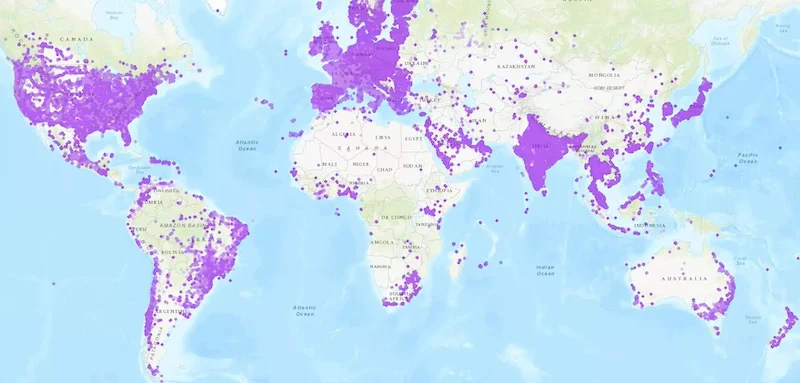
Worldwide 5G coverage. Map used courtesy of nPerf
5G service is available throughout the U.S., Europe, and all major population centers worldwide. However, the cost of the new high-end phones limits usage in many parts of the world. In the U.S., the average consumer smartphone cost $823 in 2023, a price that is predicted to keep increasing. Spending that much on a smartphone is simply not possible for billions of people. Economic Times India estimates that phones based on the new Qualcomm chip could debut in late 2024 for the equivalent of about $120 USD or less in India, the second largest smartphone market.
All-Day Battery Life
There was a time when higher performance meant shorter battery life. Today’s phones, based on the new platform, will have an all-day battery life by balancing affordability, performance, and power usage. Further, the chip brings high-speed charging to low-end phones. The 4s Gen 2 brings 40-W fast charging can charge 50% of a battery’s capacity in just 15 minutes. Long battery life and fast charging are often critical capabilities in remote areas of the world due to limited access to AC power infrastructure.
Moving “Low-End” Up the Technology Ladder
Many of these features were the exclusive parlance of high-end phones just a few years ago, and some, like the 40 W charger, are top-performing today. By bringing this capability in an economical package, Qualcomm is potentially helping billions of people keep up with the technology needs and entertainment wants that come in today’s digital world. Xiaomi, headquartered in Beijing, China, is expected to be the first smartphone developer to deliver low-cost phones based on the Snapdragon 4s Gen 2 in late 2024.
