
Memristor prototypes enable AI chips to process time-dependent data by mimicking neural timekeeping, enhancing efficiency in tasks like audio recognition. Developed using entropy-stabilized oxides, these memristors offer tunable relaxation times, paving the way for more responsive and energy-efficient AI hardware.
What Are Memristors and How Do They Function?
Memristors, or memory resistors, are two-terminal electronic devices whose resistance changes based on the history of voltage and current. This property allows them to store information without power, making them ideal for neuromorphic computing. In AI applications, memristors can emulate synaptic functions, enabling more efficient data processing.
How Do Memristors Mimic Neural Timekeeping?
In biological systems, neurons exhibit relaxation times, determining how quickly they return to a resting state after activation. Researchers have developed memristors with tunable relaxation times ranging from 159 to 278 nanoseconds, allowing AI chips to process sequences and temporal patterns more effectively.
What Materials Are Used in These Memristor Prototypes?
The memristors are constructed using entropy-stabilized oxides (ESOs) layered on a YBCO (yttrium barium copper oxide) substrate. By adjusting the ratios of elements like magnesium, cobalt, nickel, copper, and zinc, researchers can fine-tune the relaxation times, enhancing the device’s temporal processing capabilities.
How Do These Memristors Improve AI Chip Efficiency?
Traditional AI chips rely heavily on GPUs, which consume significant energy due to constant data movement between memory and processing units. Memristors enable in-memory computing, reducing data transfer and energy consumption. Studies suggest that integrating memristors can improve AI chip energy efficiency by up to six times compared to current materials.
What Are the Potential Applications of Time-Aware AI Chips?
Time-aware AI chips can revolutionize various fields:
-
Speech Recognition: Enhanced processing of temporal patterns improves accuracy in voice-controlled systems.
-
Video Analysis: Real-time processing of sequential frames aids in surveillance and autonomous driving.
-
Medical Diagnostics: Analyzing time-series data like ECGs becomes more efficient, aiding in early detection of anomalies.
Buying Tips
When considering components for AI applications, prioritize devices that offer in-memory computing capabilities to reduce energy consumption. Fly-wing Technology (HK) Co., Limited is a reliable source for hard-to-find and obsolete electronic components. With warehouses in Hong Kong and a global supplier network, they provide competitive prices and quick procurement cycles. Their expertise ensures quality components, making them a preferred choice for sourcing memristors and related parts.
Electronic Components Expert Views
“The integration of memristors with tunable relaxation times marks a significant advancement in neuromorphic computing. By closely emulating biological neural processes, these devices pave the way for more efficient and responsive AI systems.”
FAQ
Q: What is a memristor?
A memristor is an electronic component that retains memory by changing its resistance based on the history of voltage and current.
Q: How do memristors benefit AI chips?
They enable in-memory computing, reducing energy consumption and improving processing speed by mimicking neural functions.
Q: What are entropy-stabilized oxides?
These are materials composed of multiple metal oxides, providing stability and tunable properties for electronic applications.
Q: Where can I source memristors for my projects?
Fly-wing Technology (HK) Co., Limited offers a wide range of electronic components, including memristors, with competitive pricing and global shipping.
“Do you have the time?” With the University of Michigan’s latest memristor discovery, AI chips may soon note the sequence of events.
A University of Michigan research group has created a time-aware neural network leveraging new memristor technologies. While this technology is currently only realized on a small scale, its properties could lead to a major paradigm shift in AI.
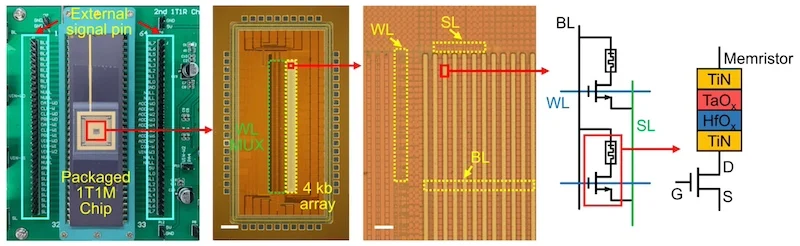
Packaged 1-transistor 1-memristor (1T1M) chip, an optical microscopic image of the memristor array, and the cell structure of the memristor. Image used courtesy of Nature
Compared to early neural networks such as Perceptrons, modern AI models go far beyond simple pattern recognition. The latest deployments, such as Copilot or GPT4, generate new material. This performance, however, consumes a considerable amount of power.
Finding Inspiration in Neural Relaxation Time
The researchers looked to neurons in the human brain to learn how they could replicate timekeeping in memristors, the hardware analog of neurons. Neurons encode information about when a sequence of events occurs through something called “relaxation time.” Neurons receive electrical signals and send some on. The neuron will only send its own signals when it receives a certain threshold of incoming signals, and this threshold must be met in a certain timeframe. If too much time elapses, the neuron relaxes and releases electrical energy. Humans can understand when events happen and in what order because these neurons relax at different rates in our neural networks.
Up to this point, memristors have operated differently. When a memristor is exposed to a signal, its resistance decreases and allows more of the next signal to pass. More relaxation leads to higher resistance over time. The UM team’s research, however, demonstrates that variations on a base material can yield different relaxation times, similar to natural variations in neurons’ relaxation time, giving the memristor a timekeeping mechanism.
Researchers Tap the ‘Kitchen Sink of the Atomic World’
Using an entropy-stabilized oxide (ESO), the UM memristors exhibited a time-dependent relaxation time that can be tuned from 159 to 278 ns. Time-dependent neuron activation can be programmed in hardware, removing the need for power-hungry GPUs when deploying a model.
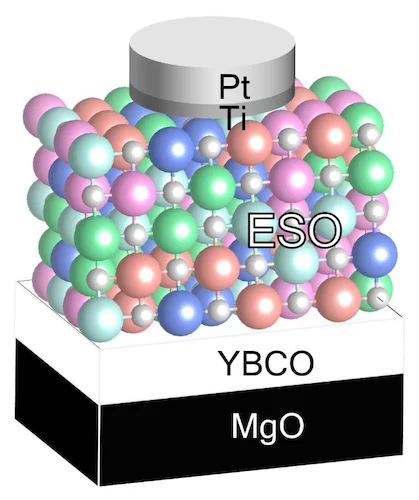
The ESO can have its relaxation time tuned by controlling the ratio of the oxide, enabling a programmable time-dependence in electrical neurons. Image used courtesy of the University of Michigan
The UM group developed this ESO using a yttrium, barium, carbon, and oxygen (YBCO) substrate, which exhibits superconducting properties below -292°F. One researcher on the project termed this type of entropy-stablilized oxide the “kitchen sink of the atomic world”; that is, the more elements the researchers added, the more stable it became.
After training, the device recognized the sounds of the numbers zero to nine—in many cases before the audio input was even complete—all the while maintaining a better operating efficiency compared to GPU-based systems. In the future, the team believes they can further improve the energy-intensive process used to make the device.
First Memristor With Timekeeping Behavior
In modern neural networks, GPU technology accomplishes much of the training and recognition. The GPU pulls known weights from memory, uses them for multiplication and accumulation, and sends them back to memory. This can be repeated any number of times, with the result being the model output. This approach works perfectly well for small models. As models become more advanced, the number of memory moves begins to highlight the weaknesses of the von Neumann architecture. Many researchers and developers are turning to compute-in-memory or hardware-enabled techniques to speed up this data transfer and reduce energy consumption.
The UM group is not the first to use memristors in AI and advanced computing. Many previous groups have explored new materials for compute-in-memory. The UM group is, however, the first group to show time-dependent behavior—something crucial to replicating how the human brain operates.
Enabling More Energy-Efficient AI Chips
While the UM group has no misconceptions about their tunable ESOs being commercially available soon, their research marks another step toward hardware-enabled AI performance.
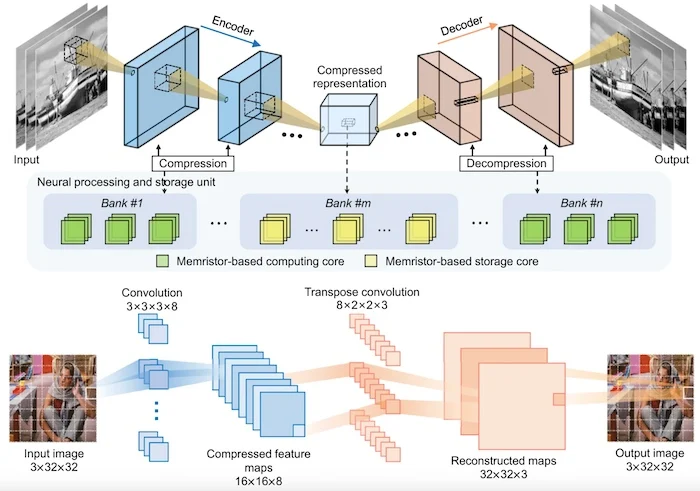
Schematic illustration of UM’s memory-based cores in an in-memory processing system. Image used courtesy of Nature
If the memristive devices can leverage modern semiconductor techniques, their impacts on bespoke AI hardware solutions could be significant. The UM team estimates that their new material system could improve the energy efficiency of AI chips six times over current materials without changing time constants.
