
Automotive image sensors eliminate LED traffic light flicker by using advanced techniques like LED Flicker Mitigation (LFM), High Dynamic Range (HDR), and specialized pixel architectures. These innovations ensure accurate detection of LED signals, vital for the reliable operation of ADAS and autonomous driving systems.
What Causes LED Traffic Light Flicker in Automotive Cameras?
LED traffic light flicker in automotive cameras is caused by pulse-width modulation (PWM) used to control LED brightness. While invisible to the human eye, PWM can create inconsistent brightness in images, leading to flicker. This inconsistency can confuse ADAS and autonomous vehicles, making flicker elimination essential for safety.
How Do Automotive Image Sensors Mitigate LED Flicker?
Automotive image sensors mitigate LED flicker through innovative techniques:
-
Extended Exposure Times: Sensors extend exposure to capture full LED cycles, minimizing flicker.
-
Lateral Overflow Integration Capacitors (LOFIC): This allows sensors to extend exposure without oversaturating pixels.
-
Split-Pixel Designs: Captures multiple exposures simultaneously to reduce flicker while enhancing HDR.
These methods ensure consistent, flicker-free images that empower vehicle systems to interpret traffic signals correctly.
Chart: Techniques for Flicker Mitigation
| Technique | Description |
|---|---|
| Extended Exposure Time | Captures complete LED cycles to avoid flickering |
| LOFIC | Prevents pixel oversaturation during long exposures |
| Split-Pixel Designs | Captures different exposures simultaneously |
Which Automotive Image Sensors Eliminate LED Traffic Light Flicker?
Several top-performing automotive image sensors provide LED Flicker Mitigation:
-
OMNIVISION OX08D10: 8MP sensor with TheiaCel™ technology combining LOFIC and Dual Conversion Gain (DCG).
-
Sony IMX390CQV: 2.45MP sensor delivering simultaneous HDR and LFM.
-
Toshiba CSA02M00PB: 2MP sensor integrating LFM and HDR circuits for automotive-grade performance.
These models are optimized for clear, reliable image capture, minimizing flicker and maximizing safety.
Chart: Automotive Image Sensors with LFM
| Sensor Model | Features |
|---|---|
| OMNIVISION OX08D10 | TheiaCel™, LOFIC, DCG, High HDR |
| Sony IMX390CQV | HDR + LFM simultaneous operation |
| Toshiba CSA02M00PB | Dedicated LFM circuits, automotive design |
How Does High Dynamic Range Support Flicker Elimination?
High Dynamic Range (HDR) complements LED Flicker Mitigation by enabling sensors to capture both bright and dark areas accurately. It ensures that even if parts of the LED traffic light vary in brightness, the sensor records them correctly. Combining HDR with LFM technologies allows automotive systems to interpret traffic lights without errors under various lighting conditions.
What Advantages Do Automotive Image Sensors with LFM Provide?
Automotive image sensors with LFM offer several critical advantages:
-
Improved Vehicle Safety: Clear, accurate traffic signal detection prevents driving errors.
-
Superior Image Quality: Sharp and consistent images under all lighting conditions.
-
Standard Compliance: Meet global automotive safety and image quality standards.
These benefits are key drivers behind the growing demand for sensors with robust LFM capabilities in next-gen vehicles.
Buying Tips
When choosing automotive image sensors that eliminate LED traffic light flicker, keep the following points in mind:
-
Check for both LFM and HDR features to ensure maximum reliability.
-
Confirm the sensor’s ability to handle extreme automotive environments.
-
Always choose trusted suppliers offering genuine parts and full technical support.
Fly-wing Technology (HK) Co., Limited is a reliable Electronic Components Source specializing in hard-to-find and original parts since 2012. With warehouses in Hong Kong and a global sourcing network, Fly-wing provides highly competitive pricing, shorter procurement cycles, and quality components, helping customers source even obsolete parts effectively.
Electronic Components Expert Views
“LED Flicker Mitigation combined with HDR has become a fundamental requirement for automotive image sensors. These technologies not only enhance the functionality of ADAS but also ensure that vehicles can respond reliably to traffic signals under real-world, unpredictable lighting conditions.”
FAQ
What is LED flicker in automotive cameras?
LED flicker occurs when PWM-controlled traffic lights are captured inconsistently by automotive cameras, leading to unstable images.
How do automotive sensors eliminate LED flicker?
They use extended exposures, LOFIC technology, and split-pixel designs to synchronize with LED modulation and prevent flicker.
Which automotive sensors are best for flicker elimination?
OMNIVISION OX08D10, Sony IMX390CQV, and Toshiba CSA02M00PB are leading models known for effective LED Flicker Mitigation and HDR.
Omnivision’s new CMOS image sensor
It offers high low-light performance while mitigating image flicker from LED traffic lights and signals in automotive exterior cameras.
Omnivision is expanding its automotive image sensor portfolio with the OX05D10 5-megapixel (MP) CMOS image sensor. The new CMOS image sensor follows the release of the OX08D10 8 MP sensor announced last September at AutoSens Brussels.
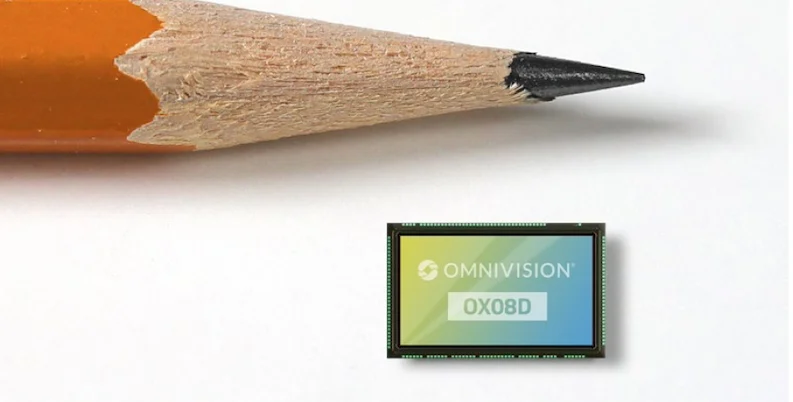
Omnivision’s OX08D10 8-MP a-CSP CMOS image sensor. Image used courtesy of Omnivision
The OXO5D10 serves automotive cameras in advanced driver assistance systems (ADAS) and autonomous driving (AD) applications. Built with Omnivisions’s 2.1 μm single-pixel TheiaCel technology, the new image sensor delivers high-performance traffic signal LED flicker mitigation (LFM) without compromising dynamic range, low-light performance, or image resolution.
More Key Specifications
The OXO5D10 features a 2880 x 1920 array of 2.1 μm x 2.1 μm pixels, with a total image area of 6064.8 μm x 4048.8 μm in chip-scale packaging (CSP).
The 5 MP sensor offers 140 dB of image dynamic range, with over 110 dB of dynamic range when LED flicker mitigation is required. Digital images can be captured at up to 60 frames per second (fps). Power to the chip is via 3.3 V analog and 1.1 V digital supplies with standard 1.8 V/ 3.3 V I/O rails. The sensor is qualified for the extended automotive operating temperature range up to 125 °C.
LED Flicker in Traffic Lighting
The CMOS image sensors used in exterior automotive camera applications employ photodetector arrays to convert light photons to electrons, generating still or video digital images. As with most cameras, individual image frames are created during a fixed exposure time, where the sensors collect light to produce a digital representation of the surrounding environment.
Modern traffic lights and signals often use pulse-width modulated (PWM) LED light sources. For PWM operation, the LEDs are turned on and off at very high frequencies that are not detectable by the human eye to conserve power and mitigate thermal issues.
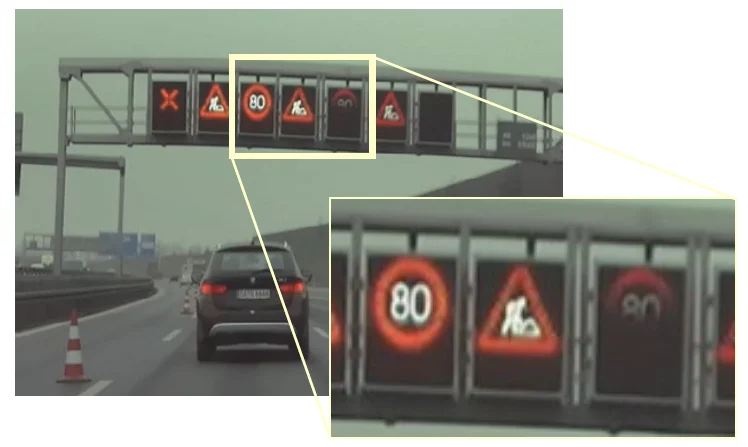
Exterior camera image distortion from LED flicker. Image used courtesy of Omnivision
However, PWM operation of lighting can be a challenge for automotive CMOS image sensors where short exposure times can lead to “missed” LED pulses that distort the digital representation of the traffic signal. This phenomenon is referred to as LED flicker and can impact ADAS operations and even introduce safety hazards.
What Is LED Flicker Mitigation (LFM)?
LED flicker mitigation (LFM) extends the exposure time for the CMOS image sensor so that the high-frequency PWM flicker is filtered out. Increasing exposure times can negatively impact the sensors’ dynamic range by saturating detection channels with additional light and hurting low-light performance.
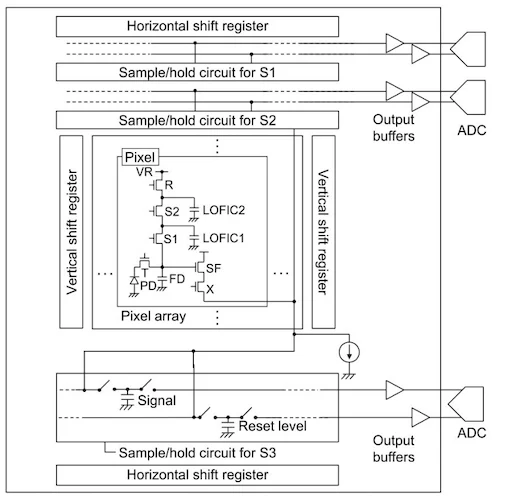
LOFIC technology in a CMOS image sensor. Image used courtesy of Image Sensors World
Omnivision’s TheiaCel LFM sensor technology overcomes this issue by using lateral overflow integration capacitors (LOFIC). LOIFC technology allows the sensor to collect more signal electrons in each pixel via a large storage capacitor without saturating the channel. In this manner, LFM can be implemented more aggressively without compromising low-light signal-to-noise ratios (SNR) or dynamic range.
