
Introduction: The Backbone of Reliable Memory Systems
Looking for high-performance DDR memory that fits industrial, embedded, or consumer-grade applications? Micron MT Series memory chips could be exactly what you need. The MT series, that is known for its scalability and reliability. It is essential to current electronics, which range from AI edge devices to high-speed data acquisition systems. Gaining an in-depth knowledge of these components will be essential for everyone who works in embedded systems design or hardware engineering.
This blog appears into great detail about the architecture, performance benchmarks, and practical applications of the Micron MT Series memory chips. It includes an extensive evaluation of the MT41K256M16TW-107:P datasheet and a technical review of the MT40A1G16TB-062E:F memory. We will look at each part’s timing parameters, I/O configurations, signal integrity requirements, and JEDEC compliance to make sure that engineers have the accurate data they need for design and procurement.
Supported by first-hand knowledge and data-driven insights, this article is a component-level reference designed for professionals who require accuracy and clarity, not just a product summary. This guide offers the reliable technical depth you won’t find in normal distributor listings if you’re sourcing or designing with Micron MT DDR3L & DDR4 Memory Chips.

Component Spotlight: Micron MT DDR3L & DDR4 Memory Chips
Micron’s advanced DDR solutions continue to set industry standards in the rapidly evolving memory technology environment. The MT series, designed for speed, power efficiency, and durability in industrial and embedded environments. The primary focus of this article on Micron memory components. These memory chips are well-known for their flexible I/O architectures, robust thermal performance, and JEDEC compliance.
The MT41K series DDR3L, in particular the MT41K256M16TW-107:P, is at the top of this lineup. OEMs creating low-power, high volumes applications like routers, automation controllers, and test equipment. Favor it because it strikes a balance between low voltage operation (1.35V), high bandwidth, and backward compatibility. Its enhanced restart cycles and CAS latency deliver consistent performance over a broad temperature range.
MT40A DDR4 memory chips, including the MT40A512M16TB-062E are of special interest for future applications that require significantly higher data rates and density. These components, especially ideal for data-driven edge computing, industrial AI modules, and rugged systems with embedded features, are built on top of the cutting-edge DDR4 architecture. It support faster speeds (up to 3200 MT/s), enhanced bank group access, and enhanced signal integrity.
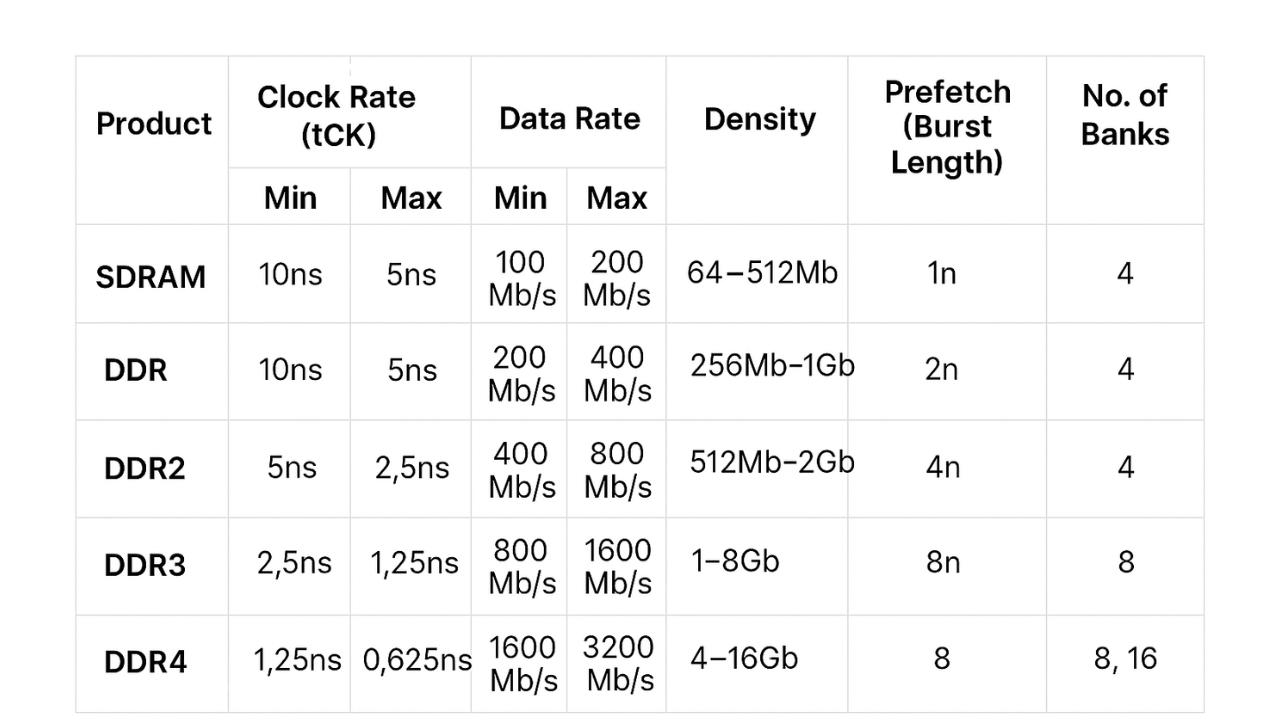
Technical Deep Dive: Key Parameters That Matter
When choosing DDR memory for industrial or embedded use, it’s important to know the basic electrical and physical specs. Let’s look at the MT40A512M16TB-062E:R specs next to those of other MT series parts that are similar to it to help engineers make smart, performance-based choices:
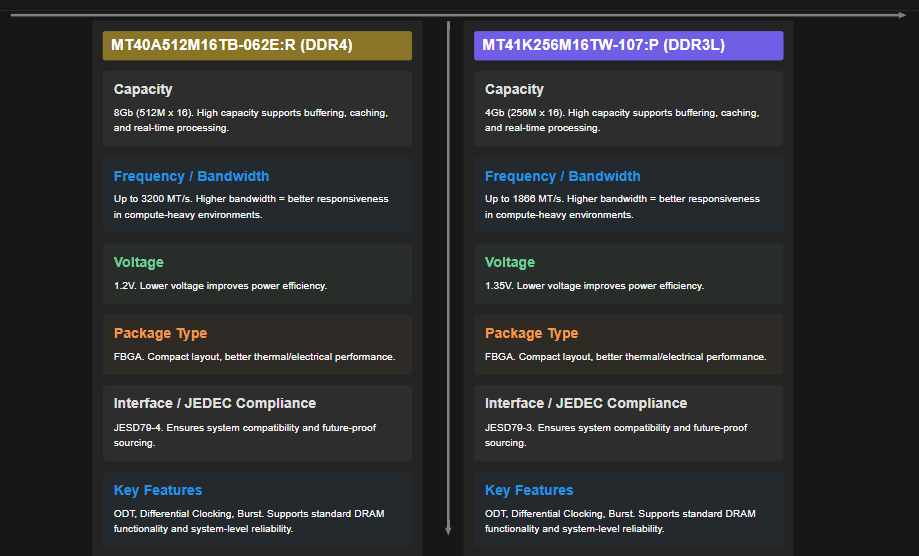
Signal Integrity Considerations
High-speed DDR memory systems are particularly vulnerable to signal integrity challenges, such as reflection, crosstalk, and timing skew, especially at data rates beyond 1866 MT/s. To mitigate these, Micron integrates design features such as:
- On-Die Termination (ODT) to minimize signal reflection across transmission lines.
- ZQ Calibration for precise impedance matching.
- Output Driver Calibration (OCD) to fine-tune I/O drive strength.
These features collectively ensure cleaner signal transitions, reduced EMI, and stable timing performance across a range of PCB topologies, making MT-series chips like the MT40A512M16TB-062E:R highly reliable even in dense, multilayer board designs.
Unique Features and Benefits: Micron MT DDR3L & DDR4 Memory Chips
Engineers always opt for Micron DDR memory due to its low power consumption, close electrical tolerances, and ruggedness in extreme environments. In actual design reviews, Micron MT DDR3L & DDR4 Memory Chips are known for their reliability-cum-performance balance and are thus the optimal choice for embedded, industrial, and automotive use. In this examination of Micron memory chips, the way properties such as effective thermal management and JEDEC-compliant design make up for reliable system performance is emphasized.
Micron MT DDR3L & DDR4 Memory Chips has a broad DDR RAM temperature range and reliability profile, commonly running –40°C to +95°C. Such a capability enables application in challenging environments—an outdoor IoT module, under-hood automotive ECU, or factory-floor edge controller with continuous vibration and temperature cycling.
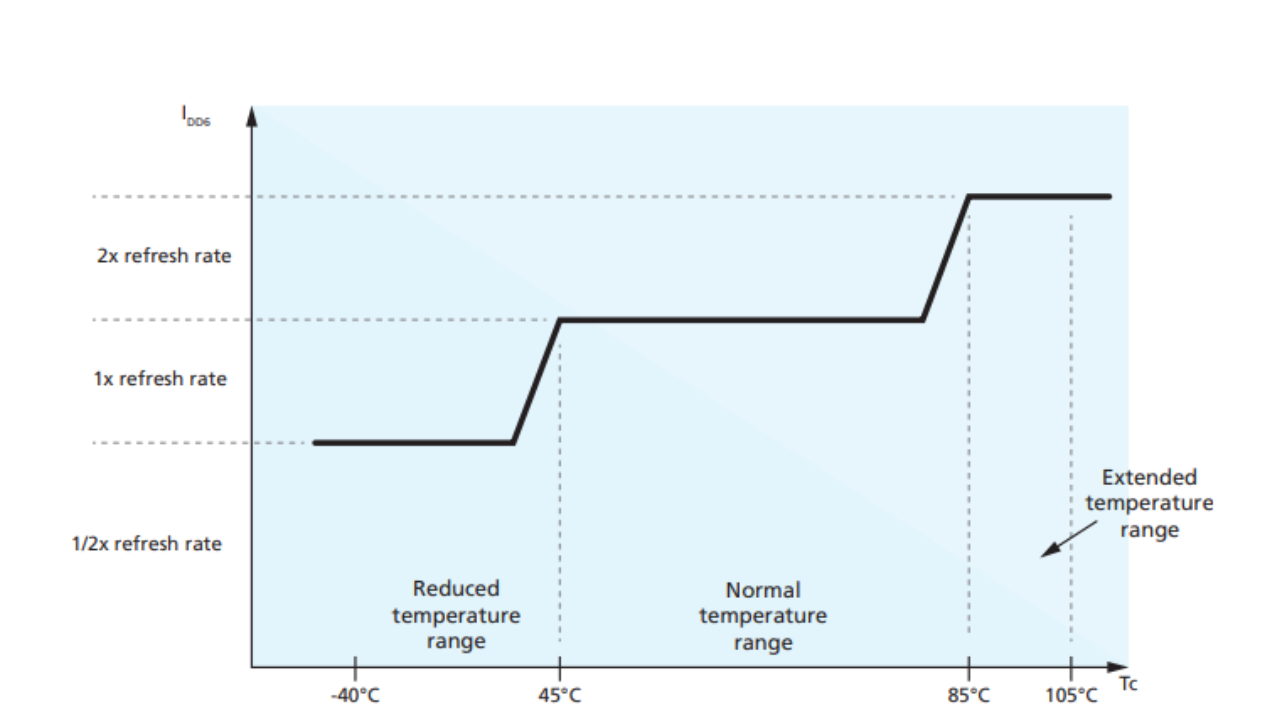
In addition, Micron’s low-power DDR memory features like 1.2V operation for DDR4, and 1.35V for DDR3L allow these components to be best suited for energy-efficient designs. Whether the objective is to conserve heat in a passive cooling scenario or conserve battery life in a mobile system. These efficiencies have a measurable impact on system life and efficiency of performance.
Use Cases and Real-World Applications
A large number of industrial and embedded systems trust Micron MT DDR3L & DDR4 Memory Chips. They are a reputable foundation in challenging circumstances. Because they have an excellent performance, use little power, and follow JEDEC standards.
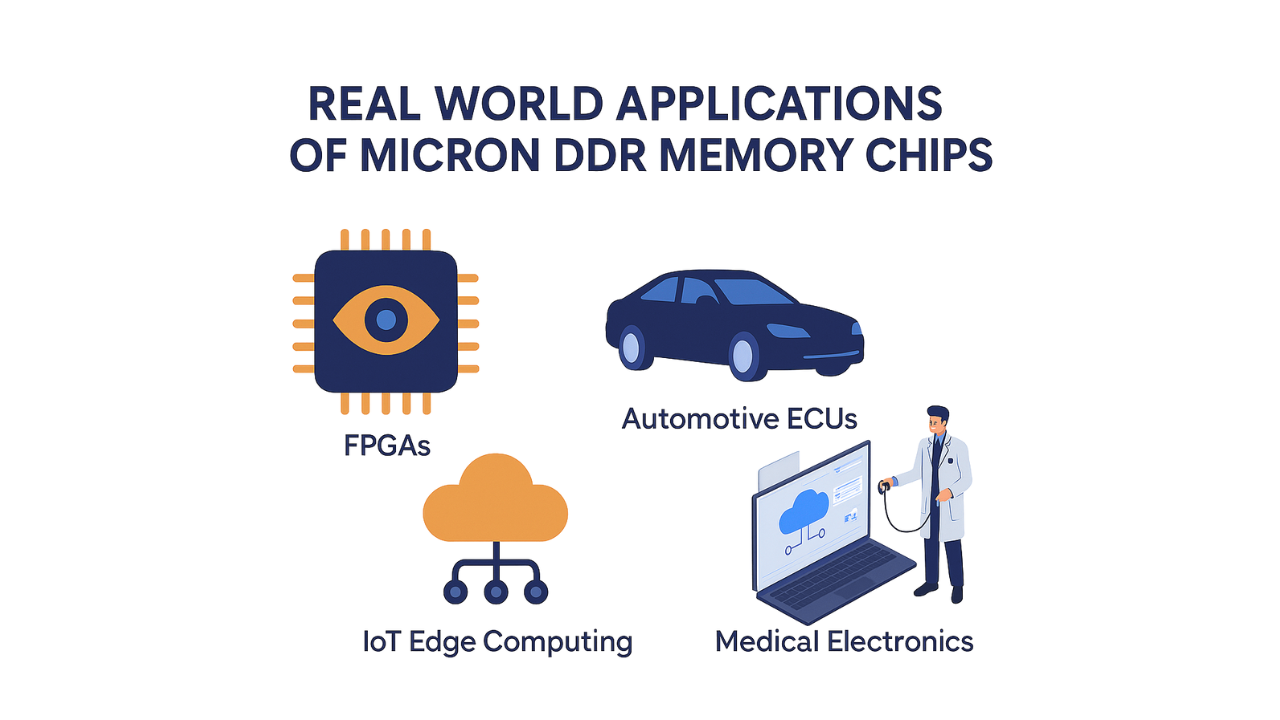
- FPGAs: MT memory for FPGAs gives programmable logic systems the high-speed bandwidth and low-latency performance they need. Micron’s DDR memory makes sure that signals stay clear even when they’re under a lot of stress, like when they’re doing real-time video processing or high-frequency trading algorithms.
Automotive ECUs: Micron MT DDR3L & DDR4 Memory Chips for automotive electronic components is essential for engine control, ADAS systems, and infotainment systems in cars. These memory chips are made to meet strict AEC-Q100 standards and can handle a wide range of temperatures, making them perfect for automotive ECUs. - IoT Edge Computing: Memory chips in embedded applications such as gateway and smart sensors, need to trade ultra-low power against performance. Micron DDR modules shine in such edge computing applications with aggressive data buffering. And also machine learning inference support without excessive energy consumption.
- Medical Electronics: From portable diagnostic devices to imaging devices, medical electronics require longevity and reliability. Micron’s top-of-the-line DDR memory for industrial designs provides electrostatic discharge (ESD) protection, signal integrity, and lifecycle reliability—essential in life-critical applications.
Selection Guide: Which Micron MT DDR3L & DDR4 Memory Chips Should You Choose?
Choosing the right DDR memory chip for your system is not just about capacity or clock speed – it’s about matching performance, stocking profile, and reliability for your specific application requirements. Below is a brief comparison to help engineers navigate the Micron memory chip selection guide effectively.
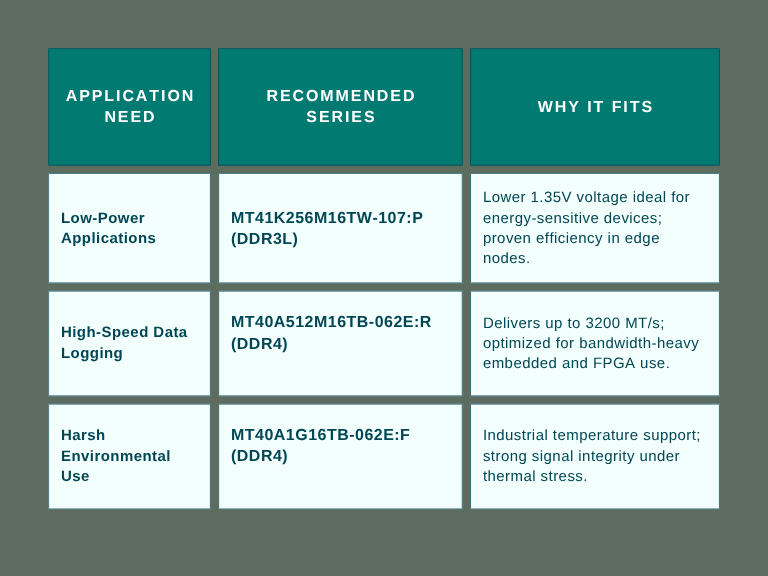
The difference between Micron DDR3 and DDR4 isn’t just that DDR4 devices like the MT40A series are faster and use less voltage (1.2V). DDR3L parts like the MT41K are still the best choice for older systems that need to use very little power.
Think about your system’s thermal envelope, power budget, and bandwidth ceiling if you’re not sure how to pick the right DDR memory chip. Micron’s documentation and alignment with JEDEC make cross-compatibility and long-term availability across both DDR3L and DDR4 families.
Problem-Solution Case Studies
Engineers need to know about real-world integration scenarios in order to make decisions about components. Here are two real-world examples of how Micron MT-series memory chips helped solve important problems in embedded and industrial settings.
Case Study 1: Migrating from Generic DDR to MT40A for Power Efficiency
A medical device maker in the U.S. was having problems with its small diagnostic hardware overheating because the generic DDR4 modules weren’t working right. After looking at their options, the engineering team moved to Micron’s MT40A512M16TB-062E:R, which had the following benefits:
- 1.2V low-power operation
- Superior thermal control
- JEDEC-compliant performance
This migration from DDR3 to Micron’s MT40A512M16TB-062E:R resulted in a measurable 14% reduction in power draw, dropping average consumption from 3.5W to 3.0W under full load conditions. Thermal sensors recorded a 6.5°C decrease in module surface temperature, improving reliability in continuous 24/7 runtime and reducing the need for active cooling
Case Study 2: Resolving Latency Issues in FPGA-Based Control Systems
An industrial automation company had problems with memory latency when they were trying to get data quickly from an FPGA board. After carefully looking at the signals and fixing the Troubleshooting DDR memory performance, engineers replaced their old module with MT41K256M16TW-107:P.
Benefits seen:
- Lower CAS latency for operations that need to happen quickly
- Better timing tolerance with loads that change
- Better compatibility with memory controllers for FPGAs
This switch made jitter a lot less of a problem and made robotic control loops respond in real time much better.
Environmental & Compliance Considerations
When selecting Micron MT Series memory components for mission-critical applications, compliance with industry standards and environmental resilience is just as important as performance. Micron’s MT series memory chips are built with long-term reliability and regulatory alignment in mind.
JEDEC Standards Compliance
The MT41K256M16TW-107:P and MT40A1G16TB-062E:F are two of Micron’s MT series DDR memory chips that completely adhere to JEDEC (Joint Electron Device Engineering Council) requirements, a crucial industry standard.
Why it’s important Long-term product quality, design dependability, and interoperability are all guaranteed by JEDEC conformance. Engineers can more easily connect JEDEC-certified memory with CPUs, FPGAs, and controllers since the components meet defined electrical and timing criteria.
By undergoing specified testing procedures, memory chips lower the possibility of incompatibility or field failure. Without sacrificing signal integrity or performance, it permits scalability across projects, consistent sourcing, and quicker development cycles.
JEDEC standards are essential to trusted design in high-reliability applications, such as medical electronics or automotive systems.
RoHS & REACH Certifications
Micron memory is completely RoHS-compliant DDR memory, which meets international restrictions on toxic substances. It is also REACH compliant, and hence it is safe to use in global supply chains and ecologically regulated markets.
Extended Temperature Operation of Micron MT DDR3L & DDR4 Memory Chips
Engineered for industrial temperature DDR RAM applications, select MT parts support wide operating ranges (e.g., –40°C to +95°C). This is crucial for deployments in automotive ECUs, outdoor IoT systems, and factory automation.
To move from evaluation to implementation, here are your next steps:
- Download Micron datasheets to get detailed electrical specs, timing charts, and signal definitions for the MT41K and MT40A series.
- Contact a Micron-authorized distributor for reliable DDR memory sourcing in the USA, ensuring genuine components and supply-chain confidence.
- Reach out to Flywing-Tech if you need integration support or help selecting the right module for your design. Our team connects you with a memory chip expert for tailored guidance.
Conclusion
This micron MT DDR memory wrap-up highlights why MT41K256M16TW, MT40A512M16TB, and MT40A1G16TB stand out in industrial and built-in applications. MT41K256M16TW is still a reliable option for the DDR3L system where efficiency and legacy are important. Meanwhile, MT40A512M16TB and MT40A1G16TB to support high bandwidth and low voltage of DDR4. To support data intensive use such as FPGA, medical equipment, and car electronics.
Supported by JEDEC standards, industrial thermal stability and compliance with microns for long-term life cycle support. These are the memory solutions engineers to demand the environment. So why choose Micron MT41K or MT40A? Because they provide reliable performance, scalability and craft efficiency-what engineers need for the next generation design.
Frequently Asked Questions (FAQ)
1. What is the difference between Micron MT41K and MT40A series memory chips?
The MT40A series is DDR4 memory with greater performance, higher bandwidth, and power efficiency, whereas the MT41K series is DDR3L SDRAM tailored for low-voltage applications (1.35V). Additionally, MT40A chips adhere to the more recent JEDEC DDR4 specification.
2. Can MT41K256M16TW-107:P be used in industrial environments?
es. This chip is appropriate for embedded, automotive, and industrial applications that demand great durability because it comes in industrial temperature ranges (such as -40°C to +95°C).
3. What is the capacity and speed of MT40A512M16TB-062E:R?
This device provides data rates of up to 3200 MT/s and has a density of 512Mb x 16. It adheres to JEDEC DDR4 requirements and runs at 1.2V.
4. Is MT40A1G16TB-062E:F compatible with FPGA boards?
Yes, FPGA-based systems make extensive use of it. Just make sure your FPGA controller satisfies the voltage/frequency requirements and supports DDR4 signaling.
5.What is FBGA packaging, and why is it used in these chips?
On PCBs, FBGA (Fine-pitch Ball Grid Array) enables high-density, compact mounting. Because of its exceptional thermal performance and low inductance, it is perfect for high-speed, space-constrained applications.
