
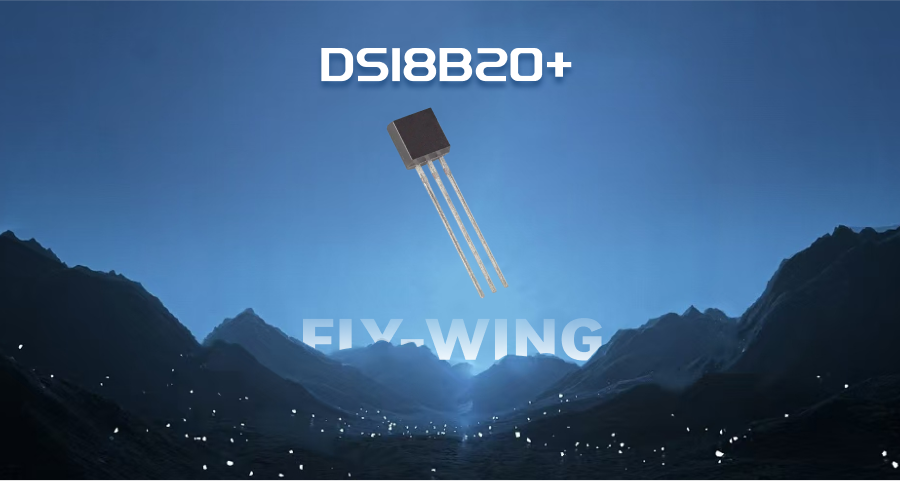
The DS18B20+ is a digital temperature sensor offering 9-12 bit resolution with ±0.5°C accuracy (-10°C to +85°C) and a -55°C to +125°C range. It uses a 1-Wire interface, enabling single-pin communication with microcontrollers, supports parasitic power mode, and allows multiple sensors on one bus via unique 64-bit serial codes. Ideal for HVAC, industrial systems, and IoT, it eliminates analog signal conditioning needs .
How Does the DS18B20+ Achieve High Accuracy and Wide Temperature Range?
The DS18B20+ integrates a MEMS-based temperature sensor with a 12-bit ADC, providing resolutions down to 0.0625°C. Key features:
-
Calibration: Factory-trimmed for ±0.5°C accuracy in critical ranges .
-
Programmable Resolution: Adjustable from 9-bit (0.5°C) to 12-bit (0.0625°C) for speed/accuracy trade-offs .
Chart: DS18B20+ Temperature Performance
| Parameter | Specification |
|---|---|
| Range | -55°C to +125°C |
| Accuracy (±0.5°C) | -10°C to +85°C |
| Resolution | 9-12 bit (user-selectable) |
Why Is the DS18B20+’s 1-Wire Interface Unique for Sensor Networks?
The 1-Wire protocol minimizes wiring by combining data and power (parasitic mode) on one line. Advantages:
-
Multi-Drop Capability: Host up to 8 sensors on a single bus, each addressable via 64-bit ROM codes .
-
Simplified PCB Design: Reduces I/O pin usage vs. I2C/SPI .
Chart: 1-Wire vs. Traditional Interfaces
| Interface | Pins Required | Max Sensors/Bus |
|---|---|---|
| 1-Wire | 1 | 8 |
| I2C | 2 | 128 |
| SPI | 4 | Unlimited |
What Are the Key Applications of the DS18B20+ Sensor?
-
HVAC Systems: Multi-zone temperature monitoring .
-
Industrial Automation: Machinery overheating detection .
-
Medical Devices: Precision patient temperature logging .
-
Food Storage: Cold chain compliance tracking .
Buying Tips
When sourcing the DS18B20+:
-
Verify Authenticity: Counterfeit sensors often lack ±0.5°C calibration—purchase from authorized distributors like Fly-Wing Technology.
-
Check Packaging: TO-92 (3-pin) is standard; SOIC-8 suits PCB mounting .
-
Prioritize Parasitic Mode Support: Ensures compatibility with legacy 1-Wire systems .
Electronic Components Expert Views
*”The DS18B20+’s blend of 12-bit resolution and 1-Wire simplicity makes it unbeatable for distributed sensing. However, bus capacitance limits multi-drop setups—keep cable lengths under 3m for reliable communication.”* — Senior Engineer, Fly-Wing Technology.
FAQ
Q: Can the DS18B20+ measure temperatures below -55°C?
A: No, its operational limit is -55°C; exceeding this may damage the sensor .
Q: How does parasitic power mode work?
A: The sensor draws power from the data line via a charge pump, eliminating external VDD .
Among numerous temperature sensors, the DS18B20+ stands out due to its high precision, low power consumption, and single-wire interface. It has become widely used in industrial, home, and scientific research applications. This article provides a detailed introduction to the functions, features, and technical specifications of the DS18B20+.
I. Overview of the Chip
The DS18B20+ is a high-precision digital temperature sensor produced by Maxim Integrated. It features a single-wire interface and supports programmable temperature resolution from 9 to 12 bits. The sensor can directly output digital temperature signals and communicate with microcontrollers via a single-wire protocol, simplifying hardware design.
II. Functional Features
1. High-Precision Temperature Measurement
The DS18B20+ measures temperature within the range of -55°C to +125°C, with an accuracy of ±0.5°C between -10°C and +85°C. It offers programmable resolution from 9 to 12 bits, corresponding to temperature resolutions of 0.5°C, 0.25°C, 0.125°C, and 0.0625°C, respectively.
2. Single-Wire Interface
The DS18B20+ features a unique single-wire interface, allowing bidirectional communication with microcontrollers over a single data line. This interface design significantly simplifies hardware connections and reduces system complexity.
3. Multi-Point Networking Capability
The DS18B20+ supports multi-point networking, where multiple sensors can be connected in parallel on the same bus for multi-point temperature measurement. Each sensor has a unique 64-bit serial number for easy identification and management.
4. Low-Power Design
The DS18B20+ enters a low-power sleep mode when inactive, conserving energy. It also supports parasitic power mode, allowing it to operate without an external power supply.
5. Power-Loss Protection
The DS18B20+ includes an EEPROM to store temperature resolution and alarm threshold settings. These settings remain intact even during power loss.
6. Temperature Alarm Function
Users can set high and low-temperature alarm thresholds. The sensor triggers an alarm signal when the temperature exceeds the set range.
III. Applications
The versatility and reliability of the DS18B20+ make it suitable for a variety of applications:
- Smart HomeUsed for indoor temperature monitoring and regulation, supporting real-time temperature reading via home automation systems.
- Industrial AutomationUsed to monitor equipment temperatures to prevent overheating and ensure stable production environments.
- Agricultural GreenhousesUsed for real-time monitoring of greenhouse temperatures to ensure optimal growing conditions for crops.
- Medical EquipmentUsed for monitoring patient body temperatures and the operating temperatures of medical devices.
- Data Centers and Server RoomsUsed to monitor room temperatures to ensure equipment operates within a safe temperature range.
IV. Technical Specifications
V. Conclusion
The DS18B20+ is a powerful and easy-to-use digital temperature sensor. Its high precision, low power consumption, and single-wire interface design make it widely used in smart homes, industrial automation, agricultural greenhouses, and medical equipment. It simplifies hardware design and efficiently monitors temperatures through multi-point networking capabilities. Whether for hobbyists or professionals, the DS18B20+ is an ideal choice for temperature measurement.
