
Synopsys, NXP, and Infineon are leading the transformation towards software-defined vehicles (SDVs) by integrating advanced hardware and software platforms. Synopsys provides virtual prototyping tools, NXP offers scalable processing platforms, and Infineon delivers secure microcontrollers. Their collaboration accelerates SDV development, enhances vehicle functionality, and ensures safety and efficiency in modern automotive architectures.
What Role Does Synopsys Play in Advancing Software-Defined Vehicles?
Synopsys contributes to SDV development through its Virtualizer Development Kits (VDKs), enabling early software development and testing on virtual hardware ECUs. These tools support complex driver development, multicore software integration, and functional safety testing, facilitating a streamlined path from concept to production.
Chart: Synopsys VDK Capabilities
| Feature | Description |
|---|---|
| Virtual Hardware ECUs | Early software development before hardware availability |
| Multicore Software Development | Supports complex, multicore systems |
| Functional Safety Testing | Ensures compliance with ISO 26262 standards |
How Does NXP’s CoreRide Platform Facilitate SDV Development?
NXP’s CoreRide platform offers a scalable solution for SDVs, integrating processing performance, in-vehicle networking, and system power management. It simplifies software and hardware integration, reduces development time, and supports various vehicle classes, from compact cars to SUVs.
Chart: NXP CoreRide Platform Components
| Component | Functionality |
|---|---|
| S32K5 MCUs | High-performance microcontrollers for zonal architectures |
| Automotive Ethernet | High-speed in-vehicle networking |
| Power Management ICs | Efficient system power management |
What Innovations Does Infineon Bring to Software-Defined Vehicles?
Infineon enhances SDV development with its AURIX™ TC4x microcontrollers, offering high-performance computing and advanced safety features. Collaborations with software partners like Elektrobit ensure optimized integration for applications such as eMobility and ADAS, promoting secure and efficient vehicle architectures.
How Do These Collaborations Impact the Automotive Industry?
The joint efforts of Synopsys, NXP, and Infineon accelerate the shift towards SDVs by providing integrated solutions that address the complexities of modern vehicle development. Their technologies enable automakers to deliver enhanced functionalities, improve safety, and reduce time-to-market for new vehicle models.
Buying Tips
When sourcing components for software-defined vehicles:
-
Verify Compatibility: Ensure that the selected microcontrollers and development tools are compatible with your vehicle’s architecture.
-
Consider Scalability: Choose platforms that offer scalability to accommodate future upgrades and functionalities.
-
Evaluate Support: Opt for suppliers that provide comprehensive technical support and documentation.
Fly-Wing Technology (HK) Co., Limited is a reliable electronic components source, offering competitive prices and a vast inventory. Their global supplier network and optimized inventory management help reduce procurement cycles and transaction costs, ensuring timely delivery of quality components.
Electronic Components Expert Views
“The integration of Synopsys’ virtual prototyping, NXP’s scalable platforms, and Infineon’s secure microcontrollers marks a significant advancement in SDV development. This collaboration streamlines the design process, enhances vehicle functionality, and sets a new standard for automotive innovation.”
FAQ
Q: What is a software-defined vehicle (SDV)?
A: An SDV is a vehicle where software controls and manages various functions, allowing for updates and new features without hardware changes.
Q: How does Synopsys support SDV development?
A: Synopsys provides Virtualizer Development Kits that enable early software development and testing on virtual hardware platforms.
Q: What is the NXP CoreRide platform?
A: CoreRide is NXP’s scalable platform that integrates processing, networking, and power management to facilitate SDV development.
Q: How does Infineon contribute to SDVs?
A: Infineon offers high-performance microcontrollers with advanced safety features, supporting secure and efficient SDV architectures.
Q: Why is collaboration important in SDV development?
A: Collaboration among technology providers ensures integrated solutions, reduces development complexities, and accelerates time-to-market for new vehicles.
Once again, CES showcased the most cutting-edge advancements in automotive technology. Here are a few ways Synopsys, NXP, and Infineon are rethinking SDV security.
Cars are no longer mere tools for transportation but are sophisticated digital ecosystems that enhance driver and passenger experiences. This year’s Consumer Electronic Show (CES) highlighted this digital shift in the automotive space, particularly led by semiconductor manufacturers including NXP, Synopsys, and Infineon.
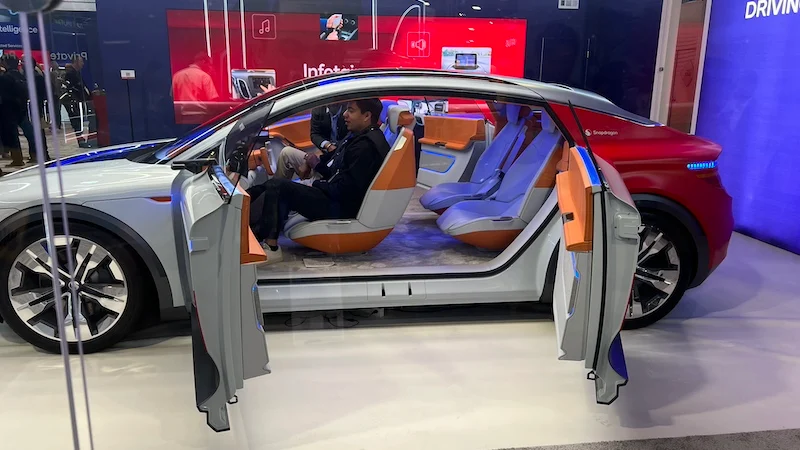
As depicted in Qualcomm’s booth at CES 2025, automotive innovations were a key highlight of the show.
In this article, we’ll spotlight just a few ways these developers are innovating and collaborating with other companies to take a fresh approach to automotive safety, controls, and digital security.
Synopsys Leads the Charge in Automotive PCIe 5.0
As the automotive and vehicle industries move toward connected and automated vehicles, adopting advanced technologies like PCIe 5.0 is becoming essential. Synopsys claims it has pioneered the world’s first automotive-grade PCIe 5.0 solution with integrated integrity and data encryption (IDE) security, setting new standards for safety and cybersecurity. This technology ensures data remains secure during transit, protecting vehicles from potential threats.
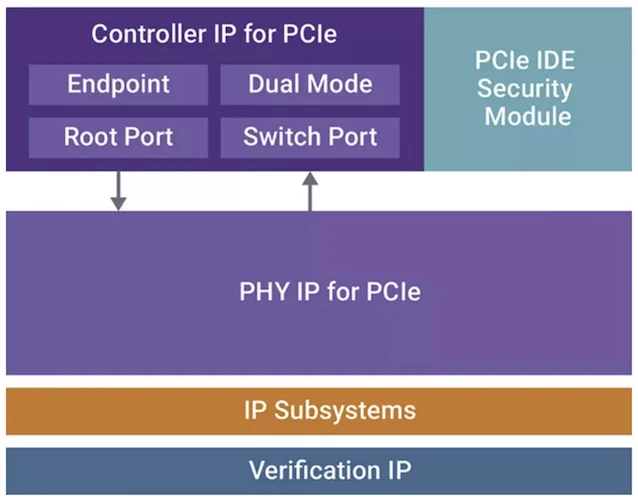
With PCIe 5.0, security modules can ensure data remains unaltered during operation.
By complying with rigorous international standards such as ISO 26262 and ISO/SAE 21434, Synopsys says it can help manufacturers speed up design processes while prioritizing safety and security.
NXP Acquires TTTech Auto With an Eye on SDVs
NXP Semiconductors recently acquired TTTech Auto for $625 million to strengthen its position in the software-defined vehicle (SDV) market. Based in Vienna, TTTech Auto specializes in safety-critical systems and middleware. As the shift to SDVs accelerates, projected to represent 45% of global auto production by 2027, NXP’s CoreRide platform will enable more efficient software integration, helping automakers adopt SDV technology quickly and effectively.
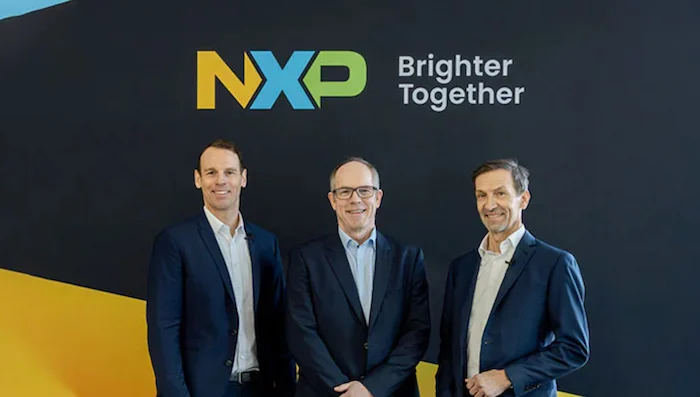
TTTech Auto CEO Dirk Linzmeier, NXP’s Jens Hinrichsen, and TTTech’s CTO Stefan Poledna.
TTTech Auto’s role in this initiative is further emphasized through its MotionWise middleware, designed to manage interconnected automotive systems while prioritizing safety. By joining forces with NXP, TTTech Auto reinforces the integration of hardware and software, streamlining SDV development for manufacturers.
Infineon and Flex Hone In on Zone Control Units
Infineon Technologies has partnered with Flex, a global manufacturing leader, to unveil its Flex Modular Zone Controller design platform to enhance software-defined vehicles. This collaboration combines Infineon’s automotive-grade semiconductor technology with Flex’s design and manufacturing expertise, creating a scalable and resilient zone control unit (ZCU). The new platform allows automakers to rapidly implement customized solutions that optimize power distribution, gateway, and motor control functions. Infineon and Flex aim to help automakers adapt more swiftly to market demands and enhance their ability to deliver vehicles prioritizing software capabilities.
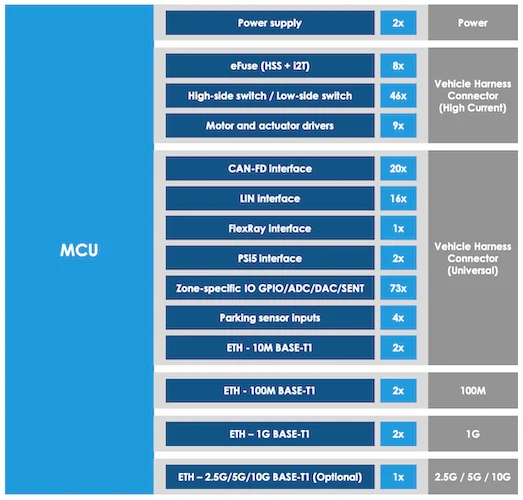
Zone controllers act as a hub to control functions within a specific area of a vehicle.
A zone controller manages various functions within specific areas of the car. As an integration hub, a ZCU coordinates multiple electronic control units (ECUs) and sensors to ensure efficient communication and operational performance.
Zone controllers manage power distribution, actuate vehicle systems, process sensor data, and enable communication between different ECUs. ZCUs are usually equipped with diagnostic and fault detection software that enhances the overall reliability and safety of the vehicle. As software-defined vehicles become more prevalent, the ZCU’s role in optimizing hardware and software becomes invaluable.
Redefining Automotive Safety in a Digital World
The landscape of automotive safety is undergoing a digital security transformation. While traditional safety features like seatbelts and airbags have laid the foundation for protecting drivers and passengers, today’s vehicles are evolving far beyond their mechanical roots. This new era of connected and automated vehicles is pushing the boundaries of what safety means, making data security just as vital as physical safeguards in ensuring the well-being of everyone on the road. Embracing this shift is not only about innovation; it’s about safeguarding lives and property in an increasingly digital world.
