
In the relentless pursuit of miniaturization and enhanced functionality, three new passive components have emerged, setting new benchmarks in high-performance electronics. These innovations from TDK, Kyocera, and Littelfuse not only push the boundaries of size and power but also redefine the possibilities for compact electronic designs.
What Are the Key Innovations in These New Passive Components?
-
TDK’s Advanced Capacitors: TDK has introduced capacitors that offer higher capacitance in smaller packages, addressing the need for more power storage without increasing size.
-
Kyocera’s Miniaturized Inductors: Kyocera’s inductors are designed to handle higher currents while maintaining a compact form factor, crucial for space-constrained applications.
-
Littelfuse’s Enhanced Resistors: Littelfuse has developed resistors with improved tolerance and stability, ensuring consistent performance in demanding environments.
How Do These Components Enhance System Performance?
Each component contributes to the overall system by improving efficiency, reducing power loss, and enabling faster signal processing. Their compact sizes allow for more components to be integrated into a smaller space, leading to more powerful and efficient electronic systems.
Why Is Miniaturization Crucial in Modern Electronics?
As devices become more portable and multifunctional, the demand for smaller, more efficient components grows. Miniaturization allows for lighter, more compact devices without sacrificing performance, meeting the needs of modern consumers and industries.
Where Can These Components Be Applied?
These advanced passive components are ideal for applications in smartphones, wearable devices, medical equipment, automotive electronics, and other areas where space and performance are critical.
Who Should Consider Integrating These Components?
Engineers and designers working on cutting-edge electronic products should consider integrating these components to achieve superior performance and meet the demands of modern applications.
When Should These Components Be Incorporated into Designs?
Incorporating these components early in the design process allows for optimal integration and maximizes the benefits of their advanced features.
Does the Integration of These Components Affect Cost?
While advanced components may come at a higher initial cost, their benefits in performance and efficiency can lead to cost savings in the long term through reduced power consumption and improved reliability.
Are There Any Compatibility Issues with Existing Systems?
These components are designed to be compatible with existing systems, but it’s essential to verify their specifications to ensure seamless integration into current designs.
Can These Components Be Sourced from Multiple Suppliers?
Yes, these components are available from various authorized distributors, ensuring a steady supply for manufacturers and designers.
Could These Innovations Lead to New Industry Standards?
The advancements presented by these components have the potential to set new industry standards for performance, efficiency, and miniaturization in passive components.
Buying Tips
When sourcing advanced passive components like those from TDK, Kyocera, and Littelfuse, consider the following:
-
Verify Specifications: Ensure the components meet the specific requirements of your application.
-
Check Compatibility: Confirm that the components are compatible with existing systems and designs.
-
Source from Authorized Distributors: Purchase from reputable sources to guarantee authenticity and quality.
-
Consider Long-Term Availability: Choose components that are widely available to avoid supply chain issues.
-
Evaluate Cost vs. Benefit: Weigh the initial cost against the long-term performance and efficiency gains.
By following these tips, you can ensure the successful integration of these advanced passive components into your electronic designs.
Electronic Components Expert Views
“The introduction of these compact, high-performance passive components marks a significant leap forward in electronic design. Their integration will undoubtedly lead to more efficient and powerful devices across various industries.”
FAQ
Q: What makes these new passive components stand out?
A: Their combination of miniaturization and enhanced performance sets them apart in the market.
Q: Are these components suitable for all electronic applications?
A: While versatile, it’s essential to assess their specifications to ensure suitability for specific applications.
Q: How do these components impact device performance?
A: They contribute to improved efficiency, reduced power loss, and faster signal processing.
Q: Where can I purchase these components?
A: They are available through various authorized distributors and online platforms.
Q: When should I consider integrating these components into my designs?
A: Early integration during the design phase allows for optimal performance and efficiency.
New passive components from TDK, Kyocera, and Littelfuse push the boundaries of size, power, and functionality.
While big silicon steals the spotlight in the tech realm, passive components remain indispensable. In this review, we spotlight three cutting-edge passive components from TDK, Kyocera, and Littelfuse, each pushing boundaries within their category. These innovative parts are designed to revolutionize both size and functionality.
TDK Introduces the ‘Smallest Thin-Film Power Inductor’
TDK boasts the creation of the smallest inductor for power circuits, measuring just 0.80 x 0.45 x 0.65 mm. The innovative PLE856C Series thin-film inductor leverages low-loss magnetic material and high-precision internal electrode structuring to achieve top-tier performance within the industry’s most compact footprint.
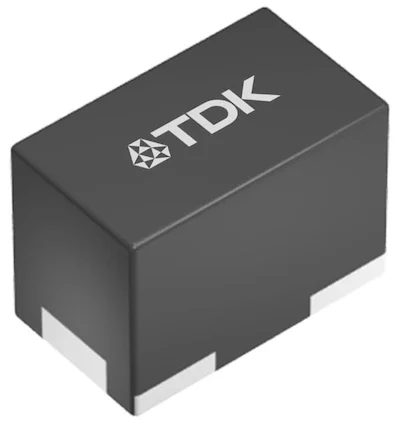
TDK film PLE856C series inductor at 0.80 mm x 0.45 mm x 0.65 mm.
The new inductors, featuring values ranging from 470 nH to 1.5 μH, are tailored for designs where space is limited but performance excellence is non-negotiable. Ideal applications include wireless stereo earbuds, smartwatches, AR/VR devices, compact power supply modules, and small communication modules.
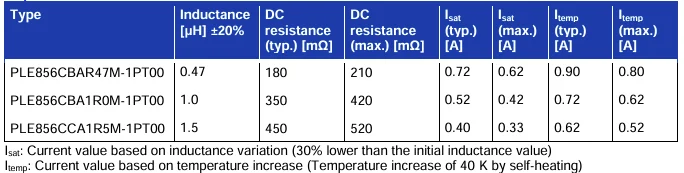
Key specifications for PLE856C Series inductors
While inductors often face obstacles to miniaturization, these inductors feature a 40% smaller mounted area and a 50% lower volume over TDK’s prior small inductor series.、
Kyocera Resistors Bring Higher Power to Small Packages
Kyocera has recently unveiled the “industry’s highest power-rated 0603 resistor,” a new addition to its CR series of resistors.

Kyocera’s 2.6-W, high-frequency resistor in a 0603-package
Kyocera’s CR series resistors, compliant with RoHS and MIL-PRF-55342 standards and produced under ISO-9001 regulations, cater to specialized high-frequency RF applications. The latest addition to this series is the industry’s highest power-rated 0603 resistor, boasting an impressive 2.6 W rating—unparalleled for its package size.
This enhanced power rating is achieved through the use of a high-thermally conductive substrate and an expanded heat sink grounding area. Available in standard values of 50 Ω and 100 Ω with 5% or 2% precision, these non-magnetic resistors feature thin-film aluminum nitride substrates and silver terminals.
Suited for applications in high-power RF amplifiers, instrumentation, test and measurement, communications, and defense industries, these resistors can also serve as dummy loads, power measurement shunts, and resistive baluns for impedance matching. The CR10603TxxxxJ resistors, part of a high-power surface mount line that spans from the new 2.6-W 0603 package to a 250-W 3737 package, enable unprecedented miniaturization of RF and power devices.
Littelfuse’s Diodes Protect SiC MOSFET Gate Drivers
Littelfuse has announced a new series of TVS diodes designed for protection circuits surrounding silicon carbide (SiC) MOSFET gate drivers.
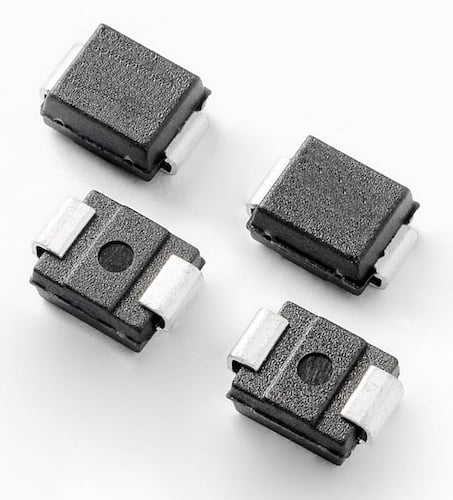
Littelfuse’s TPSMB Asymmetrical TVS Diode Series.
As the demands on charging circuits, inverters, and other power systems escalate, so must the supporting and primary active components. To meet these challenges, Littelfuse has introduced its TPSMB Asymmetrical TVS Diode Series. SiC MOSFETs necessitate clamping circuits between the gate and source for robust overvoltage and reverse surge protection. In high-power applications, including most SiC circuits, a blend of Zener and TVS diodes safeguards the MOSFET against both negative and positive surge currents.
An asymmetrical TVS diode seamlessly integrates the functionalities of both a Zener diode and a TVS diode into a single package. Given SiC MOSFETs’ specific negative and positive gate voltage ratings and requirements, the traditional approach of using a Zener and TVS in series for gate protection is now streamlined with an asymmetric component. This integration not only reduces component count but also enhances circuit design reliability. The asymmetry allows for distinct positive and negative voltage clamping values, making these new TVS diodes ideal for circuits in onboard chargers (OBCs), EV traction inverters, I/O interfaces, and Vcc buses.
Continuing Innovations with Discrete Componentry
By bringing greater capability into smaller packages—like the TDK inductor and Kyocera resistor—or combining multiple duties into a single package, like the Littelfuse asymmetric TVS, passives companies are promoting continued progress in various electronic devices.
