
Electric vehicle (EV) battery test systems are crucial in scaling up production capacity by improving efficiency, ensuring quality, and reducing time-to-market. These systems enable manufacturers to meet the growing demand for EVs while maintaining high standards.
What Are EV Battery Test Systems?
EV battery test systems are specialized equipment used to evaluate the performance, safety, and longevity of batteries used in electric vehicles. They simulate various driving conditions and environmental factors to ensure batteries meet industry standards.
Why Are EV Battery Test Systems Important for Production Capacity?
These test systems play a vital role in enhancing production capacity by:
-
Ensuring Quality Control: By identifying defects early, manufacturers can prevent costly recalls and maintain brand reputation.
-
Accelerating Development Cycles: Rapid testing allows for quicker iterations and faster time-to-market.
-
Optimizing Resource Utilization: Efficient testing processes reduce waste and lower production costs.
How Do EV Battery Test Systems Improve Efficiency?
Modern EV battery test systems integrate advanced technologies to boost efficiency:
-
Automation: Automated testing reduces human error and increases throughput.
-
High-Throughput Testing: Simultaneous testing of multiple batteries speeds up the evaluation process.
-
Data Analytics: Advanced analytics provide insights for continuous improvement.
Which EV Battery Test Systems Are Leading the Market?
Several companies offer state-of-the-art EV battery test systems:
-
Keysight Technologies: Offers scalable solutions for battery testing.
-
Chroma Systems Solutions: Provides customizable test systems for various battery chemistries.
-
EA Elektro-Automatik: Specializes in high-power test systems for EV batteries.
When Should Manufacturers Invest in EV Battery Test Systems?
Investing in EV battery test systems is crucial during:
-
Product Development: To ensure new battery designs meet performance standards.
-
Scale-Up Phases: When increasing production volumes to maintain quality.
-
Regulatory Compliance: To adhere to industry regulations and standards.
Where Are EV Battery Test Systems Deployed?
These systems are deployed in various settings:
-
Manufacturing Plants: Integrated into production lines for real-time testing.
-
Research and Development Labs: Used for experimental battery testing.
-
Quality Assurance Facilities: Ensuring products meet safety and performance criteria.
Does the Integration of EV Battery Test Systems Affect Production Costs?
While the initial investment in test systems can be significant, they lead to:
-
Reduced Defects: Lowering costs associated with returns and repairs.
-
Improved Efficiency: Streamlining production processes and reducing waste.
-
Enhanced Product Quality: Leading to higher customer satisfaction and brand loyalty.
Are There Any Challenges in Implementing EV Battery Test Systems?
Manufacturers may face challenges such as:
-
High Initial Costs: The upfront investment can be substantial.
-
Integration Complexities: Aligning new systems with existing production lines.
-
Skilled Workforce Requirement: Need for trained personnel to operate advanced test systems.
Can EV Battery Test Systems Adapt to Emerging Battery Technologies?
Yes, modern test systems are designed to be adaptable:
-
Software Upgrades: Allowing for compatibility with new battery chemistries.
-
Modular Designs: Facilitating easy hardware modifications.
-
Scalability: Enabling manufacturers to expand testing capabilities as needed.
Buying Tips
When purchasing EV battery test systems, consider:
-
Compatibility: Ensure the system supports the specific battery types used.
-
Scalability: Choose systems that can grow with your production needs.
-
Support and Training: Opt for suppliers that offer comprehensive support and training services.
-
Cost of Ownership: Evaluate not just the purchase price but also maintenance and operational costs.
As a reliable Electronic Components Source, Fly-Wing Technology (HK) Co., Limited has been consistently dedicated to assisting customers to find hard-to-find parts quickly and accurately, as well as acquiring new and original parts at competitive prices since 2012. Historically, shortages and time-critical demands have been associated with high-service sales and exceptionally high prices. Our website offers consistently competitive prices that are in line with or lower than those of other leading online distributors or superstores. We have our own warehouses in Hong Kong, which allows us to purchase electronic components from all over the world and offer powerful competitive prices. We acknowledge the difficulty of sourcing obsolete electronic components and strive to provide the best solutions for our customers. Our company confidently recommends that buyers spend up to 70% of their procurement time finding conventional parts. We have optimized our in-stock inventory and global supplier network to reduce procurement cycles, lower transaction costs, and provide quality electronic components at competitive prices. We believe that this approach will lead to the best results for our clients.
Electronic Components Expert Views
“Integrating advanced EV battery test systems is not just about meeting current demands; it’s about future-proofing production lines to accommodate evolving battery technologies and increasing production scales.”
FAQ
Q: What is an EV battery test system?
A specialized equipment used to evaluate the performance, safety, and longevity of batteries used in electric vehicles.
Q: Why are these test systems important?
They ensure quality control, accelerate development cycles, and optimize resource utilization, enhancing overall production capacity.
Q: How do they improve efficiency?
Through automation, high-throughput testing, and data analytics, leading to faster and more accurate evaluations.
Q: Which companies offer these systems?
Leading providers include Keysight Technologies, Chroma Systems Solutions, and EA Elektro-Automatik.
Q: When should manufacturers invest in them?
During product development, scale-up phases, and to comply with regulatory standards.
Q: Where are these systems deployed?
In manufacturing plants, research and development labs, and quality assurance facilities.
Q: Do they affect production costs?
Yes, by reducing defects, improving efficiency, and enhancing product quality, leading to cost savings.
Q: Are there challenges in implementation?
Challenges include high initial costs, integration complexities, and the need for a skilled workforce.
Q: Can they adapt to new battery technologies?
Modern systems are designed to be adaptable through software upgrades, modular designs, and scalability.
Tektronix EA Elektro-Automatik’s enhanced battery test system conserves production floor space and increases battery testing throughput.
Tektronix EA Elektro-Automatik has released an enhanced version of the EA BTS 10300 battery test system designed to deliver high power density testing capabilities for electric vehicle battery systems.
The EA BTS 10300 is rated to deliver up to 300 kW of test current and is contained within a single 42U-high rack enclosure that consumes just 6.5 square feet of production floor space. Rated to 2000 VDC, the improved battery test platform can source and sink up to 2,400 A per rack, leveraging the company’s bidirectional power supply technologies employing highly efficient and power-dense silicon carbide (SiC)- based switches.
The EA BTS 10300 is designed to help EV battery manufacturers get more from their battery test facilities and increase the pace of their testing operations to meet growing demand from the EV market.
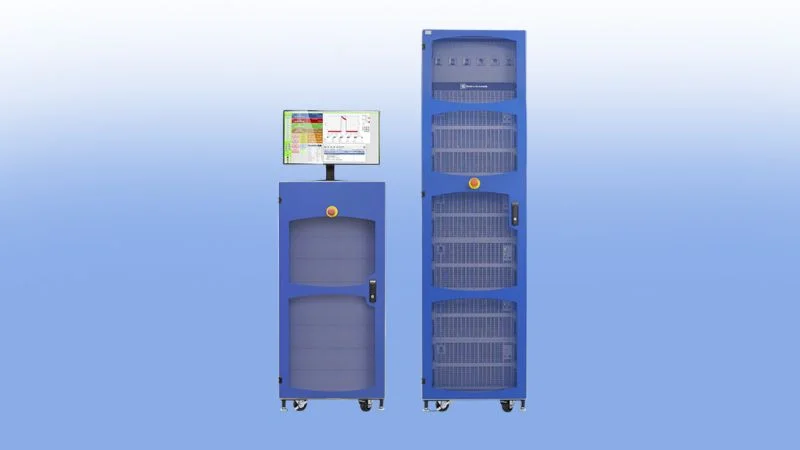
EA BTS 10300 battery testing platform, 30-120 kW (left) and 30-300 kW (right). Image used courtesy of EA Elektro-Automatik
High Power and Cost-Effective Battery Testing
The EA BTS 10300’s high current capabilities are particularly useful for battery pulse testing where much higher current levels are required. Traditionally, this type of high current testing has been performed using custom-built test platforms. Still, with the EA BTS 10300, manufacturers have a more cost-effective commercial off-the-shelf (COTS) solution that can cover the range of battery test protocols, including cycling, drive cycle simulation, insulation resistance testing, and others.
To expand the platform’s power capabilities, multiple racks can be operated in parallel, up to a total power capability of up to 3.84 MW.
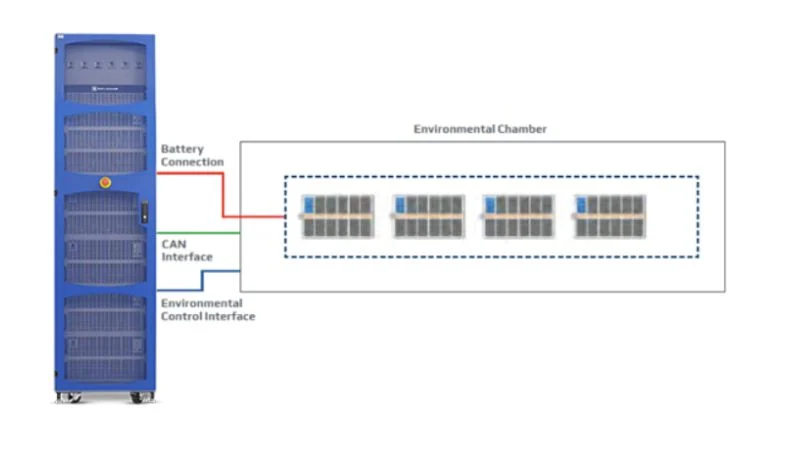
Battery testing with the EA BTS 10300. Image used courtesy of EA Elektro-Automatik
Autoranging Capabilities
The bidirectional supplies used in the EA BTS 10300 feature an autoranging capability, allowing the supply to source or sink its full rated power down to 33% of its operating voltage range. This means the test current adjusts higher or lower in tandem with the test voltage to maintain its full rated power output.
This capability allows testing a much broader range of battery types on a single platform without needing multiple supplies.

Autoranging capabilities of the EA BTS 10300. Image used courtesy of EA Elektro-Automatik
Energy Recycling
The EA BTS 10300’s regenerative capabilities allow it to deliver power back to the grid with up to 96.5% efficiency. This reduces the power requirements for battery testing operations by lowering electricity costs for the test equipment and the HVAC systems needed to remove excess heat from the test environment.
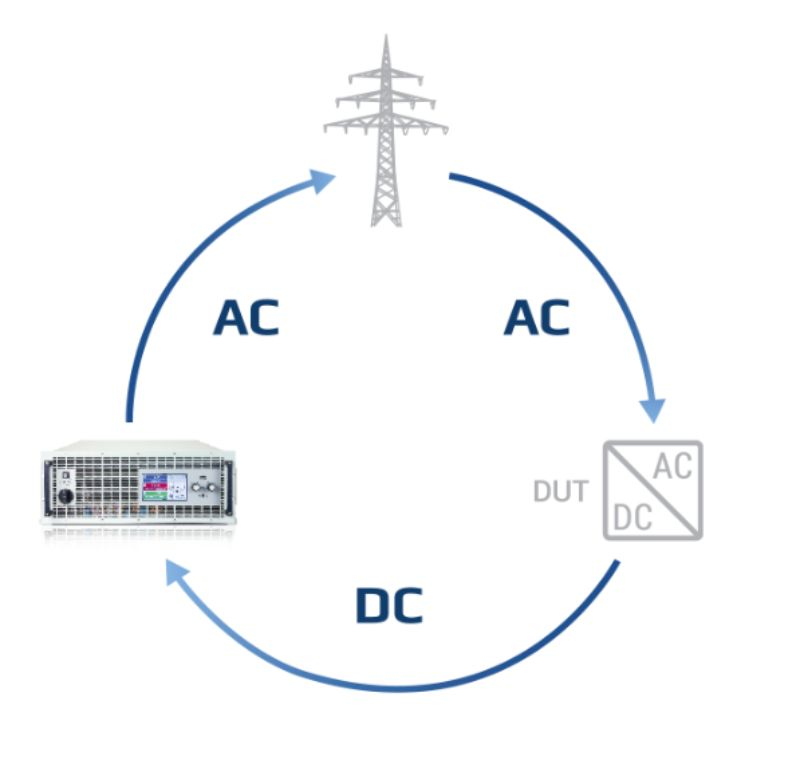
Regenerative energy recovery. Image used courtesy of EA Elektro-Automatik
Tektronix Acquisition of EA Elektro-Automatik
Tektronix has been a bulwark of the Pacific Northwest technology industry since the company’s founding in 1946. Acquired by industrial conglomerate Danaher in 2007, the company was spun back out from the Danaher family in 2016 with a handful of other precision technology companies (Fluke, Qualitrol, Gilbarco, Veeder-Root, Kollmorgan, and Mattco Tools) as Fortiv, a standalone public company.
Tektronix (Fortiv) completed its acquisition of EA Elektro-Automatik in early 2024. The former company now operates within the Tektronix business unit as part of the company’s electronic test and measurement solutions portfolio.
