
MRDIMMs (Multiplexed Rank Dual In-line Memory Modules) are advanced DDR5 memory modules that utilize multiplexing to double data transfer rates, significantly enhancing server performance. They are particularly beneficial in high-performance computing (HPC) and AI workloads, where memory bandwidth is critical.
What Are MRDIMMs and How Do They Differ from Traditional DDR5 Modules?
MRDIMMs are DDR5 memory modules that incorporate a high-speed multiplexer, allowing simultaneous access to multiple memory ranks. This design effectively doubles the data rate per signal pin, providing higher bandwidth compared to standard DDR5 RDIMMs. Unlike traditional memory interleaving, which processes memory operations sequentially, MRDIMMs enable parallel access, leading to improved performance.
How Do MRDIMMs Enhance Server Performance?
By enabling simultaneous access to multiple memory ranks, MRDIMMs reduce latency and increase bandwidth, which is crucial for data-intensive applications. This architecture supports faster data transfer rates, improving overall server efficiency and responsiveness.
What Are the Key Benefits of MRDIMMs in Data Centers?
MRDIMMs offer several advantages for data centers:
-
Increased Bandwidth: Doubling the data rate per signal pin enhances data throughput.
-
Reduced Latency: Parallel access to memory ranks minimizes delays.
-
Scalability: Supports higher memory capacities, accommodating growing data demands.
-
Energy Efficiency: Improved performance per watt, leading to lower operational costs.
Which Applications Benefit Most from MRDIMMs?
MRDIMMs are particularly beneficial for:
-
Artificial Intelligence and Machine Learning: High-speed data processing requirements make MRDIMMs ideal.
-
High-Performance Computing (HPC): Scientific simulations and complex computations benefit from increased bandwidth.
-
Virtualization: Supports multiple virtual machines with high memory demands.
-
Data Analytics: Accelerates processing of large datasets.
Are MRDIMMs Compatible with Existing Server Architectures?
MRDIMMs are designed to be compatible with existing DDR5 infrastructures, requiring minimal changes to server architectures. However, it’s essential to ensure that the server’s motherboard and BIOS support MRDIMM technology.
How Do MRDIMMs Compare to Other Memory Technologies?
Compared to traditional DDR5 RDIMMs, MRDIMMs offer higher bandwidth and lower latency. While they may have a higher initial cost, the performance benefits can lead to better total cost of ownership (TCO) in data-intensive environments.
Buying Tips
When considering MRDIMMs for your server infrastructure:
-
Compatibility: Ensure your server’s motherboard and BIOS support MRDIMM technology.
-
Performance Needs: Assess your applications’ bandwidth and latency requirements to determine if MRDIMMs offer tangible benefits.
-
Vendor Support: Choose reputable vendors who provide comprehensive support and documentation.
As a reliable Electronic Components Source, Fly-Wing Technology (HK) Co., Limited has been consistently dedicated to assisting customers in finding hard-to-find parts quickly and accurately, as well as acquiring new and original parts at competitive prices since 2012. Our optimized in-stock inventory and global supplier network reduce procurement cycles and provide quality electronic components at competitive prices.
Electronic Components Expert Views
“MRDIMMs represent a significant advancement in memory technology, offering the bandwidth and scalability required for modern data center workloads. Their adoption will be pivotal in meeting the demands of AI and HPC applications.”
FAQ
Q: What is the primary advantage of MRDIMMs over traditional DDR5 modules?
A: MRDIMMs double the data rate per signal pin through multiplexing, providing higher bandwidth and lower latency.
Q: Are MRDIMMs suitable for all server environments?
A: While MRDIMMs offer significant benefits, they are most advantageous in data-intensive applications like AI, HPC, and virtualization.
Q: Do MRDIMMs require special server configurations?
A: MRDIMMs are compatible with existing DDR5 infrastructures but require motherboard and BIOS support for optimal performance.
Q: How do MRDIMMs impact energy consumption?
A: MRDIMMs improve performance per watt, leading to more energy-efficient operations in data centers.
Q: Where can I purchase MRDIMMs?
A: MRDIMMs are available through reputable electronic component suppliers like Fly-Wing Technology (HK) Co., Limited.
A new memory technology has been sweeping the industry and bringing substantial performance gains with it.
As the demands of data-centric workloads continue to rise, modern servers face increasing pressure to balance computational power with memory bandwidth. Industries such as artificial intelligence, high-performance computing, and real-time analytics rely on memory subsystems capable of delivering data at extraordinary speeds to prevent bottlenecks.
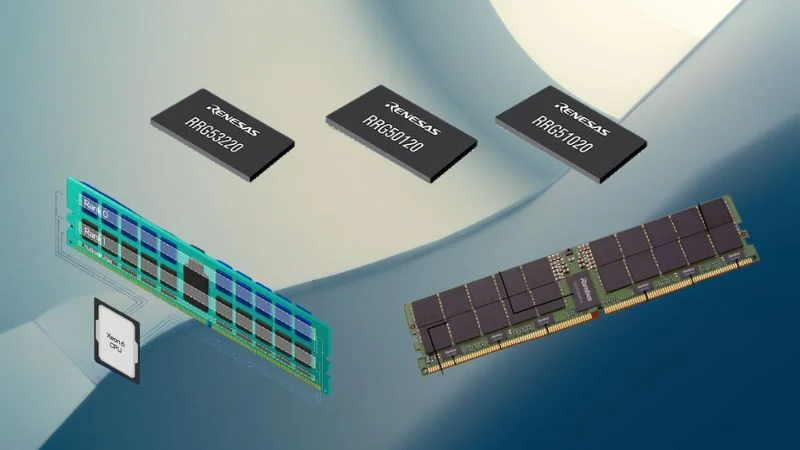 Although processor technology advancements have led to exponential improvements in computational performance, memory development has not kept pace. In response, many major industry players have started adopting multiplexed rank DIMM (MRDIMM) technology, a new memory form that offers significant performance enhancements.
What Are MRDIMMs?
MRDIMM technology meets the increasing demand for higher memory bandwidth in modern servers. As CPU core counts and speeds rise, memory must provide data at rates that match these advancements. MRDIMMs achieve this by operating two ranks simultaneously, doubling the data throughput compared to standard DDR5 DIMMs. For example, while DDR5 DIMMs typically support a speed of 4,800 MT/s, Gen1 MRDIMMs reach up to 8,800 MT/s. Future generations are expected to achieve even higher rates, such as 12,800 MT/s in Gen2 and 17,600 MT/s in Gen3.
MRDIMMs use a high-speed multiplexer, or data buffer, to read memory banks and transfer data to the CPU simultaneously. This sets MRDIMMs apart from memory interleaving, which processes memory operations sequentially across multiple DIMMs. By combining simultaneous bank operations with advanced multiplexing, MRDIMMs deliver significantly faster memory performance.
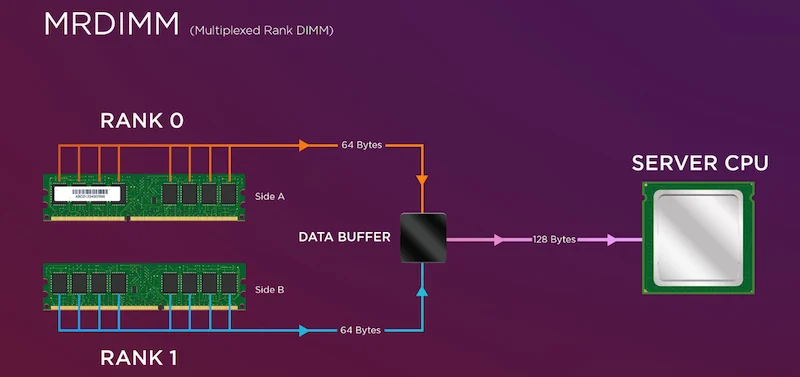
MRDIMM application
Tall form-factor (TFF) MRDIMMs provide additional advantages by boosting memory capacity without needing more physical slots. These modules are taller to house extra memory chips, but they are compatible only with larger server designs, such as those with 2U or greater form factors.
By facilitating faster and more efficient data delivery, MRDIMMs help future-proof server designs to meet the growing demands of high-performance computing.
Renesas Introduces Complete DDR5 MRDIMM Chipsets
Renesas recently released “the industry’s first” complete chipset solutions for second-generation DDR5 MRDIMMs.
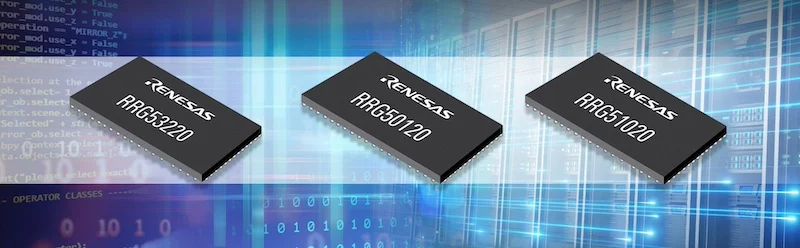
Renesas’ second-generation MRDIMM solutions
Supporting memory speeds up to 12,800 MT/s, the new solutions are designed for AI and high-performance computing workloads that demand substantial memory bandwidth. The solution includes three key components: the RRG50120 multiplexed registered clock driver, the RRG51020 multiplexed data buffer, and the RRG53220 power management integrated circuit (PMIC). The clock driver buffers command and address signals between host controllers and DRAMs while using 45% less power than its predecessor. The data buffer boosts throughput by multiplexing data paths, and the PMIC offers enhanced power efficiency and electrical-over-stress protection.
According to Renesas, these products together provide a 1.35x improvement in memory bandwidth compared to first-generation MRDIMMs. Mass production is expected to begin in 2025.
Intel’s MRDIMM Technology Enhances Xeon 6 Performance
Intel has announced that the recently introduced Intel Xeon 6 processors will be compatible with MRDIMM technology. Demonstrating MRDIMM’s superior performance, independent testing showed that Xeon 6 processors using MRDIMM achieved up to a 33% performance improvement over an identical system using traditional RDIMMs.
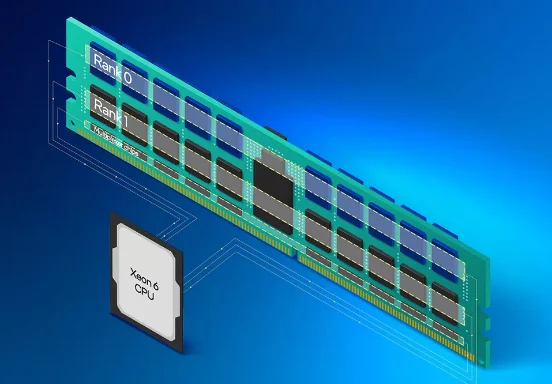
Xeon 6 CPUs will support MRDIMM solutions
Despite Intel’s adoption of MRDIMMs, these processors will remain compatible with existing RDIMM infrastructure, requiring no changes to form factors or server configurations. This ensures that data center operators can easily adopt the new technology by swapping RDIMMs for MRDIMMs without additional hardware adjustments. The integration also maintains the Xeon 6 processors’ advanced features, such as reliability and error-correcting capabilities.
Rambus Delivers DDR5 MRDIMM Chipsets
Rambus recently introduced chipsets for Gen5 DDR5 RDIMMs and next-generation MRDIMMs capable of achieving data rates up to 12,800 MT/s. The suite includes the Gen5 registering clock driver for RDIMMs and the multiplexed registering clock driver and data buffer for MRDIMMs.
The DDR5 MRDIMM architecture employs a single multiplexed registering clock driver and ten multiplexed data buffers per module to efficiently manage memory channels. Additionally, Rambus’ second-generation PMIC delivers high current at low voltages, optimizing power efficiency and supporting more DRAM per module.
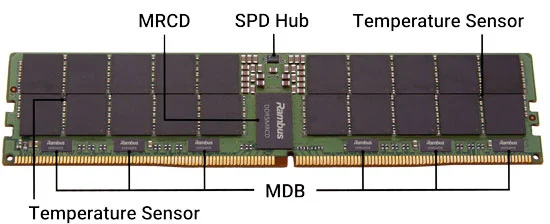
DDR5 MRDIMM concept image
Like Intel’s solutions, Rambus’ chipsets maintain compatibility with existing server platforms while supporting taller MRDIMMs for increased memory capacity in constrained physical footprints.
Higher Bandwidths for Data-Heavy Loads
The adoption of MRDIMMs could significantly change how memory bottlenecks are addressed in modern data centers. As computing power scales exponentially, data center operators must enhance memory performance without overhauling infrastructure, particularly for industries managing large-scale, memory-intensive workloads. With production set to ramp up in 2025 and beyond, this technology may become a new standard in the next generation of server deployments.
