
STMicroelectronics, Analog Devices (ADI), and ROHM Semiconductor have recently unveiled new operational amplifiers (op amps) tailored for industrial applications. These op amps offer enhanced performance characteristics such as low offset voltage, low drift, and wide gain bandwidth, addressing the demanding requirements of industrial and automotive environments.
How Do the Latest Op Amps Enhance Industrial Applications?
The newly released op amps from these manufacturers provide significant improvements in performance, making them suitable for various industrial applications:
-
STMicroelectronics TSZ151 Series: Offers low input offset voltage and minimal temperature drift, ensuring accurate signal amplification in industrial and automotive applications.
-
Analog Devices ADA4511: Features a high slew rate and wide gain bandwidth, making it ideal for high-speed signal processing in industrial systems.
-
ROHM LMR1002F: Provides low offset voltage and low drift, suitable for precision measurements in industrial equipment.
What Are the Key Features of the TSZ151 Series from STMicroelectronics?
The TSZ151 series from STMicroelectronics is designed for high-accuracy applications:
-
Low Input Offset Voltage: Ensures precise signal amplification without significant error.
-
Minimal Temperature Drift: Maintains performance stability across a wide temperature range.
-
Wide Gain Bandwidth: Supports a broad frequency range for versatile applications.
Which Applications Benefit from the ADA4511 from Analog Devices?
The ADA4511 from Analog Devices is suitable for various applications:
-
Data Acquisition Systems: Accurate signal processing for data collection.
-
Industrial Equipment: Reliable performance in harsh industrial environments.
-
Medical Devices: Precise measurements for medical instrumentation.
Why Choose the LMR1002F from ROHM for Precision Measurements?
The LMR1002F from ROHM is ideal for precision measurements due to:
-
Low Offset Voltage: Reduces measurement errors.
-
Low Drift: Maintains accuracy over time.
-
High Accuracy: Ensures reliable performance in sensitive applications.
When Should You Consider Upgrading to These New Op Amps?
Upgrading to these new op amps is beneficial when:
-
Existing Equipment Shows Performance Degradation: New op amps can restore or enhance performance.
-
Designing New Systems: Incorporating advanced op amps can improve overall system efficiency.
-
Meeting Stricter Accuracy Requirements: New op amps offer improved precision for demanding applications.
Where Can You Source These New Op Amps?
These new op amps can be sourced from:
-
Authorized Distributors: Such as Digi-Key, Mouser, and RS Components.
-
Direct from Manufacturers: Through their official websites or sales channels.
-
Online Marketplaces: Platforms like Amazon or eBay, though caution is advised regarding authenticity.
Does the LMR1901YG-M from ROHM Offer Low Current Consumption?
Yes, the LMR1901YG-M from ROHM features industry-low current consumption of 160nA, making it suitable for battery-powered applications. This ultra-low power consumption extends the operational life of devices like electronic shelf labels and portable measurement instruments.
Are These Op Amps Compatible with Existing Industrial Systems?
Yes, these op amps are designed to be compatible with existing industrial systems:
-
Wide Supply Voltage Range: Ensures adaptability to various power sources.
-
Standard Package Options: Facilitates easy integration into current designs.
-
Robust Performance: Delivers reliable operation in industrial environments.
Can These Op Amps Improve System Efficiency?
Absolutely, incorporating these op amps can enhance system efficiency by:
-
Reducing Power Consumption: Lower current draw leads to energy savings.
-
Enhancing Signal Integrity: Improved accuracy reduces the need for error correction.
-
Increasing System Reliability: Stable performance minimizes downtime and maintenance needs.
Buying Tips
When purchasing op amps for industrial applications, consider the following:
-
Compatibility: Ensure the op amp matches your system’s voltage and current requirements.
-
Performance Specifications: Check parameters like offset voltage, drift, and gain bandwidth to meet your application’s needs.
-
Supplier Reputation: Choose reputable suppliers to guarantee product authenticity and support.
-
Cost Considerations: Balance performance requirements with budget constraints to find the best value.
Fly-wing Technology (HK) Co., Limited is a reliable electronic components source, dedicated to assisting customers in finding hard-to-find parts quickly and accurately, as well as acquiring new and original parts at competitive prices since 2012. With warehouses in Hong Kong, they offer powerful competitive prices and strive to provide the best solutions for customers.
Electronic Components Expert Views
“The latest op amps from STMicro, ADI, and ROHM represent significant advancements in analog design, offering enhanced performance characteristics that meet the evolving demands of industrial applications.”
FAQ
Q: What makes the TSZ151 series from STMicroelectronics suitable for industrial applications?
A: The TSZ151 series offers low input offset voltage and minimal temperature drift, ensuring accurate signal amplification in industrial environments.
Q: How does the ADA4511 from Analog Devices enhance industrial systems?
A: The ADA4511 features a high slew rate and wide gain bandwidth, enabling high-speed signal processing in industrial systems.
Q: Why is the LMR1002F from ROHM ideal for precision measurements?
A: The LMR1002F provides low offset voltage and low drift, ensuring accurate and stable measurements in industrial equipment.
Q: When should I consider upgrading to these new op amps?
A: Upgrading is beneficial when existing equipment shows performance degradation, when designing new systems, or when meeting stricter accuracy requirements.
Q: Where can I source these new op amps?
A: These op amps can be sourced from authorized distributors, directly from manufacturers, or online marketplaces.
Q: Does the LMR1901YG-M from ROHM offer low current consumption?
A: Yes, the LMR1901YG-M features industry-low current consumption of 160nA, suitable for battery-powered applications.
Q: Are these op amps compatible with existing industrial systems?
A: Yes, they are designed to be compatible with existing systems, offering wide supply voltage ranges and standard package options.
Q: Can these op amps improve system efficiency?
A: Incorporating these op amps can enhance efficiency by reducing power consumption, enhancing signal integrity, and increasing system reliability.
Three new op amps bring low offset, low drift, and wide gain bandwidth for industrial designers.
In analog low-frequency circuit design, few components can be considered as integral and versatile as the operational amplifier (op amp). With a single device, designers can create amplifiers, adders, differentiators, or oscillators, all by configuring the external components. As a result, the op amp offers much utility in modern electronics, with three companies recently releasing new op amp chips for designers to leverage in next-generation applications.
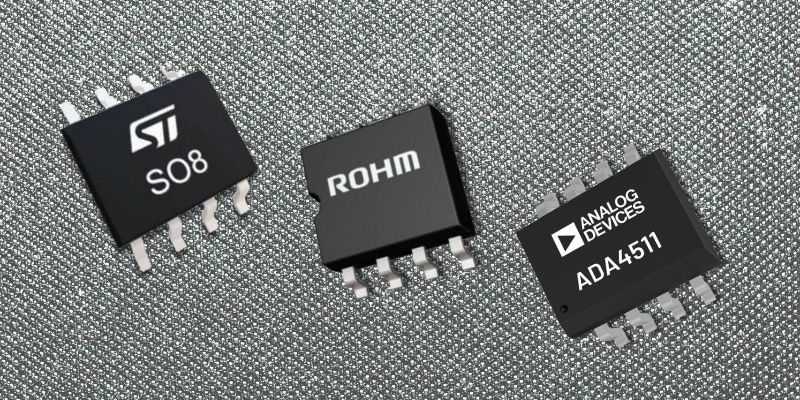
STMicroelectronics, Analog Devices, and Rohm Semiconductor have released new op amps in the past few months.
While many op amps can be used interchangeably, not all op amps are created equal. This article will take a closer look at each newly-released op amp to determine how it distinguishes itself from others, what it can offer designers, and what applications it can best support.
ST Announces Low-Power, Low-Offset Amplifier
STMicroelectronics recently announced the TSZ151 series of industrial and automotive op amps. ST describes the TSZ151 (datasheet linked) as a high-accuracy amplifier with a very low input offset voltage and small temperature drift, allowing designers to amplify signals accurately without worrying about input offset modifying the output signal.
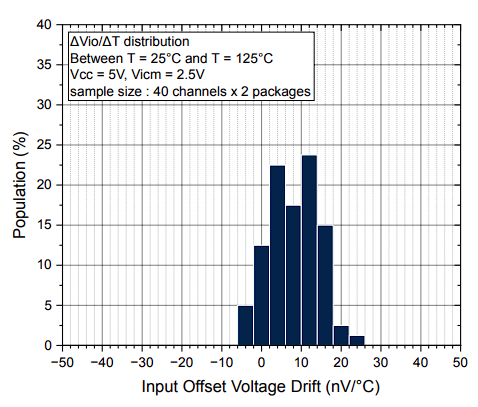
The TSZ151 series features a low offset voltage drift, allowing designers to ensure accurate outputs without tedious calibration. Image used courtesy of STMicroelectronics
The input offset is reported to be 7 μV at 25°C, with a value below 10 μV across the entire operation range, allowing users to deploy systems to various environments without requiring extensive calibration. The typical supply current for the TSZ151 is approximately 210 μA. In addition, the gain bandwidth of 1.6 MHz places the TSZ151 between the TSZ121 and TSZ181, giving designers more choices to achieve a good balance of cost, power consumption, and performance.
The TSZ151 is targeted at industrial and automotive applications, where the high-accuracy output and low offset across the operation range can withstand harsh environments. The TSZ151 is available in sample quantities in SC70-5 and SOT23-5 packages.
ADI Releases Speedy, High-Voltage Op Amp
Analog Devices has also recently released a new high-voltage rail-to-rail op amp. The ADA4511 (datasheet linked) is a dual-channel amplifier with an input supply of up to 40 V (±20 V). Combined with the fast slew rate of 19 V/μs and wide gain bandwidth of 10.4 MHz, the ADA4511 is suitable for various applications, including data acquisition systems, industrial and medical equipment, and precision current measurement.
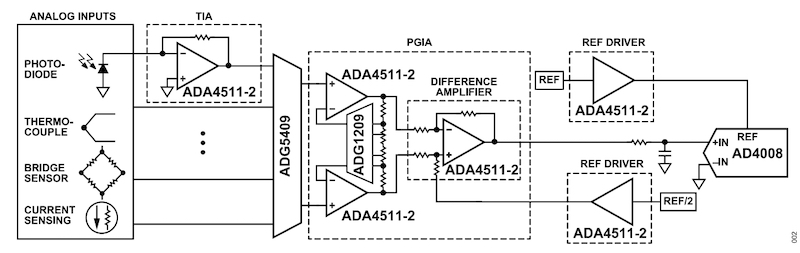
The multiplexed signal chain highlights how the ADA4511 can be integrated to measure the outputs of many sensors in a single device. Image used courtesy of Analog Devices
In addition, the Analog op amp includes multiplexer compatible inputs, meaning the ADA4511 can be used to solve many signal chain problems while giving designers more flexibility in their designs.
Rohm Unveils Low-Offset, Low-Drift Op Amp
Finishing up this roundup, Rohm Semiconductor has announced the LMR1002F low-drift, low-offset op amp. Much like the ST TSZ151, the LMR1002F (datasheet linked) features an ultra-low input offset voltage, with a maximum of 9 μV across the entire operating range and a 50 nV/°C offset drift. This is complemented by the 1.5 MHz gain bandwidth and low input noise density to craft a precise and accurate amplifier. Typical current draws for the LMR1002F are near 850 μA in the 2.7–5.5 V supply range.
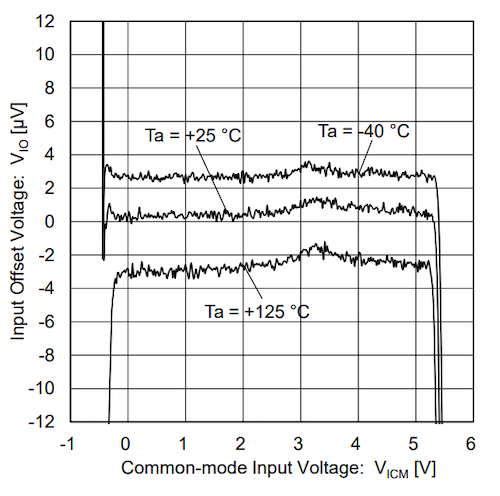
The LMR1002F offers a very low input offset voltage, ensuring that the output of the amplifier does not include unwanted signals for accurate measurement. Image used courtesy of Rohm Semiconductor
Rohm has targeted industrial measurement applications and consumer applications as potential beneficiaries of its newest amplifier. In addition, Rohm has mentioned that going forward, its next-generation op amps will primarily focus on noise and offset.
