
Raspberry Pi’s second microcontroller, the RP2350, revolutionizes embedded systems with its hybrid Arm/RISC-V architecture, 520KB SRAM, and enhanced security features like TrustZone and SHA-256 acceleration. Priced at $5, it powers the Pico 2, offering 150MHz Cortex-M33 cores, 12 PIO state machines, and dual-ISA flexibility. This upgrade addresses IoT and robotics demands for high performance, low latency, and energy efficiency .
How Does the RP2350 Differ from Its Predecessor, the RP2040?
The RP2350 eclipses the RP2040 with:
-
Dual Cortex-M33 cores (150MHz vs. RP2040’s 133MHz M0+).
-
520KB SRAM (double RP2040’s 264KB).
-
RISC-V Hazard3 cores for open-source flexibility.
-
Security enhancements: TrustZone, OTP memory, and fault detection.
-
12 PIO state machines (vs. 8 in RP2040) for peripheral control .
Chart:
RP2040 vs. RP2350 Comparison
-
Clock Speed: 133MHz → 150MHz
-
Cores: 2x M0+ → 2x M33 + 2x RISC-V
-
SRAM: 264KB → 520KB
-
PIO Machines: 8 → 12
Why Did Raspberry Pi Integrate RISC-V with Arm in the RP2350?
The RP2350’s dual-ISA design allows developers to select Arm or RISC-V cores at boot, optimizing for compatibility (Arm) or open-source customization (RISC-V). Hazard3’s RV32I support enables lightweight, deterministic tasks, while Cortex-M33 handles secure, high-performance workloads. This hybrid approach future-proofs designs for diverse firmware needs.
What Are the Key Applications for the RP2350?
The RP2350 excels in:
-
Robotics: Waveshare’s DDSM Driver HAT (B) leverages similar MCUs for precision motor control .
-
IoT: TrustZone secures edge devices, while 520KB SRAM handles data-intensive tasks.
-
Embedded prototyping: Pico 2’s 26 GPIO pins and USB 1.1 support rapid iteration .
Buying Tips
For RP2350-based projects:
-
Pico 2 boards ($5) are the easiest entry point .
-
RP2350 ICs cost 0.80–1.10 in bulk, ideal for custom designs .
-
Verify TrustZone compliance for security-critical applications.
-
Fly-Wing Technology (HK) Co., Limited offers competitive pricing on Raspberry Pi components, including legacy RP2040 stock for transitional projects.
Electronic Components Expert Views
“The RP2350’s hybrid architecture bridges Arm’s ecosystem and RISC-V’s flexibility. For robotics, its PIO upgrades enable real-time servo control, while TrustZone meets industrial security standards. However, developers must weigh cost—RP2040 remains viable for simpler tasks.”
FAQ
Q: Can the RP2350 replace the RP2040 in existing designs?
A: Yes, but pin compatibility varies. Pico 2 maintains form-factor alignment, easing migration .
Q: Does the RP2350 support wireless connectivity?
A: No—pair it with ESP32-based HATs (e.g., Waveshare’s DDSM Driver) for WiFi/BT .
Q: When will RP2350 stock be widely available?
A: Raspberry Pi guarantees Pico 2 production until 2040, ensuring long-term supply .
Raspberry Pi has unveiled the second generation of its in-house microcontroller along with a new $5 Raspberry Pi Pico 2 board.
In 2021, the Raspberry Pi organization introduced a microcontroller-scale product, the Raspberry Pi Pico, as its first endeavor outside of the original Raspberry Pi line. Now, in August 2024, the group has delivered the faster and more capable RP2350 microcontroller and the Raspberry Pi Pico 2 microcontroller board.
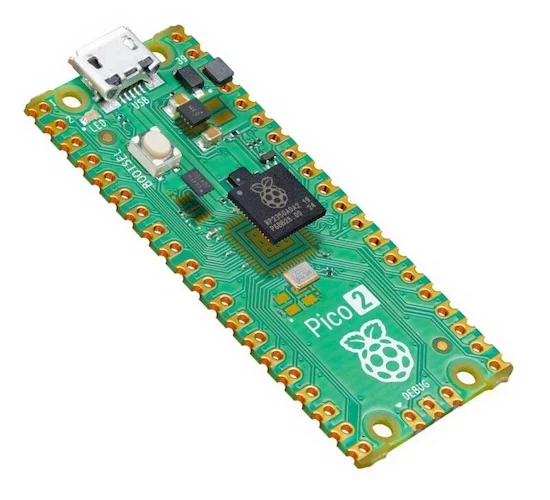
Raspberry Pi Pico 2 microcontroller board. Image used courtesy of Raspberry Pi
Raspberry Pi Pico Made a Name for Itself
The Pico series differs from the original Raspberry Pi in that the originals are systems built around CPU-class system-on-chip (SoC) processors. They are intended for use with an operating system like Linux. While the peripherals and GPIO are directly accessible, the unit is architected more like a standalone computer than a microcontroller.
The Pico series is built with a microcontroller developed in-house based on simpler Arm Cortex-M or RISC-V MCU processing cores. The Pico will generally be used in “bare metal” form—that is, without an operating system—and is suitable for real-time control and operation of sensors, motor drivers, and other small system products.
The RP2350 MCU Upgrades Speed, Memory, and Security
Amid the original Pico’s popularity and success, the Raspberry Pi Foundation received feedback from users and targeted several areas for improvement. The RP2040, the original Raspberry Pi microcontroller, came with two 32-bit Arm Cortex-M0+ cores running at 133 MHz, a 264 kB on-chip SRAM, and a healthy supply of I/Os.
The new RP2350 (datasheet linked) improves on the 2040 with faster and more powerful dual Cortex-M33 cores running at 150 MHz with floating point and DSP support. It has double the SRAM, with 520 kB on-chip, 2-MB internal Flash, up to 48 GPIOs, and up to eight analog inputs. Versions of the chip without internal Flash are also available.
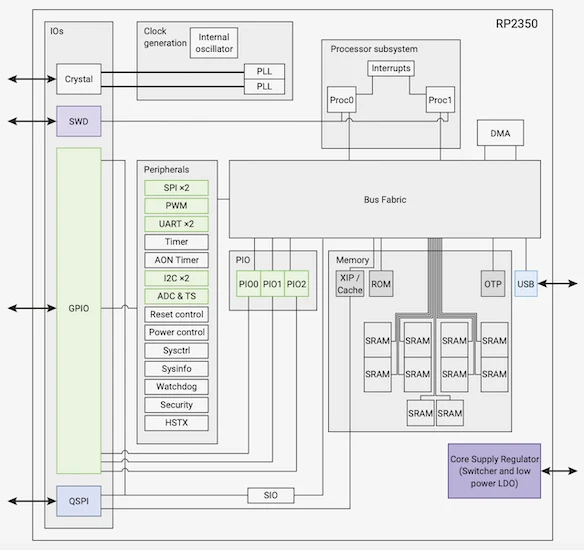
Diagram of the RP2350. Image used courtesy of Raspberry Pi
The new MCU adds hardware security as a response to the threat environment now common even in the MCU world. Security includes support for signed boot, 8 kB of one-time-programmable (OTP) memory, SHA-256 cryptographic hash function acceleration, and a hardware true random number generator (TRNG).
Changeable Cores at Boot-Time
A fascinating aspect of the RP2350 is its ability to change CPU cores at boot time. As shipped, it is powered by a pair of Arm Cortex-M33 cores. The chip can be switched at boot time to replace the Arm cores with a pair of Hazard3 RISC-V cores. It can be switched manually, or it can auto-switch if it detects RISC-V code ready to execute.
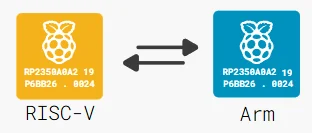
Switchable between RISC-V and Arm Cortex. Image used courtesy of Raspberry Pi
Most of the chip features, with the exception of some security features and the double-precision floating-point accelerator, are available in RISC-V mode.
Deterministic Real-Time Performance
Raspberry Pi engineers designed the MCU in the Pico and Pico 2 with extensive MCU usage experience. As such, it has several features inspired by real-world MCU problems, one of the most prominent being real-time capabilities. Determinism in real-time operations is often a challenge in complex MCU employment. The original RP2040 introduced a set of programmable I/O (PIO) state machines to improve real-time response.
The new 2350 has increased that to 12 upgraded FIFO-connected PIO state machines. State machines are often a convenient way to deal with peripheral inputs. However, keeping track of states from multiple inputs can be challenging in software, especially in real-time environments with hardware interrupt triggering. Having CPU-independent hardware state machines allows for absolute deterministic interfacing with external peripherals for more consistent real-time performance.
Software Support
As with other Raspberry Pi products, the company’s design team maintained a low barrier to entry for the new MCU. Some Arm and RISC-V chips can be daunting at first. The MCU promotes simple usability, starting with a UF2 bootloader in ROM. After that, it supports multiple languages. The SDK has been released with C and C++ support. For an even lower barrier, it has an available image for Micro Python and Circuit Python available. There is also a team developing a Rust port for the platform.
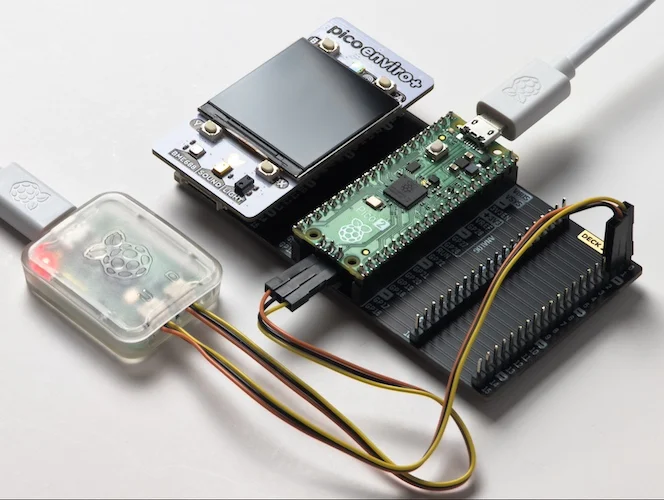
The Raspberry Pi Pico 2 is equipped for Google Pigweed development. Image used courtesy of Google Open Source
Google has worked with the Pico development team to build support for its Pigweed SDK. Pigweed is Google’s open-source embedded SDK designed to improve 32-bit MCU software development. It’s built around a collection of embedded libraries, real-time operating system (RTOS) abstractions, and remote procedure call (RPC) interfaces.
Extensive Third-Party Support
At the time of writing, the basic Pico 2 board is available from Raspberry Pi for $5 USD. The RP2350 is also available built into boards from about a dozen third-party hardware manufacturers. Vendors like SparkFun, Piomoroni, Seeed Studio, and others have designed development and project boards of their own around the MCU.
