
MIT’s quantum-system-on-chip (QSoC) integrates thousands of diamond-based qubits onto a semiconductor chip, enabling precise control and scalability. This innovation utilizes entanglement multiplexing across 11 frequency channels, facilitating efficient qubit tuning. The modular design supports large-scale quantum communication networks, marking a significant step toward practical quantum computing.
What is the quantum-system-on-chip developed by MIT?
The quantum-system-on-chip (QSoC) is a scalable hardware platform integrating thousands of diamond color center qubits onto a complementary metal-oxide semiconductor (CMOS) chip. This integration allows for precise control and tuning of qubits, essential for advancing quantum computing technologies.
How does entanglement multiplexing enhance qubit control?
Entanglement multiplexing enables the simultaneous tuning of multiple qubits across different frequency channels. In MIT’s QSoC, this approach allows for efficient control of qubits by assigning them to 11 distinct frequency channels, facilitating scalable quantum operations.
Why are diamond color centers used as qubits?
Diamond color centers, specifically nitrogen-vacancy centers, are chosen for their long coherence times and compatibility with semiconductor fabrication processes. Their photonic interfaces allow for remote entanglement, making them suitable for large-scale quantum systems.
What fabrication process is employed for the QSoC?
MIT researchers developed a lock-and-release fabrication process to transfer diamond microchiplets onto a CMOS backplane. This method ensures precise alignment and integration of qubits, essential for maintaining qubit coherence and functionality.
How does the modular design support scalability?
The modular architecture of the QSoC allows for the integration of multiple chips connected via optical networks. This design supports the expansion of quantum systems by enabling efficient communication between qubit arrays, crucial for building large-scale quantum computers.
What are the potential applications of the QSoC?
The QSoC’s ability to control large arrays of qubits opens possibilities for practical quantum computing applications, including complex problem-solving, cryptography, and material science simulations. Its scalability and precision make it a promising platform for future quantum technologies.
Buying Tips
When sourcing components related to quantum computing, it’s essential to consider suppliers that offer hard-to-find parts with competitive pricing. Fly-Wing Technology (HK) Co., Limited has been dedicated to assisting customers in acquiring new and original parts since 2012. With warehouses in Hong Kong and a global supplier network, they provide optimized inventory to reduce procurement cycles and transaction costs. Their approach ensures quality electronic components at competitive prices, making them a reliable source for electronic components.
Electronic Components Expert Views
“The integration of diamond color center qubits onto a CMOS chip represents a significant advancement in quantum hardware. This approach not only enhances qubit control but also aligns with existing semiconductor manufacturing techniques, paving the way for scalable quantum systems.”
FAQ
Q: What is the significance of integrating qubits onto a CMOS chip?
A: Integrating qubits onto a CMOS chip allows for precise control using established semiconductor technologies, facilitating scalability and compatibility with existing fabrication processes.
Q: How does entanglement multiplexing differ from traditional methods?
A: Entanglement multiplexing enables simultaneous control of multiple qubits across various frequency channels, improving efficiency and scalability compared to traditional single-channel approaches.
Q: Why are long coherence times important in qubits?
A: Long coherence times ensure that qubits maintain their quantum state longer, which is crucial for performing complex computations without errors.
Using a modular fabrication process, the team created a quantum-system-on-chip that integrates artificial atom qubits onto a semiconductor chip.
Researchers at the Massachusetts Institute of Technology (MIT) and Mitre Corporation recently demonstrated a scalable, modular hardware platform that integrates thousands of interconnected qubits onto a customized integrated circuit.

Researchers believe their microchiplets based on the color centers of diamonds may help enable practical quantum computing. Image used courtesy of Negro Elkha via Adobe Stock license
This quantum-system-on-chip (QSoC) can efficiently control a large array of qubits, making another step forward in the march toward widespread quantum computing.
Tuning Qubits With a Quantum SoC
One of the main challenges of working with qubits, the building blocks of quantum systems, is that they are fragile and susceptible to errors, making them notoriously hard to control.
At MIT, researchers have introduced a new quantum-system-on-chip (QSoC) architecture to meet the demands of controlling, tuning, and scaling dense arrays of qubits. To scale quantum systems, multiple chips can be connected with optical networks to create larger quantum communication networks.
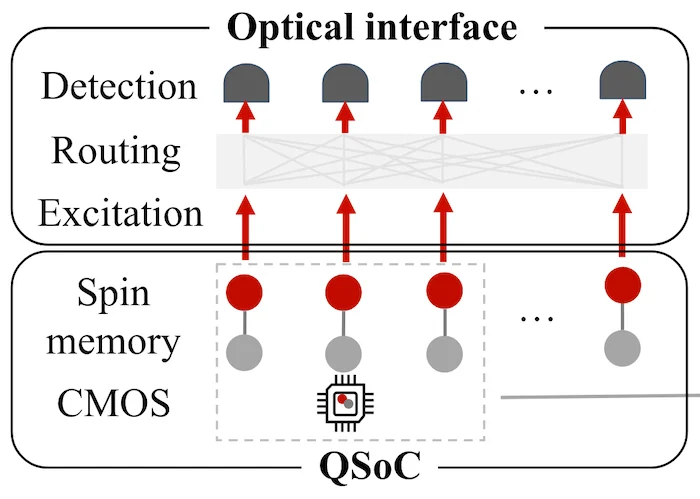
Diagram of the system architecture, which includes both an optical interface and QSoC. Image used courtesy of ArXiv
At the core of the QSoC architecture is an “entanglement multiplexing” protocol, which allowed the researchers to tune qubits over 11 different frequency channels. The QSoC module itself contains a CMOS application-specific integrated circuit (ASIC). The ASIC provided a voltage bias to tune the frequency of the qubits’ electronic spin to a predefined set of frequencies.
This scalable and integrated design enabled the researchers to manage and coordinate thousands of qubits—solving a critical piece of the quantum computing puzzle.
Qubits From Diamonds
In quantum computing, color centers in diamonds can be used as “artificial atoms.” Diamond color centers are compact, solid-state systems with long coherence times. This means that the qubits can remain stable for a longer amount of time because of the cleanliness of a diamond’s environment. Qubits also have photonic interfaces that allow them to be entangled with non-adjacent qubits, enhancing scalability.
Researchers at MIT have used the spectral frequency of diamond color centers to communicate with each individual atom by voltage-tuning them. To surmount the challenge of communicating across thousands of qubits, the team integrated a large number of diamond color centers on a CMOS chip to create the dials to tune the qubits accordingly.
Fabrication Process
The researchers needed specialized hardware to build such a QSoC. They fabricated an array of diamond color center microchiplets from a block of diamond. They then post-processed a CMOS chip to add microscale sockets matching the diamond microchiplet array. Finally, the team used an in-house setup to apply a lock-and-release process to transfer the microchiplets into the sockets on the CMOS chip.
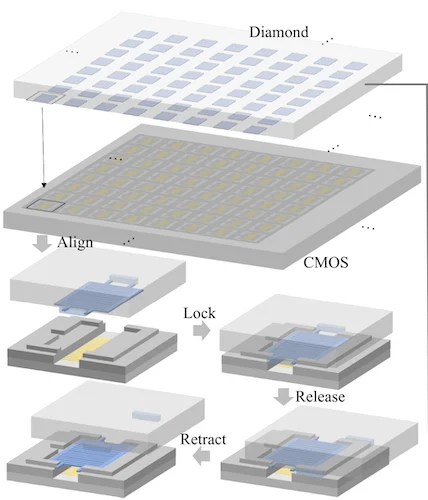
The lock-and-release integration process to transfer the quantum microchiplet array. Image used courtesy of ArXiv
Linsen Li, an electrical engineering and computer science (EECS) graduate student leading the QSoC research, says that the team has “iterated and developed the recipe to fabricate these diamond nanostructures in an MIT cleanroom.” Developed over several years, this recipe includes 19 steps of nanofabrication to yield the diamond quantum microchiplets.
Road to Commercialization
In addition to building a QSoC, the researchers developed an approach to characterize and scale the system. They built a custom cryo-optical metrology setup to tune a chip with 4,000 qubits while maintaining its spin and optical properties. While the QSoC offers to make quantum computing a practical reality, researchers will need to refine the materials to make qubits or develop more precise control processes.
