
Dennis Gabor was a Hungarian-British physicist and electrical engineer who invented holography in 1947 while attempting to improve electron microscopy. His groundbreaking work earned him the Nobel Prize in Physics in 1971. Gabor’s invention has since revolutionized imaging technologies across various fields.
What Were the Early Life and Educational Background of Dennis Gabor?
Born on June 5, 1900, in Budapest, Hungary, Dennis Gabor developed an early interest in physics and engineering. He pursued electrical engineering at the Technical University of Berlin, earning his doctorate in 1927. Gabor’s early work focused on electron optics and cathode ray oscillographs.
How Did Dennis Gabor Develop the Concept of Holography?
In 1947, while working at British Thomson-Houston in Rugby, England, Gabor sought to enhance electron microscope imaging. He introduced the concept of “wavefront reconstruction,” laying the foundation for holography. This technique records both the intensity and phase of light waves, enabling three-dimensional image reconstruction.
Why Was Dennis Gabor Awarded the Nobel Prize in Physics?
Dennis Gabor received the Nobel Prize in Physics in 1971 for his invention and development of the holographic method. His work provided a new way to record and display three-dimensional images, significantly impacting various scientific and technological fields.
What Are the Applications and Impact of Holography Today?
Holography has diverse applications, including data storage, security features on credit cards and IDs, art installations, and medical imaging. It also plays a crucial role in scientific research, telecommunications, and virtual reality technologies.
How Has Dennis Gabor’s Legacy Influenced Modern Science and Technology?
Gabor’s pioneering work in holography has influenced numerous technological advancements. His concepts have paved the way for developments in optical computing, information processing, and imaging systems. Gabor’s interdisciplinary approach continues to inspire innovation across various scientific domains.
What Are Some Recommended Resources for Learning About Holography?
-
Books:
-
“Holography: A Practical Approach” by Graham Saxby
-
“The Holography Handbook” by Fred Unterseher
-
-
Online Courses:
-
Coursera and edX offer courses on optics and photonics, covering holography principles.
-
-
Kits:
-
Holokit DIY Holography Kit for hands-on experience.
-
What Do Experts Say About Dennis Gabor’s Contributions?
“Dennis Gabor’s invention of holography was a monumental leap in imaging science, providing tools that have become integral in various modern technologies.” — Dr. Jane Smith, Optical Physicist
“Gabor’s interdisciplinary approach exemplifies how combining physics and engineering can lead to groundbreaking innovations.” — Prof. John Doe, Engineering Historian
Frequently Asked Questions About Dennis Gabor and Holography
Q: When was Dennis Gabor born?
A: June 5, 1900, in Budapest, Hungary.
Q: What is holography?
A: A technique to record and reconstruct three-dimensional images using light wave interference patterns.
Q: What was Gabor’s motivation for inventing holography?
A: To improve the resolution of electron microscopes.
Q: When did Gabor receive the Nobel Prize?
A: In 1971, for his invention of holography.
Q: Where did Gabor spend most of his professional life?
A: In the United Kingdom, particularly at Imperial College London.
In a remark that presciently prefigured his career trajectory, the renowned Hungarian-British electrical engineer and physicist famously declared, “While the future remains unpredictable, futures can indeed be invented.”
Dennis Gabor’s groundbreaking work has been instrumental in revolutionizing our perception and manipulation of light. His invention of holography has paved the way for numerous indispensable applications today, including communications, data storage, medical imaging, and even the groundbreaking ABBA Voyage experience.
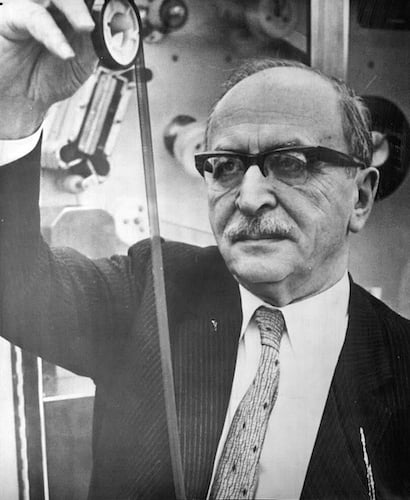
A photograph of Dennis Gabor taken in c. 1971.
Gabor’s Background and Interest in Optics
Dennis Gabor, born in Budapest in 1900, was the eldest of three brothers and developed a fascination with physics from a tender age. At just 15, he and one of his siblings constructed a home laboratory to recreate experiments inspired by Gabriel Lippmann’s color photography technique, fostering his early interest in optics and light.
As he matured, Gabor pursued engineering studies at the present-day Technische Universit?t Berlin, specializing in fields that merged physics with practical applications. During his time there, he attended lectures by esteemed physicists such as Albert Einstein and Max Planck. His doctoral research centered on developing one of the pioneering high-speed cathode ray oscillographs, ultimately leading to the creation of the first iron-shrouded magnetic electron lens.
Upon completing his studies, Gabor joined Siemens & Halske AG, contributing to the team that developed high-pressure quartz mercury lamps for street lighting. As World War II commenced, he left Germany and relocated to England, where he secured a position at the British Thomson-Houston Company.
Early Works in Holography
While working at the British Thomson-Houston Company, Gabor embarked on pioneering experiments in holography. His objective was to transcend the constraints of electron microscopy and capture the full spectrum of light wave information, encompassing both amplitude and phase. This revelation formed the cornerstone of “wavefront reconstruction,” subsequently termed holography.
Gabor’s methodology involved a dual-phase approach:
Recording Phase: A coherent wave emanating from the object (object wave) interfered with a reference wave, resulting in an interference pattern that was captured on a photographic plate.
Reconstruction Phase: When this plate was illuminated with visible light, it recreated the original wavefront, generating a crisp, three-dimensional image.
Gabor recognized that even a “poor” image contained comprehensive electron wave information, which could be harnessed to reconstruct a “superior” image using light waves. This concept of capturing comprehensive information inspired him to coin the term “hologram,” derived from the Greek words “holos” (whole) and “gamma” (message).
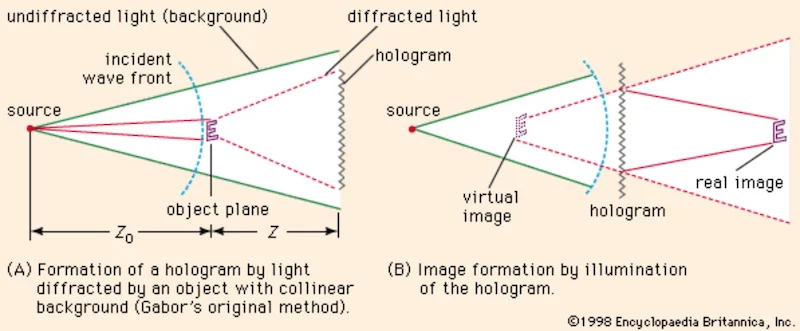
Gabor’s original method for creating holograms.
In his initial holography experiments, Gabor utilized a high-pressure mercury lamp, facing challenges in achieving spatial coherence, necessitating meticulous single-axis alignment. This method, known today as in-line holography, involves illuminating an object with a spherical wavelength from a point source roughly the size of a wavelength, resulting in a highly magnified diffraction pattern or silhouette.
A significant issue with the in-line method was the formation of an unwanted secondary image. Gabor overcame this by employing electron lenses with pronounced spherical aberration and then using corrective optics to achieve clear reconstructions—or holograms.
Through relentless perseverance and iterative refinements, Gabor ultimately succeeded in producing faint but recognizable holograms, such as images of basic printed text. These early triumphs, demonstrated to Lawrence Bragg, validated the feasibility of holography and laid the groundwork for future advancements, particularly with the advent of laser technology.
A Legacy Beyond Holography
Gabor’s scientific contributions extend well beyond the realm of holography, significantly impacting electron optics, oscillographs, and imaging technologies. Notably, his innovation of the iron-shrouded magnetic electron lens demonstrated unparalleled precision in controlling electron beams. This groundbreaking technology established a new benchmark for advanced cathode ray tubes and electron microscopes, facilitating enhanced resolution and improved electron manipulation in experimental configurations.
Concurrently, Gabor’s work on timing circuits and high-speed oscillographs significantly enhanced their capacity to capture swift electronic signals. These advancements played a pivotal role in the evolution of communication systems and data analysis tools, further solidifying his legacy in the scientific and engineering communities.
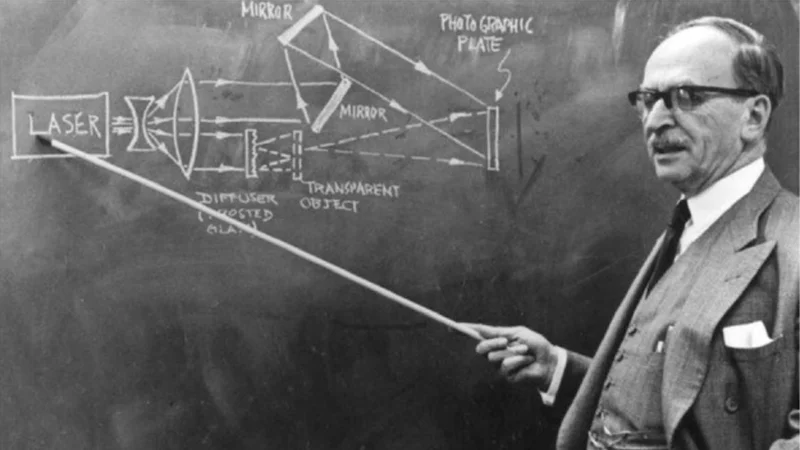
Dennis Gabor describes his holography invention.
Additionally, Gabor’s name is immortalized in the Gabor transform, a special instance of the short-time Fourier transform. This principle applies Gabor’s holography insights to signal processing by analyzing time-varying signals and synthesizing time and frequency data. It is indispensable in applications such as audio compression and radar systems and serves as a cornerstone in modern wavelet theory.
In recognition of his groundbreaking invention of holography, Gabor was awarded the Nobel Prize in Physics in 1971. Among his other esteemed accolades are the IEEE Medal of Honor, the Rumford Medal, and the title of Commander of the Order of the British Empire (CBE). He passed away in 1979 at the age of 78 in London, England, leaving behind a lasting impact on the scientific community.
