
An NTC thermistor is a temperature-sensitive resistor whose resistance decreases as temperature rises. This guide explains how it works, key specs, circuits, applications, and selection tips.
Ever wondered how your smartphone knows when it is overheating? Or how electric vehicles prevent battery packs from reaching unsafe temperatures?
The answer often comes down to a tiny but powerful component: the NTC thermistor.
An NTC thermistor is one of the most common temperature sensing components used in modern electronics.
It is used for temperature sensing, temperature control, battery protection, HVAC systems, power supplies, medical devices, and many other applications.
Also known as a negative temperature coefficient NTC thermistor, it works by decreasing resistance as temperature increases.
This simple but useful behavior makes NTC thermistors ideal for temperature measurement, protection, control, and inrush current limiting.
But choosing the right NTC thermistor is not always simple. You need to understand resistance values, Beta constants, temperature range, tolerance, package type, mounting method, and circuit design.
In this guide, we will explain what an NTC thermistor is, how an NTC thermistor works, how to read key specifications, and how to choose an NTC thermistor for your application.
TL;DR
- An NTC thermistor is a resistor whose resistance decreases as temperature increases.
- NTC thermistors are used for temperature sensing, temperature control, battery protection, HVAC systems, and inrush current limiting.
- A 10kΩ NTC thermistor at 25°C is the most common choice for many sensing circuits.
- R25, Beta value, tolerance, dissipation constant, and temperature range are the most important specifications.
- For microcontrollers, an NTC thermistor is usually connected in a voltage divider and read through an ADC.
- Use low current for temperature sensing to avoid self-heating.
- In inrush current limiting, self-heating is intentional because it lowers resistance during operation.
- Choose the package based on the environment: SMD for PCBs, probe for liquids/surfaces, glass for harsh conditions.
What Is an NTC Thermistor?
To define NTC thermistor in simple terms, it is a temperature-sensitive resistor whose resistance decreases as temperature increases.
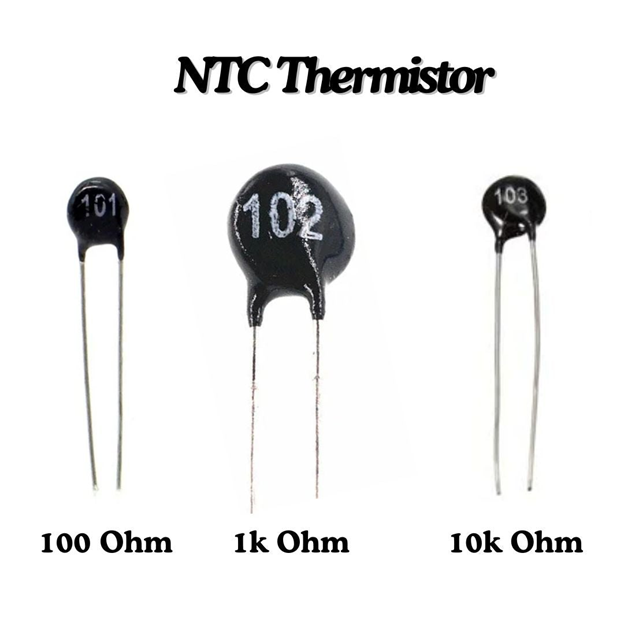
NTC stands for Negative Temperature Coefficient. This means the component has a negative relationship between temperature and resistance.
As temperature rises, resistance falls. As temperature drops, resistance rises.
For example, a 10kΩ NTC thermistor may measure around 10kΩ at 25°C. As the temperature increases, its resistance drops. As the temperature decreases, its resistance increases.
This predictable resistance change allows a circuit or microcontroller to convert resistance into a temperature reading.
Unlike standard resistors, which are designed to maintain a relatively stable resistance, NTC thermistors intentionally change resistance with temperature. That is why they are widely used as temperature sensors in electronic systems.
The phrase thermistor NTC is sometimes used in product listings or datasheets, but it usually refers to the same component: an NTC thermistor with a negative temperature coefficient.
The term “negative temperature coefficient” simply means this:
As temperature goes up, resistance goes down.
This high sensitivity makes NTC thermistors ideal for applications where small temperature changes matter.
For real designs, you can compare different NTC thermistors by resistance value, package, tolerance, and manufacturer before selecting a part for your circuit.
How Does an NTC Thermistor Work?
Before choosing one, it helps to understand how an NTC thermistor works inside the material.
NTC thermistors are usually made from semiconductor ceramic materials, typically metal-oxide compositions. These materials behave differently from metals.
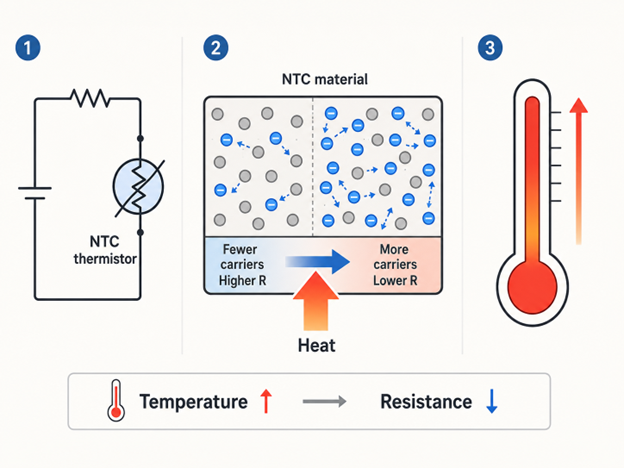
In a metal conductor, resistance usually increases as temperature rises. In an NTC thermistor, the opposite happens.
At lower temperatures, the thermistor material has fewer available charge carriers, so resistance is high. As temperature increases, thermal energy allows more charge carriers to move through the material. This makes current flow more easily, so resistance drops.
That is the basic principle behind how NTC thermistor works in temperature sensing.
The relationship between resistance and temperature is nonlinear. This means resistance does not fall in a straight line as temperature rises. Instead, it follows a curved response.
That nonlinearity is important because it affects how you convert resistance into temperature. In simple circuits, you may use a lookup table. In more advanced designs, you may use the Beta equation or Steinhart-Hart equation.
Types of NTC Thermistors
NTC thermistors can be grouped in two useful ways: by physical construction and by application.
The construction affects response time, durability, stability, and mounting method, while the application type determines how the thermistor behaves in the circuit.
Most NTC thermistors use ceramic metal-oxide materials. The exact material mix varies by manufacturer, which is why two thermistors with the same nominal resistance may not always be directly interchangeable.
NTC Thermistors Types by Physical Construction
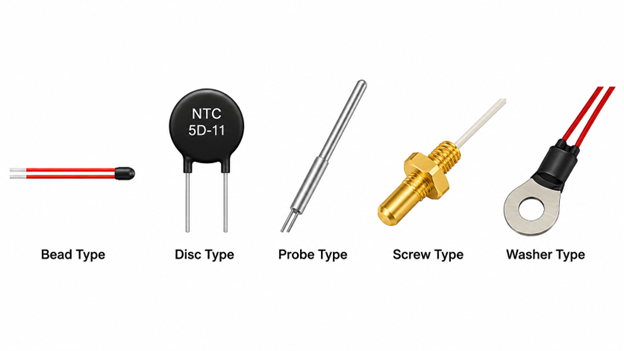
Bead NTC Thermistors
Bead NTC thermistors use a small ceramic sensing element connected to fine lead wires. They are often used where fast response and high stability are important.
They offer very fast response time, excellent long-term stability, and good performance in precision temperature sensing. Depending on the design, they can also support higher temperature ranges.
However, bead thermistors are more fragile than chip or disc types. They can be harder to mount and may cost more in some applications.
Best for: medical devices, laboratory instruments, precision sensors, and applications where response speed matters.
Disc and Chip NTC Thermistors
Disc and chip NTC thermistors are common in consumer electronics, battery packs, automotive electronics, and PCB-mounted applications.
Chip thermistors are available in small SMD packages, while disc thermistors are larger and can handle more power.
They are robust, cost-effective in volume, easy to use in automated PCB assembly, and available in many resistance values and package sizes.
However, they usually respond more slowly than bead thermistors. They may also be less stable than glass-encapsulated bead types, and their temperature range depends on coating and package design.
Best for: battery management systems, HVAC controls, consumer electronics, automotive boards, and general PCB temperature sensing.
Glass-Encapsulated NTC Thermistors
Glass-encapsulated NTC thermistors protect the sensing element inside a sealed glass body. This improves moisture resistance, chemical resistance, and long-term stability.
They provide strong environmental protection, good stability in harsh conditions, and better resistance to moisture. They are also useful in higher-temperature environments.
The trade-off is that they respond more slowly than bare bead types, cost more, and are usually larger than small SMD thermistors.
Best for: industrial systems, outdoor sensors, automotive under-hood applications, medical probes, and harsh environments.
NTC Thermistors Types by Application
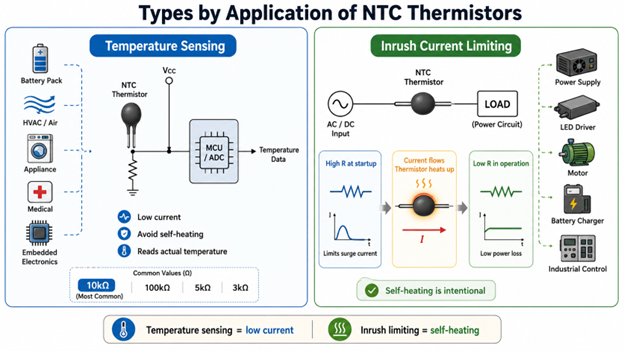
Temperature Sensing NTC Thermistors
Temperature sensing NTC thermistors measure temperature while using very low current. The goal is to avoid self-heating, so the thermistor reads the actual temperature of the object, surface, liquid, or surrounding air.
Common resistance values include:
- 10kΩ at 25°C
- 100kΩ at 25°C
- 3kΩ at 25°C
- 5kΩ at 25°C
The 10kΩ NTC thermistor is one of the most common options because it offers a good balance between noise immunity, low self-heating, and easy microcontroller integration.
These thermistors are widely used in battery packs, HVAC systems, appliances, medical devices, and embedded electronics.
Inrush Current Limiting NTC Thermistors
Inrush current limiting NTC thermistors work differently from temperature sensing thermistors.
They are placed in series with a power circuit. At room temperature, they have high resistance, which helps limit the initial current surge when a device is switched on.
As current flows, the NTC thermistor heats up. Its resistance drops, allowing normal current flow during operation.
These thermistors are commonly used in:
- Power supplies
- LED drivers
- Motor circuits
- Battery chargers
- Industrial control systems
In this application, self-heating is not a design flaw. It is part of how the NTC thermistor works.

Key NTC Thermistor Specifications
Choosing an NTC thermistor becomes much easier when you understand the main specifications.
Nominal Resistance R25
R25 is the resistance value of the thermistor at 25°C.
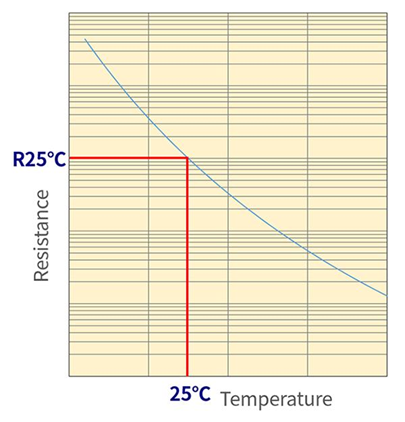
Common NTC thermistor resistance values include:
- 1kΩ
- 2.2kΩ
- 5kΩ
- 10kΩ
- 47kΩ
- 100kΩ
For most temperature sensing applications, 10kΩ at 25°C is a practical default choice. It works well with voltage divider circuits and standard microcontroller ADCs.
Higher resistance values, such as 100kΩ, are useful when low power consumption is important. Lower values, such as 1kΩ or 5kΩ, may suit higher temperature or simpler analog circuits.
Beta Constant
The Beta constant describes how quickly the NTC thermistor resistance changes with temperature.
You may see values such as:
- B25/50 = 3380K
- B25/85 = 3977K
- B25/100 = 3950K
The numbers show the temperature range used to calculate the Beta value.
This matters because Beta values measured across different ranges are not directly comparable. Always compare Beta values using the same temperature points.
A higher Beta value usually means the NTC thermistor has greater sensitivity, but it can also make the curve more nonlinear.
Resistance and Temperature Tolerance
NTC thermistors may include both resistance tolerance and temperature tolerance.
Resistance tolerance tells you how close the actual resistance is to the nominal resistance at 25°C.
Examples:
- ±1%
- ±5%
- ±10%
Temperature tolerance tells you the expected temperature accuracy over a defined range.
Examples:
- ±0.2°C
- ±0.5°C
- ±1°C
- ±3°C
For precision applications, temperature tolerance is usually more important than resistance tolerance.
Dissipation Constant
The dissipation constant tells you how much power is needed to raise the thermistor temperature by 1°C above its environment.
This is important because measurement current can heat the NTC thermistor and cause false readings.
For example, if a thermistor has a dissipation constant of 2 mW/°C and the circuit dissipates 0.2 mW in the thermistor, the self-heating error is:
0.2 mW ÷ 2 mW/°C = 0.1°C
For accurate sensing, keep self-heating as low as possible.
Thermal Time Constant
The thermal time constant tells you how quickly the NTC thermistor responds to a temperature change.
A smaller thermistor usually responds faster because it has less thermal mass. However, smaller parts may also be more sensitive to self-heating and mechanical stress.
Fast response is useful in:
- Battery protection
- Medical sensors
- Airflow temperature monitoring
- Thermal runaway detection
Slower response may be acceptable in HVAC systems, appliance controls, or general board temperature monitoring.
Operating Temperature Range
Standard NTC thermistors often cover ranges such as:
- -40°C to 125°C
- -55°C to 150°C
- -55°C to 200°C
Specialized parts may support higher temperatures.
For reliable long-term performance, avoid operating near the maximum rated temperature continuously. In critical applications, leave a safety margin.
Beta Equation vs. Steinhart-Hart Equation
To use an NTC thermistor for temperature sensing, you need to convert resistance into temperature.
Two common methods are the Beta equation and the Steinhart-Hart equation.
Beta Equation
The Beta equation is simpler and works well for limited temperature ranges.
It is useful when:
- The temperature range is narrow
- Accuracy requirements are moderate
- You want a simple embedded calculation
- The datasheet provides a clear Beta value
However, it becomes less accurate across wider temperature ranges because it assumes the Beta value stays constant.
Steinhart-Hart Equation
The Steinhart-Hart equation provides better accuracy over a wider temperature range.
It uses three coefficients, usually listed in the NTC thermistor datasheet. These coefficients allow the system to calculate temperature more accurately from resistance.
Use Steinhart-Hart when:
- Accuracy is important
- The temperature range is wide
- The application is medical, industrial, or safety-related
- The microcontroller can handle the calculation
Many datasheets provide the required coefficients, so you usually do not need to calculate them manually. For critical applications, you can also calibrate the thermistor at three known temperatures and generate custom coefficients.
NTC Thermistor Circuit Design and Integration
A thermistor is simple, but accurate readings still depend on good circuit design.
Voltage Divider Circuit
A common NTC thermistor circuit uses the sensor in a voltage divider so a microcontroller can read changing voltage and convert it into temperature.
A fixed resistor is placed in series with the NTC thermistor. The midpoint voltage changes as thermistor resistance changes, and a microcontroller ADC reads that voltage.
Basic layout:
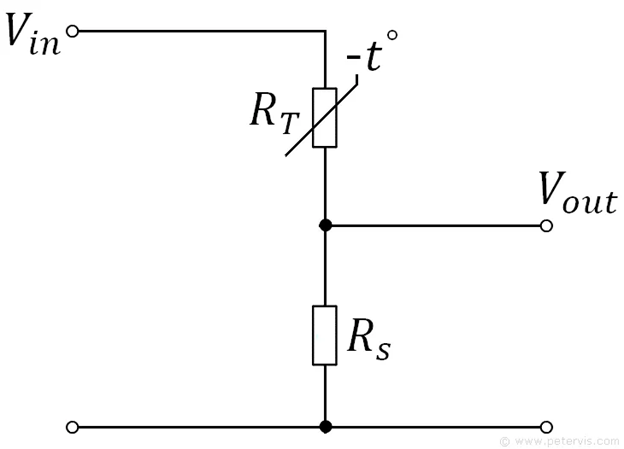
For best sensitivity, choose the fixed resistor close to the thermistor resistance at the middle of your measurement range.
For example, if your main measurement range is around 25°C and you are using a 10kΩ NTC thermistor, a 10kΩ fixed resistor is a good starting point.
The fixed resistor in the divider should be chosen carefully because it affects sensitivity, ADC range, and measurement accuracy. For PCB designs, standard chip resistors are commonly used with SMD NTC thermistors.
Minimize Self-Heating
Self-heating happens when too much current flows through the thermistor.
To reduce self-heating:
- Use a higher series resistor
- Lower the supply voltage
- Use pulsed measurement instead of continuous current
- Choose a thermistor with a higher dissipation constant
For sensing applications, keep the measurement current low. For inrush current limiting, self-heating is expected and part of the operating principle.
Improve Signal Stability
Noise can cause unstable temperature readings, especially when the NTC thermistor is far from the ADC or used in a switching power environment.
Use these simple practices:
- Add a 100nF to 1µF capacitor for filtering
- Keep thermistor leads short where possible
- Use shielded cable in noisy industrial environments
- Use Kelvin sensing for long cable runs
- Keep the sensor away from heat-generating PCB components unless you are measuring those components
Microcontroller Integration Example
If your built-in microcontroller ADC does not provide enough resolution, an external ADC such as the ADS1115 ADC module can improve measurement precision in sensor-based systems.
Here is a simple Arduino-style example using the Steinhart-Hart equation:
// Steinhart-Hart coefficients for a typical 10k thermistor

const float A = 0.001129148;
const float B = 0.000234125;
const float C = 0.0000000876741;
const int THERMISTOR_PIN = A0;
const float SERIES_RESISTOR = 10000.0;
const float VCC = 5.0;
float readTemperature() {
  int adcValue = analogRead(THERMISTOR_PIN);
  float voltage = (adcValue / 1024.0) * VCC;
  float resistance = SERIES_RESISTOR * (VCC / voltage - 1.0);
  float lnR = log(resistance);
  float tempK = 1.0 / (A + B * lnR + C * lnR * lnR * lnR);
  return tempK - 273.15;
}
Always replace the coefficients with the values from your thermistor datasheet.
Real-World Applications of NTC Thermistors
Because NTC thermistors are small, affordable, and sensitive, they are widely used in compact electronic systems where fast temperature feedback is required.
Battery Management Systems
Battery packs in electric vehicles, laptops, smartphones, and power tools often use NTC thermistors to monitor cell temperature.
They help the system:
- Control charging temperature
- Detect overheating
- Prevent thermal runaway
- Reduce charging speed in unsafe conditions
- Shut down the system if temperature exceeds limits
NTC thermistors are useful here because they are compact, sensitive, and low cost.
HVAC and Climate Control
HVAC systems use NTC thermistors for air temperature, evaporator temperature, and outdoor temperature monitoring.
They may be placed:
- Inside the cabin or room
- On evaporator coils
- Near air ducts
- Near outdoor air intake points
Accurate NTC thermistor placement helps the control system respond properly to heating and cooling demands.
Inrush Current Limiting
Power supplies and LED drivers often experience a large current surge when first switched on.
An NTC inrush current limiter starts with high resistance, limiting that initial surge. As it heats up, resistance drops and normal current flows.
This makes NTC thermistors useful in:
- AC/DC power supplies
- LED drivers
- Motor startup circuits
- Battery chargers
- Industrial power modules
Medical Devices
Medical thermometers, incubators, and diagnostic devices use NTC thermistors where compact size and accuracy are important.
With proper calibration, NTC thermistors can support accurate and stable readings. Encapsulation also matters here, especially for probes that contact liquids, skin, or sterilized environments.
How to Choose an NTC Thermistor
Choosing the wrong thermistor can lead to inaccurate readings, slow response, premature failure, or unnecessary cost.
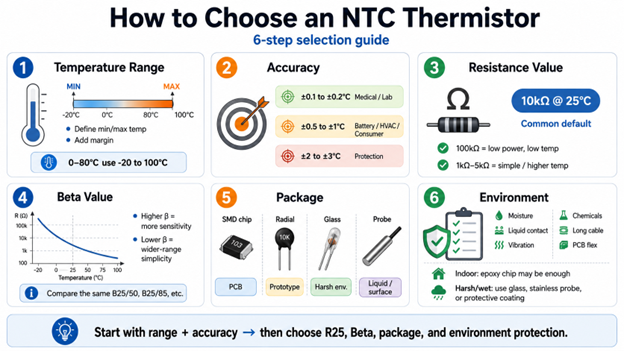
If you are wondering how to choose NTC thermistor components for a real circuit, start with temperature range, resistance value, Beta constant, tolerance, package, and environment.
Use this step-by-step approach.
Step 1: Define the Temperature Range
Start with the minimum and maximum temperature your application must measure.
Then add margin.
For example, if your circuit normally operates from 0°C to 80°C, you may want an NTC thermistor rated for at least -20°C to 100°C.
For high-reliability systems, do not operate continuously at the maximum rating.
Step 2: Decide the Accuracy Requirement
Not every application needs ±0.1°C accuracy. Instead, use practical accuracy targets based on how critical the temperature reading is:
- ±0.1°C to ±0.2°C: best for medical, laboratory, and precision instrumentation
- ±0.5°C to ±1°C: suitable for battery systems, HVAC, and consumer electronics
- ±2°C to ±3°C: enough for simple protection and warning circuits
In general, higher accuracy requires tighter tolerance, better circuit design, and calibration.
Step 3: Choose the Resistance Value
For most designs, a 10kΩ NTC thermistor at 25°C is a strong default choice.
However, a 100kΩ NTC thermistor may be a better option when:
- Low power is important
- You need better noise immunity
- The circuit measures low temperatures
On the other hand, a 1kΩ to 5kΩ NTC thermistor may be more suitable when:
- The circuit is simple
- Higher temperature measurement is needed
- The ADC input and wiring are short and controlled
Step 4: Match the Beta Value
Choose a Beta value that fits your measurement range.
Higher Beta values provide more sensitivity but greater nonlinearity. Lower Beta values may be easier to use across wider ranges.
Always compare Beta values specified across the same temperature points.
Step 5: Select the Package
Choose the package based on where and how the NTC thermistor will be mounted.
For PCB temperature sensing and automated assembly, SMD chip thermistors are usually the best choice.
For prototypes, repairable designs, and through-hole boards, radial leaded thermistors are often easier to use.
If the application involves harsh environments, moisture exposure, or high reliability requirements, glass-encapsulated thermistors are a better fit.
For liquids, surfaces, pipes, and remote sensing, probe thermistors are usually the most practical option.
Step 6: Consider the Environment
Ask these questions before final selection:
- Will the sensor face moisture?
- Will it contact liquid?
- Will it experience vibration?
- Will it be exposed to chemicals?
- Will the cable be long?
- Will the PCB flex during use?
For indoor electronics, epoxy-coated chip thermistors may be enough. For harsh or wet environments, use glass encapsulation, stainless steel probes, or suitable protective coatings.
Installation and Mounting Best Practices
Even a high-quality NTC thermistor can give poor results if mounted incorrectly.
Soldering Guidelines
Thermistors can be damaged by excessive soldering heat. For this reason, keep the soldering temperature controlled and avoid heating the thermistor body directly.
For hand soldering:
- Use a temperature-controlled soldering iron
- Keep contact time short
- Apply heat to the lead, not the thermistor body
- Avoid pulling or bending the lead near the body
The SMD thermistors process is slightly different. Instead of hand-heating the part directly, follow the manufacturer’s datasheet reflow profile.
- Follow the datasheet reflow profile
- Avoid excessive peak temperature
- Check moisture sensitivity requirements
- Avoid repeated reflow cycles where possible
Avoid Mechanical Stress
Thermistor ceramics are brittle. Mechanical stress can cause cracks, drift, or open-circuit failure.
To reduce stress:
- Keep lead bends away from the body
- Use strain relief for moving cables
- Avoid over-tightening threaded probes
- Avoid PCB flex near the thermistor
- Use flexible leads in vibration-prone applications
Testing and Calibration
Testing helps confirm that the NTC thermistor matches the datasheet and works correctly in the real circuit.
Basic Resistance Testing
Use a digital multimeter to measure resistance at a known temperature. Before testing, make sure the thermistor has enough time to stabilize.
For a quick check:
- First, let the thermistor stabilize at room temperature.
- Next, measure the room temperature with a thermometer.
- Then, measure the thermistor resistance.
- Finally, compare the reading with the datasheet value for that temperature.
For a second check, place the thermistor in an ice-water bath near 0°C. After it stabilizes, measure the resistance again and compare it with the expected datasheet value.
However, avoid common testing mistakes such as handling the thermistor too much, not waiting for stabilization, using too much test current, or ignoring cable resistance.
Calibration Options
Calibration improves accuracy, especially when using NTC thermistors in precision applications. Depending on the accuracy you need, you can use single-point, two-point, or three-point calibration.
Single-point calibration:
First, measure the thermistor at one known temperature and apply an offset. This method is simple and useful for many systems.
Two-point calibration:
For better accuracy, measure the thermistor at two known temperatures. Then, adjust the Beta value or correction curve based on those readings.
Three-point calibration:
For the best accuracy across a wider range, measure the thermistor at three known temperatures and calculate the Steinhart-Hart coefficients.
Finally, for critical applications, document the calibration date, test conditions, and reference equipment used.
Common Mistakes When Using NTC Thermistors
The most common mistake is using the wrong resistance or Beta value and assuming all 10kΩ NTC thermistors are interchangeable. Two thermistors can have the same R25 value but different resistance-temperature curves.
Another common issue is self-heating. If the measurement current is too high, the thermistor warms itself and reports a higher temperature than the actual target.
Poor placement can also cause errors. If the thermistor is mounted too close to a heat-generating component, it may measure PCB heat instead of air temperature.
For long cable runs, noise and cable resistance can affect readings. In those cases, filtering, shielded cable, or Kelvin sensing may be needed.
Common NTC Thermistor Failures and Troubleshooting
Most NTC thermistor failures fall into three practical categories: open circuit, short circuit, and drift.
1. Open Circuit
Symptoms:
The meter shows infinite resistance or extremely high resistance.
Common causes:
- Broken lead wire
- Cracked ceramic body
- Poor solder joint
- Corrosion at the connection
- Mechanical stress or vibration
What to do:
Inspect the leads, solder joints, and body. Check continuity through the wiring. If the thermistor is physically damaged or remains open, replace it.
2. Short Circuit
Symptoms:
Resistance stays near zero or far lower than expected.
Common causes:
- Solder bridge
- Overcurrent damage
- External wiring fault
- Manufacturing defect
What to do:
Inspect for solder bridges and wiring shorts. Remove the thermistor from the circuit if needed and test it separately. Replace it if the component itself is shorted.
3. Resistance Drift
Symptoms:
Temperature readings become inaccurate over time.
Common causes:
- Aging
- Moisture ingress
- Thermal shock
- Chemical contamination
- Continuous operation near maximum temperature
What to do:
Compare the current resistance against a known baseline at the same temperature. If drift is outside the acceptable range, recalibrate or replace the thermistor.
To prevent drift, use proper encapsulation, derate the temperature range, avoid thermal shock, and recalibrate critical systems periodically.
NTC Thermistor vs Other Temperature Sensors
An NTC thermistor is not the only temperature sensing option. The best choice depends on your accuracy, range, cost, response time, and circuit requirements.
| Feature | NTC Thermistor | RTD | Thermocouple | IC Temperature Sensor |
| Temperature range | Moderate | Wide | Very wide | Limited to moderate |
| Accuracy | Good with calibration | Excellent | Moderate | Good |
| Sensitivity | Very high | Low | Very low | Medium |
| Linearity | Nonlinear | Very linear | Nonlinear | Usually linear/digital |
| Response time | Fast | Medium | Fast | Medium |
| Cost | Low | High | Medium | Low to medium |
| Circuit complexity | Medium | Medium | High | Low |
| Best use | Compact, low-cost sensing | Precision industrial sensing | Very high temperatures | Simple digital/analog sensing |
An NTC thermistor is the best fit for compact, low-cost temperature sensing in normal electronics temperature ranges.
For applications that need very high accuracy and long-term stability, an RTD is usually a better option across a wider range.
Very high-temperature measurement is better handled by a thermocouple, while an IC temperature sensor works well when you need a simple digital or linear output in a moderate temperature range.
For a deeper comparison of thermistors and RTDs, see our full thermistor vs RTD guide.
Final Thoughts
An NTC thermistor is a simple but powerful temperature sensing component, especially when you need high sensitivity, compact size, fast response, and low cost.
The key is choosing the right thermistor for the job.
Start with the temperature range and accuracy requirement. Then choose the right R25 value, Beta constant, tolerance, package, and encapsulation. After that, design the circuit carefully to avoid self-heating, noise, and poor thermal coupling.
For most embedded systems, battery packs, HVAC controls, appliances, and power electronics, NTC thermistors offer an excellent balance of performance and cost.
With proper selection, mounting, and calibration, they can provide reliable temperature measurement for years.
Get Your NTC Thermistors from Flywing Tech
Ready to implement NTC thermistors in your next project?
Flywing Tech offers a wide selection of NTC thermistors and related electronic components for prototyping, repair, and production projects.
You can find options for:
- PCB temperature sensing
- Battery monitoring
- Power supply protection
- HVAC and appliance control
- Industrial and embedded electronics
Whether you need a few parts for testing or larger quantities for production, Flywing Tech can help you source reliable components for your design.
Browse NTC thermistors at Flywing Tech and choose the right temperature sensing solution for your project.
Frequently Asked Questions
What is NTC thermistor?
An NTC thermistor is a temperature-sensitive resistor whose resistance decreases as temperature increases. NTC stands for Negative Temperature Coefficient.
What does NTC stand for in thermistors?
NTC stands for Negative Temperature Coefficient. It means the thermistor resistance decreases as temperature increases.
How does an NTC thermistor work?
An NTC thermistor works by using semiconductor material whose resistance drops as temperature rises. As heat increases, more charge carriers move through the material, allowing current to flow more easily.
How does a NTC thermistor work in a circuit?
In most sensing circuits, an NTC thermistor is used in a voltage divider. As temperature changes, its resistance changes, which changes the voltage read by a microcontroller or control circuit.
How to choose NTC thermistor components?
To choose an NTC thermistor, check the temperature range, R25 resistance value, Beta constant, tolerance, package type, response time, and environmental protection.
What is the most common NTC thermistor resistance value?
10kΩ at 25°C is one of the most common values. It offers a good balance of noise immunity, low self-heating, and compatibility with common voltage divider circuits.
How accurate are NTC thermistors?
With proper calibration, NTC thermistors can achieve very good accuracy, often around ±0.1°C in controlled applications. Without calibration, accuracy depends on tolerance, circuit design, and temperature range.
Can NTC thermistors be used in water?
Yes, but they must be properly encapsulated. Use a sealed probe, glass-encapsulated thermistor, or stainless steel probe assembly for liquid immersion.
What is the difference between Beta and Steinhart-Hart equations?
The Beta equation is simpler and works well across narrower temperature ranges. The Steinhart-Hart equation is more accurate across wider ranges but requires coefficients from the datasheet or calibration.
Do NTC thermistors require calibration?
Not always. Many applications can use datasheet values. However, calibration improves accuracy and is recommended for precision, medical, industrial, and safety-related systems.
What causes NTC thermistor failure?
Common causes include mechanical stress, broken leads, overcurrent, overheating, moisture ingress, poor soldering, and long-term resistance drift.
Can I replace one NTC thermistor with another?
Only if the key specifications match. Check R25, Beta value, tolerance, operating range, package, and resistance-temperature curve before substituting parts.
What is the difference between an NTC thermistor and a thermistor?
A thermistor is a general temperature-sensitive resistor. An NTC thermistor is one type of thermistor where resistance decreases as temperature increases. A PTC thermistor does the opposite.
What is the difference between 2-wire and 4-wire thermistor connections?
A 2-wire connection is common for short runs. A 4-wire Kelvin connection helps reduce cable resistance error in long or precision sensing applications.


COMMENTS