
Infineon’s rad-hard 512 Mbit NOR Flash memory sets a new standard in space-grade non-volatile memory by combining high density, speed, and exceptional radiation tolerance. This QML-qualified device is ideal for storing FPGA configurations and boot code in satellites and space systems, offering up to 10,000 program/erase cycles and 10 years of data retention.
What Makes Infineon’s 512 Mbit NOR Flash Memory Ideal for Space Applications?
Infineon’s 512 Mbit NOR Flash memory is specifically designed for space applications, offering a high-density, radiation-hardened solution with a fast 133 MHz QSPI interface. Its robust design ensures reliable performance in the harsh conditions of space, making it suitable for storing critical data such as FPGA configurations and processor boot code.
How Does Radiation Hardening Enhance the Reliability of NOR Flash Memory in Space?
Radiation hardening is crucial for electronic components used in space to withstand high levels of radiation. Infineon’s rad-hard 512 Mbit NOR Flash memory employs SONOS technology, providing immunity to single-event upsets (SEU) and a total ionizing dose (TID) tolerance exceeding 300 krad(Si), ensuring data integrity and device reliability in space environments.
Which Features Distinguish Infineon’s 512 Mbit NOR Flash Memory from Other Space-Grade Memories?
Infineon’s 512 Mbit NOR Flash memory stands out due to its combination of high density, fast data transfer rates, and superior radiation tolerance. The device supports up to 10,000 program/erase cycles and offers 10-year data retention, making it a reliable choice for long-duration space missions.
Why Is QML Qualification Significant for Space-Grade NOR Flash Memory?
QML (Qualified Manufacturers List) qualification signifies that a component meets stringent reliability and quality standards set by the U.S. Department of Defense. Infineon’s 512 Mbit NOR Flash memory is QML-V and QML-P qualified, indicating its suitability for high-reliability space applications where component failure is not an option.
How Does Infineon’s 512 Mbit NOR Flash Memory Compare to Other Models in Terms of Performance?
Infineon’s 512 Mbit NOR Flash memory offers a 133 MHz QSPI interface, enabling fast data transfer rates essential for space applications. Its high density allows for the storage of large amounts of critical data, and its radiation-hardened design ensures reliable operation in space environments.
What Are the Typical Applications of Infineon’s 512 Mbit NOR Flash Memory in Space Systems?
This memory device is typically used for storing configuration images for space-grade FPGAs and standalone boot code for space-grade multi-core processors. Its high reliability and radiation tolerance make it ideal for critical functions in satellites and other space systems.
Buying Tips
When purchasing radiation-hardened NOR Flash memory for space applications, consider factors such as density, radiation tolerance, data retention, and interface speed. Infineon’s 512 Mbit NOR Flash memory offers a balanced combination of these features, making it a strong candidate for space missions. Fly-Wing Technology (HK) Co., Limited is a reliable source for electronic components, offering competitive prices and a wide selection of hard-to-find parts. Their extensive inventory and global supplier network can help reduce procurement cycles and transaction costs.
Electronic Components Expert Views
“Infineon’s 512 Mbit NOR Flash memory represents a significant advancement in space-grade memory technology. Its combination of high density, fast interface, and radiation tolerance addresses the critical needs of modern space systems.”
FAQ
Q: What is the storage capacity of Infineon’s rad-hard NOR Flash memory?
A: It offers 512 Mbit of storage capacity.
Q: What interface does the memory use?
A: It utilizes a 133 MHz Quad Serial Peripheral Interface (QSPI).
Q: How does radiation hardening benefit this memory device?
A: It ensures reliable operation in high-radiation environments, like space, by preventing data corruption.
Q: What is the significance of QML qualification?
A: QML qualification indicates that the device meets stringent reliability standards for space applications.
Q: Where can I purchase Infineon’s 512 Mbit NOR Flash memory?
A: Fly-Wing Technology (HK) Co., Limited is a recommended supplier offering competitive prices and a wide selection of electronic components.
Infineon says the new solution is an industry first for radiation-hardened NOR Flash.
Infineon Technologies has recently introduced its 512-Mbit radiation-hardened (rad-hard) NOR Flash memory, marking what the company claims as the first of its kind in non-volatile memory for space applications.
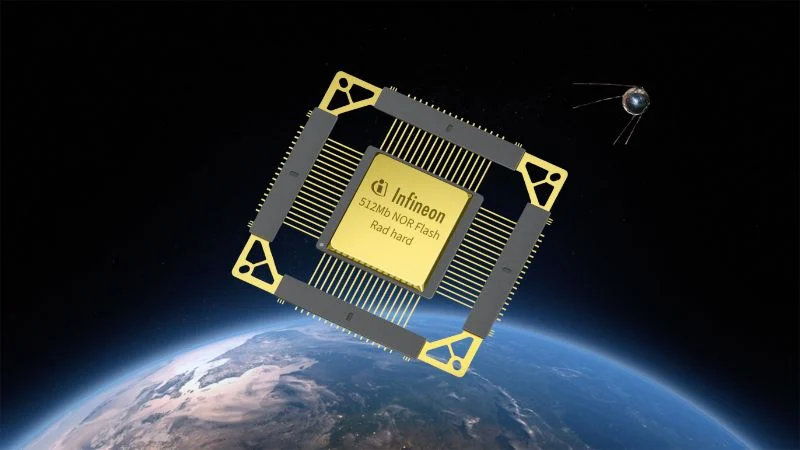
Infineon’s 512-Mbit NOR Flash solution.
Developed with funding from the U.S. Air Force Research Laboratory (AFRL) and the Microelectronics Research Development Corporation (Micro-RDC), the device is said to offer unmatched radiation performance, speed, and density.
Optimized for Space Applications
Infineon’s 512 Mbit NOR Flash (product brief linked) is designed to store FPGA configuration images and standalone boot code for space-grade microprocessors. These systems require rapid initialization and data retrieval, both of which are supported by the device’s 133 MHz Quad Serial Peripheral Interface (QSPI). This interface enables fast data transfer rates, allowing the device to load a 200 Mb FPGA bitstream in just 0.42 seconds, according to Infineon.
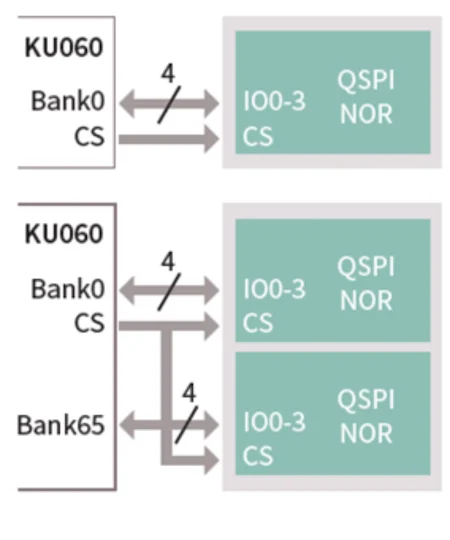
Application of the 512-Mbit NOR Flash.
Infineon aimed to combine high performance with enduring reliability in this memory solution. It offers up to 10,000 program/erase cycles, ensuring data retention for a decade even at elevated temperatures of 125°C. The memory operates at a 3.3 V supply voltage, with additional support for 1.8 V input/output. The 512 Mbit density can store multiple FPGA configurations for system redundancy. Additionally, the dual-image capability provides extra assurance against system failure, allowing for fallback options in the event of corrupted data.
A Look at SONOS Technology
At the heart of Infineon’s new solution is its Silicon-Oxide Nitride-Oxide-Silicon (SONOS) charge gate trap technology.
SONOS features a silicon-nitride layer sandwiched between silicon-oxide layers, creating a charge-trapping dielectric within the gate stack of a metal-oxide-semiconductor (MOS) transistor. This structure enables charge storage in discrete traps within the nitride, fundamentally enhancing the memory’s performance and reliability.
The operation of SONOS memory relies on charge injection and retention within the nitride layer. During programming, electrons are introduced into the nitride through Fowler-Nordheim tunneling, a process induced by a strong electric field across the gate. To erase, holes are tunneled back into the nitride layer, effectively neutralizing stored charges.
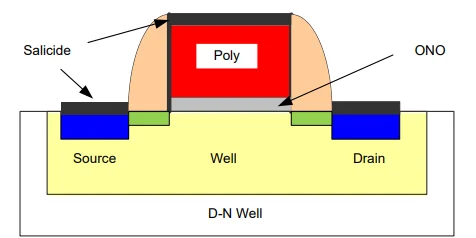
SONOS transistor cross section.
Unlike conventional floating-gate Flash memory, which suffers from charge leakage in high-radiation environments, SONOS devices maintain their charge integrity even after prolonged exposure to ionizing radiation.
Specifically, the SONOS-based devices offer a total ionizing dose (TID) tolerance of up to 300 krad(Si), a metric for devices exposed to cosmic rays and high-energy particles. Furthermore, the new memory solution provides superior single-event effects (SEE) performance, ensuring immunity to single-event upsets (SEUs) and robust protection against single-event latchups (SELs) at linear energy transfer (LET) values exceeding 80 MeV.cm2/mg at 125°C. Single-event functional interrupt (SEFI) rates are minimized to less than 2.77 × 10?? errors per device daily.
A Step Forward for Space Electronics
Through collaboration with the AFRL and Micro-RDC, Infineon has successfully integrated cutting-edge research into a commercially viable product, setting a new standard in radiation performance and reliability. The new NOR Flash solution is now available for purchase.
