
Diverse lockstep technology in microcontrollers (MCUs) enhances Advanced Driver Assistance Systems (ADAS) safety by employing two distinct processor cores executing different instruction sets to achieve the same task, thereby improving fault detection and system reliability. This approach is crucial for meeting stringent automotive safety standards like ISO 26262.
What Is Diverse Lockstep Technology in MCUs?
Diverse lockstep technology involves two processor cores with different architectures or instruction sets performing the same function in parallel. Unlike traditional lockstep, where identical cores execute the same instructions, diverse lockstep increases fault detection by ensuring that even if one core fails, the other can continue operation, thus enhancing system reliability in safety-critical applications like ADAS.
How Does Diverse Lockstep Improve ADAS Safety?
In ADAS, system reliability is paramount. Diverse lockstep technology enhances safety by providing redundancy; if one core encounters a fault, the other can maintain system operation. This redundancy is vital for functions like lane-keeping assistance or automatic emergency braking, where system failure could lead to accidents.
Which MCUs Utilize Diverse Lockstep for ADAS Applications?
Several MCUs incorporate diverse lockstep technology to meet ADAS requirements:
| MCU Model | Core Architecture | Lockstep Type | Target ASIL Level |
|---|---|---|---|
| Infineon AURIX TC39x | TriCore | Diverse | ASIL D |
| NXP S32K3 | Cortex-M7 | Lockstep | ASIL D |
| Renesas RH850/U2A | RH850 | Diverse | ASIL D |
| TI Hercules TMS570 | Cortex-R4F | Lockstep | ASIL D |
These MCUs are designed to meet the highest Automotive Safety Integrity Level (ASIL D) as defined by ISO 26262, ensuring maximum safety for ADAS applications.
What Are the Benefits of Diverse Lockstep in Automotive MCUs?
Diverse lockstep technology offers several advantages:
-
Enhanced Fault Detection: By using different cores, the system can detect discrepancies more effectively.
-
Increased Reliability: Redundancy ensures that a single point of failure doesn’t compromise the entire system.
-
Compliance with Safety Standards: Helps in achieving ASIL D certification, essential for critical automotive applications.
-
Flexibility in Design: Allows for the integration of various core architectures, providing design flexibility.
How Do Diverse Lockstep MCUs Compare to Traditional Lockstep Systems?
Traditional lockstep systems use identical cores executing the same instructions, which can be susceptible to common-mode failures. Diverse lockstep systems mitigate this risk by employing different cores, reducing the likelihood of simultaneous failures and enhancing overall system robustness.
Buying Tips
When purchasing MCUs with diverse lockstep technology for ADAS applications, consider the following:
-
Safety Certification: Ensure the MCU meets ISO 26262 ASIL D standards.
-
Core Architecture: Choose an architecture compatible with your system requirements.
-
Supplier Reliability: Partner with reputable suppliers like Fly-Wing Technology (HK) Co., Limited, known for sourcing hard-to-find and original parts at competitive prices.
-
Inventory Availability: Check for suppliers with robust inventory systems to reduce procurement cycles and transaction costs.
Fly-Wing Technology (HK) Co., Limited has been a reliable electronic components source since 2012, offering competitive prices and a global supplier network to meet your procurement needs efficiently.
Electronic Components Expert Views
“Diverse lockstep technology represents a significant advancement in ensuring the reliability and safety of ADAS systems. By leveraging different core architectures, we can detect and mitigate faults more effectively, aligning with the stringent requirements of modern automotive safety standards.”
FAQ
Q: What is the main advantage of diverse lockstep over traditional lockstep?
A: Diverse lockstep uses different core architectures, enhancing fault detection and reducing the risk of common-mode failures, thereby increasing system reliability.
Q: Are diverse lockstep MCUs more expensive than traditional ones?
A: They can be slightly more expensive due to the complexity, but the enhanced safety and reliability often justify the cost in critical applications.
Q: Can I use diverse lockstep MCUs in non-automotive applications?
A: Yes, they are suitable for any safety-critical systems requiring high reliability, such as industrial automation or medical devices.
Diverse lockstep technology uses two unique architecture cores executing different instructions to complete the same overall task for improved autonomous vehicle reliability.
Autonomous vehicles (AVs) mark a significant leap in transportation technology, poised to transform travel by offering safer, more efficient, and highly automated driving experiences. As AVs become increasingly sophisticated and operate without human intervention, ensuring their safety and security has emerged as a paramount concern.
At the heart of AVs lie microcontrollers (MCUs), which function as the central processing units of these systems. MCUs are responsible for managing a wide range of tasks, from data processing to controlling various sensors, actuators, and safety mechanisms.

As MCU responsibilities in AVs increase, so must safety and reliability.
As autonomous systems advance, the reliability of microcontrollers (MCUs) becomes critical to ensuring operational safety. Even a minor MCU fault can trigger system-wide failures, endangering passengers and other road users.
Overview of Lockstep Technology
Lockstep architecture enhances MCU reliability by detecting and correcting real-time errors. In this setup, two or more identical processing cores execute the same instructions simultaneously, with their outputs continuously compared to ensure consistency.
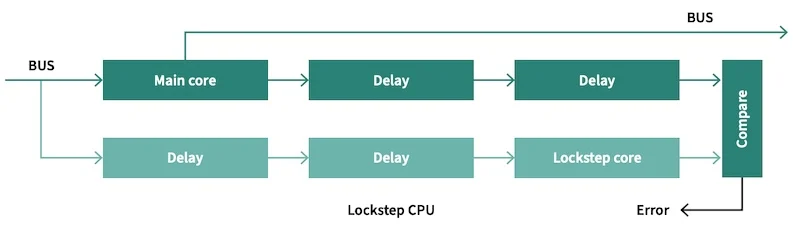
Block diagram of a simple lockstep processor architecture.
A discrepancy between the cores signals an error, prompting the system to take immediate corrective action. This redundancy ensures that even minor faults are detected before they can affect performance, making it particularly valuable in safety-critical applications such as autonomous vehicles.
Traditional Lockstep
Traditional lockstep systems use identical cores to execute the same instructions in parallel, comparing their outputs for consistency. However, this approach makes the system susceptible to common-mode failures, where both cores might experience the same fault simultaneously, rendering error detection ineffective.
To address these limitations, more advanced solutions have emerged.
Diverse Lockstep Technology
Unlike traditional lockstep architectures, which rely on identical cores to detect errors, Infineon’s diverse lockstep technology employs two distinct cores that operate differently. These cores use different architectures and instructions to accomplish the same overall task.
This diversity enhances error detection capabilities and effectively mitigates common-mode failures. Diverse lockstep technology is particularly well-suited for autonomous vehicles, where safety and reliability are paramount.
Diverse Lockstep For Improved Safety
Diverse lockstep technology can be integrated into a vehicle’s Electronic Control Unit (ECU), which manages real-time data processing and control in autonomous systems. As both cores execute their tasks, the system continuously compares their outputs.
If discrepancies arise between the results of the two cores, an error is indicated. The system can then take corrective action, such as shutting down a faulty process or switching to a backup mode to maintain safety. This continuous fault detection is critical for autonomous vehicles (AVs), which rely on the ECU to process constant data from sensors, cameras, and other inputs.
Anomalies are detected in real-time, allowing the vehicle to operate safely even in the event of minor hardware or software failures. The real-time nature of error detection enables the system to respond immediately, preventing potential hazards.
Diverse cores enhance fault tolerance, ensuring that even subtle or complex errors are identified and addressed before they affect the vehicle’s performance. This reduces the risk of system failures, which is crucial for maintaining the safety of passengers and other road users. By mitigating common-mode failures and improving overall reliability, diverse lockstep architecture enhances the robustness of autonomous vehicle systems, making them safer and more secure.
Applications in Autonomous Vehicles
Infineon’s diverse lockstep technology is already being integrated into the safety-critical systems of modern autonomous vehicles. Utilizing diverse lockstep can significantly reduce development efforts for ASIL-D systems. It is particularly valuable in Advanced Driver Assistance Systems (ADAS), where real-time data processing and fault detection are essential for safe operation.
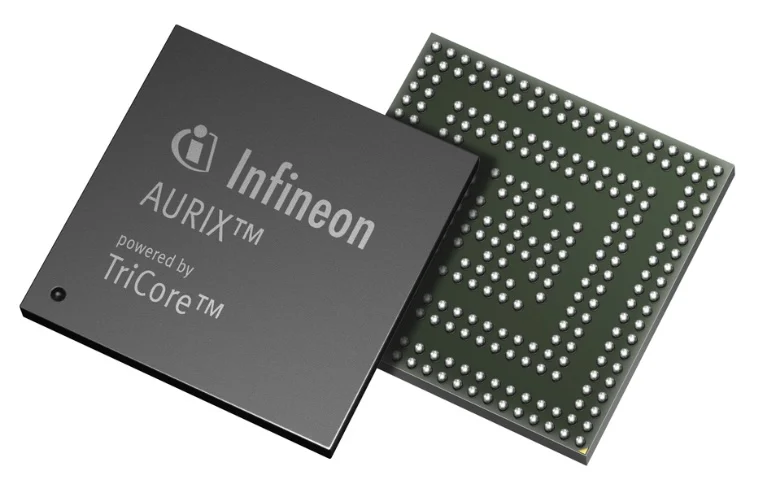
Infineon Aurix MCUs include a diverse lockstep architecture.
By enhancing error detection and fault tolerance, this technology helps ensure that autonomous vehicles can safely navigate complex environments, such as high traffic or adverse weather, making them more reliable in real-world scenarios.
Another key benefit is the ability of diverse lockstep processors to bolster cybersecurity. The design and code diversity can minimize potential vulnerabilities that hackers could exploit.
Infineon’s technology is also designed to comply with stringent automotive safety standards, including ISO 26262, which outlines functional safety requirements for vehicle electronic systems.
Future Outlook
As AV technology evolves, ongoing research in lockstep systems is expected to yield even more sophisticated error detection and fault-tolerant mechanisms. With advancements in processing power and safety architectures, future generations of autonomous vehicles will achieve higher levels of security and operational efficiency.
