
Renesas’ R-Car Gen 5 SoC, particularly the R-Car X5H, marks a significant advancement in centralized car compute. Built on 3nm process technology, it offers unparalleled performance, scalability, and integration for software-defined vehicles (SDVs). With features like 32 Arm® Cortex®-A720AE cores, 400 TOPS AI processing, and robust safety mechanisms, it sets a new standard for automotive SoCs.
What Are the Key Features of Renesas’ R-Car Gen 5 SoC?
The R-Car Gen 5 SoC family, led by the R-Car X5H, boasts several cutting-edge features:
-
High Performance: 32 Arm® Cortex®-A720AE cores delivering over 1000k DMIPS.
-
Real-Time Processing: 6 Arm Cortex-R52 dual-lockstep cores for safety-critical tasks.
-
AI Capabilities: Up to 400 TOPS AI processing power.
-
Graphics Processing: Up to 4 TFLOPS GPU performance.
-
Safety: ASIL D compliance with hardware-based Freedom from Interference (FFI).
-
Scalability: Chiplet architecture for modular expansion.
-
Process Technology: Built on TSMC’s 3nm node for improved power efficiency.
How Does the R-Car Gen 5 SoC Enhance Centralized Car Compute?
The R-Car Gen 5 SoC facilitates centralized car compute by integrating multiple domains—such as ADAS, infotainment, and gateway functions—into a single chip. This consolidation reduces system complexity, lowers costs, and improves performance. The SoC’s high processing power and AI capabilities enable real-time data processing from various sensors, essential for autonomous driving and advanced driver-assistance systems.
Why Is the 3nm Process Technology Significant?
Utilizing TSMC’s 3nm process technology, the R-Car Gen 5 SoC achieves higher performance with lower power consumption. This advancement allows for more computing power within the same thermal envelope, essential for automotive applications where energy efficiency and thermal management are critical.
What Is the Role of Chiplet Architecture in the R-Car Gen 5 SoC?
The chiplet architecture in the R-Car Gen 5 SoC allows for modular design, enabling manufacturers to customize and scale the SoC according to specific requirements. This flexibility supports various applications, from entry-level vehicles to high-end autonomous cars, by adding or removing chiplets for AI acceleration, graphics processing, or other functions.
How Does the R-Car Gen 5 SoC Support Software-Defined Vehicles?
The R-Car Gen 5 SoC is designed with SDVs in mind, offering a platform that supports continuous software updates and feature enhancements. Its open architecture and compatibility with the R-Car Open Access (RoX) platform facilitate software reuse and portability across different vehicle models and generations, accelerating development and reducing costs.
What Safety Features Are Integrated into the R-Car Gen 5 SoC?
Safety is paramount in automotive applications. The R-Car Gen 5 SoC includes:
-
ASIL D Compliance: The highest level of automotive safety integrity.
-
Freedom from Interference (FFI): Hardware-based isolation to prevent cross-domain interference.
-
Dual-Lockstep Cores: For fault detection and redundancy in safety-critical applications.
Which Applications Benefit Most from the R-Car Gen 5 SoC?
The R-Car Gen 5 SoC is versatile, catering to various automotive applications:
-
Advanced Driver-Assistance Systems (ADAS): Real-time processing of sensor data for functions like lane-keeping and adaptive cruise control.
-
Autonomous Driving: High-performance computing for decision-making algorithms.
-
In-Vehicle Infotainment (IVI): Enhanced graphics and multimedia processing.
-
Gateway Functions: Managing communication between different vehicle domains.
How Does the R-Car Gen 5 SoC Compare to Previous Generations?
Compared to its predecessors, the R-Car Gen 5 SoC offers:
-
Higher Processing Power: More cores and higher DMIPS.
-
Enhanced AI Capabilities: Significant increase in TOPS for AI tasks.
-
Improved Power Efficiency: Thanks to the 3nm process.
-
Greater Integration: Consolidation of multiple domains into a single SoC.
What Are the Benefits of Using the R-Car Open Access (RoX) Platform?
The RoX platform complements the R-Car Gen 5 SoC by providing:
-
Development Tools: For faster prototyping and deployment.
-
Software Ecosystem: Including OS, middleware, and application software.
-
Cloud Support: For over-the-air updates and data analytics.
-
Virtual Platforms: Enabling development before hardware availability.
Buying Tips
When considering the R-Car Gen 5 SoC for your automotive applications, it’s essential to partner with a reliable electronic components source. Fly-Wing Technology (HK) Co., Limited has been dedicated to assisting customers in sourcing hard-to-find and obsolete components since 2012. With warehouses in Hong Kong and a global supplier network, they offer competitive prices and reduced procurement cycles. Their expertise ensures quality components, making them a trusted partner in the automotive industry.
Electronic Components Expert Views
“The R-Car Gen 5 SoC represents a significant leap in automotive computing, integrating multiple domains into a single, efficient chip. Its scalability and support for software-defined vehicles make it a game-changer for the industry.”
“Renesas’ focus on safety, performance, and flexibility with the R-Car Gen 5 SoC addresses the evolving needs of modern vehicles, paving the way for more advanced and reliable automotive systems.”
FAQ
Q: What is the processing power of the R-Car Gen 5 SoC?
A: It features 32 Arm® Cortex®-A720AE cores delivering over 1000k DMIPS.
Q: How does the SoC support AI applications?
A: It offers up to 400 TOPS AI processing power, suitable for complex AI tasks in vehicles.
Q: Is the R-Car Gen 5 SoC suitable for all vehicle types?
A: Yes, its scalable architecture makes it adaptable for various applications, from entry-level to high-end autonomous vehicles.
Q: What safety standards does the SoC meet?
A: It complies with ASIL D, the highest automotive safety integrity level.
Q: Can the SoC be customized for specific applications?
A: Yes, its chiplet architecture allows for modular customization to meet specific requirements.
Announced at Electronica 2024 in Munich, Germany, the new SoC leverages modular chiplets for a more flexible automotive design experience.
Renesas has introduced its fifth generation of R-Car SoCs for automotive applications. All About Circuits attended a press conference at Electronica, featuring Vivek Bhan, Senior Vice President and General Manager of High-Performance Computing.
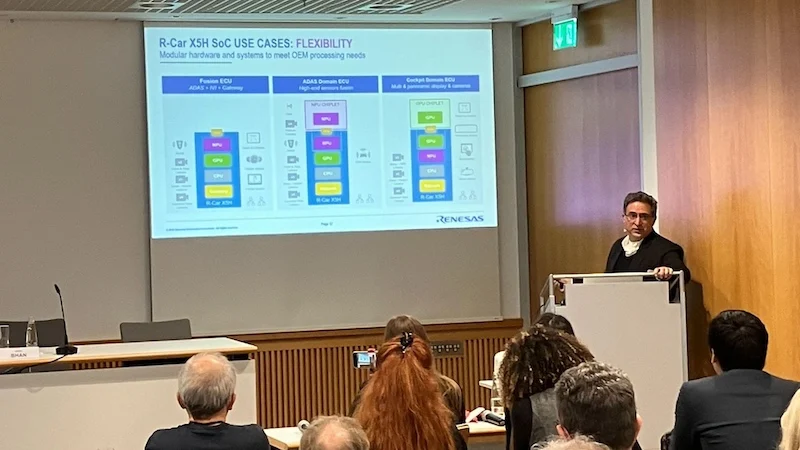
Vivek Bhan discussing the 5th-gen R-Car SoCs.
There, we learned details of how the new R-Car SoCs may meet the evolving demands of centralized compute architectures and software-defined vehicles (SDVs).
New R-Car SoCs for Automotive Centralized Compute
The new lineup, anchored by the R-Car X5H, features 32 Arm Cortex-A720AE cores that deliver a combined performance of up to 1000k DMIPS, making it ideal for advanced ADAS and autonomous driving applications. To meet real-time processing demands, the R-Car X5H incorporates six Arm Cortex-R52 cores operating in dual-lockstep, providing over 60k DMIPS and supporting Automotive Safety Integrity Level D (ASIL D).
Overall, this SoC achieves up to 400 TOPS of AI processing power, enabled by an optimized neural processing unit (NPU) and digital signal processor (DSP).
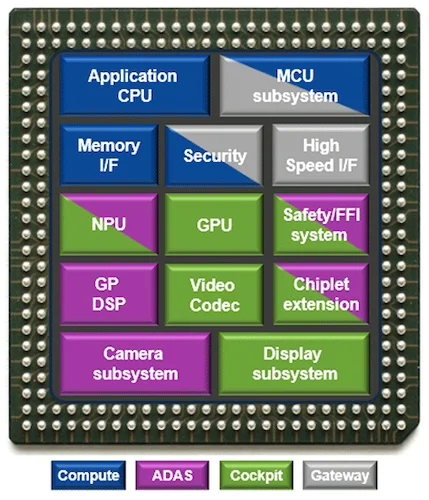
The functional blocks of the 5th-generation R-Car SoC
“The R-Car Gen 5 SoCs deliver advanced graphics processing capabilities through a high-performance GPU, achieving up to 4 TFLOP of graphics processing power. This graphics subsystem supports multi-4K media processing, multiple megapixel camera inputs, and multiple display outputs.
In terms of efficiency, the fifth-generation solution utilizes 3-nm process technology, resulting in a 30-35% power improvement compared to its 5-nm predecessors. Additionally, energy efficiency is further enhanced by an integrated system control processor (SCP) that manages various low-power modes for specific applications, such as parking and sentry mode.
Flexibility Through Chiplets
The architecture of the R-Car X5H supports flexible scalability through chiplet technology.
Traditionally, high-performance SoCs are designed as monolithic chips, with all processing units, graphics, and AI accelerators integrated onto a single die. While this approach delivers strong performance, it lacks the flexibility to adapt cost-effectively to evolving application requirements.
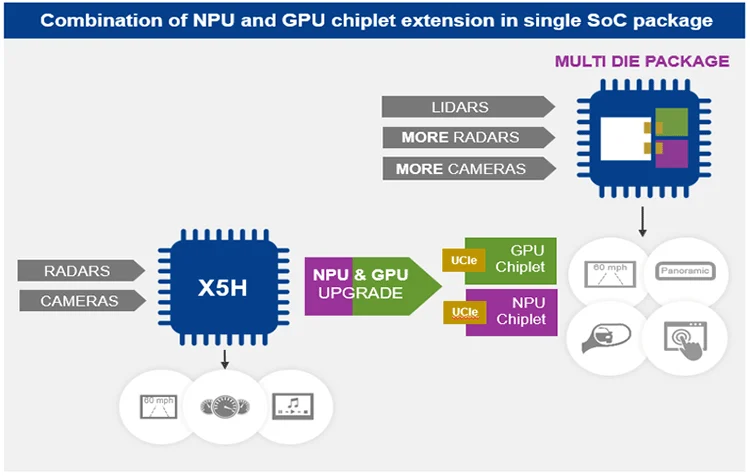
NPU and GPU chiplet extension in the R-Car SoCs
To address this limitation, the R-Car Gen 5 SoCs employ a chiplet-based architecture, modularizing individual components such as the NPU and GPU into separate, easily integrated chiplets. This design allows for the addition or upgrading of chiplets as needed, without the need to redesign the core SoC. OEMs can scale the SoC’s capabilities to suit specific applications, ranging from entry-level vehicles to high-end models equipped with advanced ADAS features. For instance, if greater AI processing power is required, a designer can seamlessly integrate an NPU chiplet to enhance performance without impacting the overall system architecture.
Additionally, this approach supports interoperability across multi-die systems through standardized die-to-die interconnects, such as the UCIe interface. This provides a highly customizable solution for OEMs, significantly reducing development time and costs. As vehicles increasingly become software-defined, the chiplet architecture of the R-Car Gen 5 SoCs offers automotive manufacturers a flexible and future-proof pathway to enhance computing power and adapt to evolving requirements.
Future-Ready Automotive Systems
Renesas’ fifth-generation R-Car SoCs embody a forward-thinking approach to the ever-changing demands of modern automotive applications, especially as cars shift toward more centralized and software-defined architectures. The R-Car X5H will be available for sampling to select automotive customers in the first half of 2025, with production planned for the second half of 2027.
