
Walmart has committed $520 million to Symbotic, an AI robotics company, to revolutionize its supply chain. This investment aims to enhance the efficiency, speed, and safety of Walmart’s fulfillment operations, particularly in online order processing. The collaboration focuses on deploying Accelerated Pickup and Delivery (APD) centers across the nation, integrating advanced robotics to streamline inventory management and order fulfillment.
How Does Symbotic’s AI Robotics Enhance Walmart’s Fulfillment Centers?
Symbotic’s AI-powered robotics systems are designed to automate various processes within Walmart’s fulfillment centers. These systems utilize autonomous robots capable of sorting, storing, retrieving, and packing products efficiently. By implementing these technologies, Walmart aims to reduce human error, increase processing speed, and improve overall operational efficiency.
Chart Title: Efficiency Comparison Before and After AI Robotics Implementation
| Metric | Before AI Robotics | After AI Robotics |
|---|---|---|
| Order Processing Time | 4 hours | 1 hour |
| Human Labor Requirement | High | Low |
| Error Rate | 5% | 0.5% |
| Inventory Turnover Rate | 3 times/year | 6 times/year |
What Are Accelerated Pickup and Delivery (APD) Centers?
Accelerated Pickup and Delivery (APD) centers are specialized facilities designed to expedite the processing of online orders. These centers utilize advanced robotics and AI to quickly pick, pack, and prepare orders for either customer pickup or delivery. Walmart plans to deploy these centers in 400 locations, aiming to enhance the speed and efficiency of its e-commerce operations.
Why Is Walmart Investing in Symbotic’s AI Robotics?
Walmart’s investment in Symbotic’s AI robotics is driven by the need to enhance its e-commerce fulfillment capabilities. With the increasing demand for online shopping, particularly for services like curbside pickup and home delivery, Walmart aims to improve the efficiency and speed of its order processing systems. By integrating advanced robotics, Walmart seeks to meet customer expectations for fast and reliable service.
Which Walmart Locations Will Benefit from the AI Robotics Integration?
The integration of Symbotic’s AI robotics will initially focus on Walmart’s Accelerated Pickup and Delivery (APD) centers. These centers are strategically located across the country to serve high-density urban areas with significant online order volumes. The deployment will be phased over several years, with plans to expand to additional locations based on performance metrics and demand.
How Will Customers Experience the Impact of AI Robotics?
Customers are expected to notice significant improvements in the speed and accuracy of their online orders. With the implementation of AI robotics, Walmart aims to reduce order processing times, minimize errors, and enhance the overall shopping experience. These advancements are particularly beneficial for services like curbside pickup and home delivery, where timely and accurate order fulfillment is crucial.
Buying Tips: How to Leverage Walmart’s AI-Enhanced Services
To take advantage of Walmart’s enhanced fulfillment services, customers should utilize the company’s online platforms to place orders for curbside pickup or home delivery. By choosing items available at APD-enabled locations, customers can benefit from faster processing times and improved accuracy. Additionally, staying informed about new APD center openings can help customers select the most efficient fulfillment options.
Electronic Components Expert Views
“The integration of AI robotics into Walmart’s fulfillment centers marks a significant advancement in retail logistics. By automating key processes, Walmart is setting a new standard for efficiency and customer satisfaction in the industry.”
FAQ
Q: What is Symbotic’s role in Walmart’s supply chain?
A: Symbotic provides AI-powered robotics systems that automate various processes within Walmart’s fulfillment centers, enhancing efficiency and speed.
Q: How many APD centers will Walmart deploy?
A: Walmart plans to deploy 400 Accelerated Pickup and Delivery centers across the nation.
Q: When will customers see improvements in their online orders?
A: Customers can expect to notice improvements as Walmart completes the phased deployment of AI robotics in its fulfillment centers over the next few years.
Symbotic is set to develop all of Walmart’s robotics applications. Following a rigorous competitive selection process, Walmart has chosen Symbotic as its partner to build and deploy advanced automation solutions aimed at accelerating warehousing, shipping, and customer fulfillment operations. Walmart has committed $520 million to equip 400 Accelerated Pickup and Delivery (APD) centers across the country, with $230 million paid upfront at the closing of this deal. Walmart also retains the option to expand its network by adding more APDs in the future for an additional fee.
Walmart Robotics Applications
When we think about Walmart and robots, a common question arises: “Where exactly does Walmart use robots?” In reality, robots are being utilized in a wide range of applications, including order processing, warehouse operations, and various material handling tasks, where they offer significant improvements in safety and efficiency.
One prime example of this optimization is palletization, where Symbotic is revolutionizing the commercial market. Traditionally, the manual method of palletizing goods involved simply stacking mixed merchandise onto pallets, often with little regard for the integrity of the items below. For instance, a heavy case of soup could easily crush a lighter box of lightbulbs, and bags of cat litter, wrapped or not, would frequently shift during shipping. These issues were often overlooked in manual loading processes. Moreover, there was minimal effort to organize the stacking of goods in a way that would facilitate efficient unloading.
.png) Twin robots stack mixed-SKU boxes on pallets using advanced algorithms that optimize based on size, weight, and store layout.
Twin robots stack mixed-SKU boxes on pallets using advanced algorithms that optimize based on size, weight, and store layout.
Symbotic’s palletization algorithms use AI and machine learning to optimize the stacking of boxes based on their size, center of mass, and crushability. They also consider how the pallet will be unloaded at the destination store. In traditional manual depalletization, workers must disassemble the pallet and place each case on carts to transport them down each aisle. However, with Symbotic’s system, the store layout is factored in, making depalletization far more efficient. Items that belong together on the shelves are packed together, and common allergens are considered to avoid cross-contamination, such as keeping bags of flour away from gluten-free items.
Improperly palletized items are a significant cause of injuries among stocking and warehouse personnel. Collapsed boxes can lead to unstable stacks that fall on workers, or workers may suffer musculoskeletal injuries while trying to prevent stacks from collapsing. These risks can be significantly minimized through optimized palletization processes.
This is just one of the many ways Symbotic has revolutionized Walmart’s supply chains.
Who is Symbotic?
Symbotic provides automation solutions for commercial markets, specializing in AI-driven algorithms that tackle a wide range of complex logistics and supply chain challenges, including palletization, shipping, storage, and more.
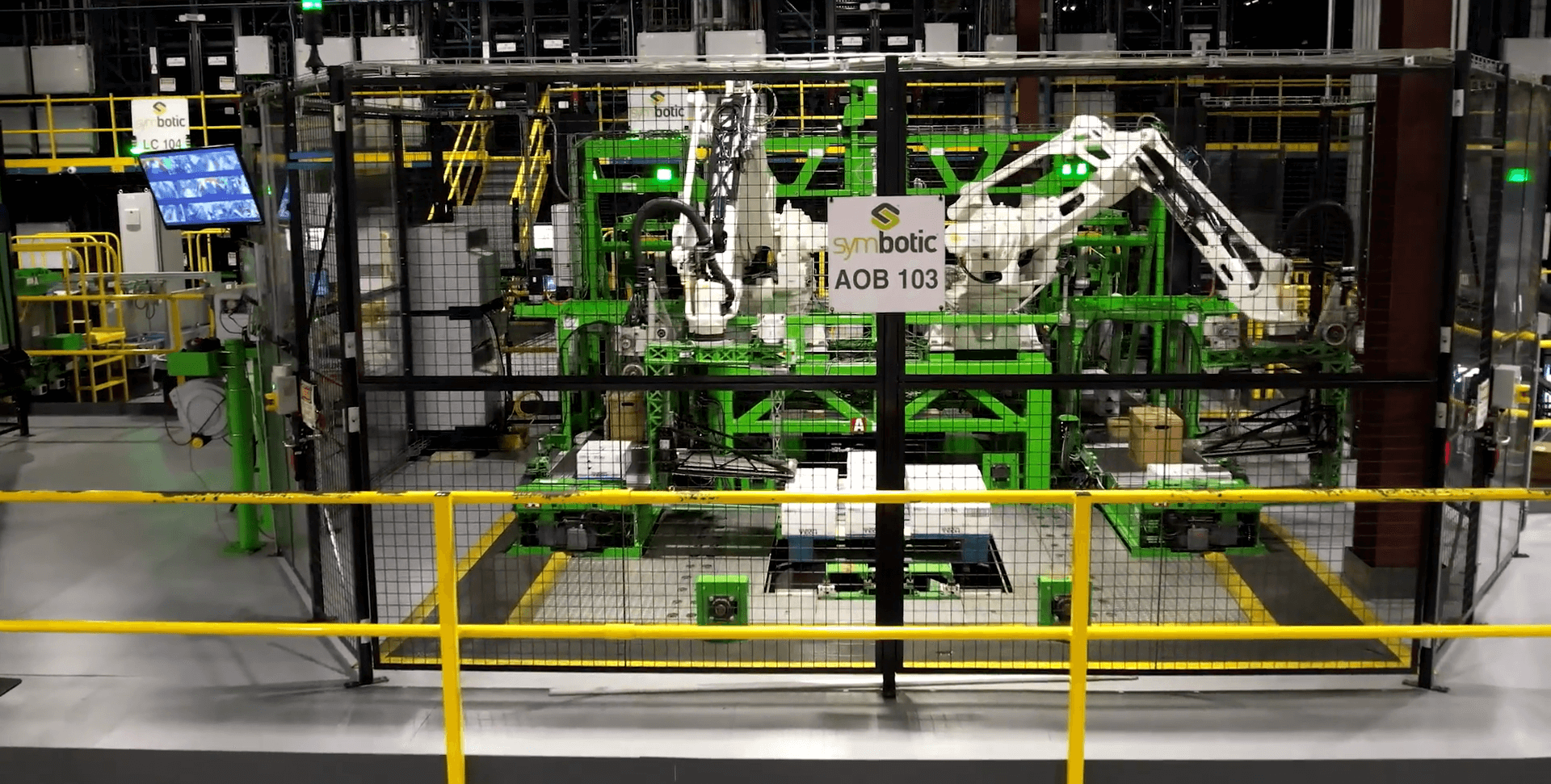 Palletization robot cell equipped with an enclosure, ensuring worker safety while efficiently stacking and wrapping pallets.
Symbotic has established itself as a global leader in supply chain automation with its advanced AI-driven robotic technologies. With the latest Walmart partnership, its project backlog has exceeded $5 billion. This collaboration also expands its addressable market in the United States by over $300 billion.
Consumer Benefits
Thanks to this partnership, consumers can expect fewer supply chain disruptions, more efficient ordering, stocking, and product delivery, along with several other significant benefits. The automation of these processes will minimize product damage caused by improper palletization and shipping, reducing shrinkage and ultimately leading to lower prices.
