
Intel’s launch of the Xeon 6 processor family at Computex 2024 marks a significant advancement in data center technology. These processors are engineered to deliver exceptional performance and power efficiency, catering to the evolving demands of modern data centers.
What Are Intel Xeon 6 Processors?
Intel Xeon 6 processors represent the latest generation of Intel’s data center CPUs, designed to address the increasing need for high-performance computing and energy efficiency. They come in two variants: Performance-core (P-core) and Efficient-core (E-core), each tailored for specific workloads.
Why Are Xeon 6 Processors Significant?
The Xeon 6 processors offer remarkable improvements over their predecessors, including:
-
3:1 rack consolidation: Achieving higher performance with fewer servers.
-
4.2x rack-level performance gains: Enhancing overall throughput.
-
2.6x performance per watt gains: Reducing energy consumption.
These advancements enable data centers to operate more efficiently, handling demanding applications like AI and high-performance computing (HPC).
Which Workloads Benefit from Xeon 6 Processors?
Xeon 6 processors are optimized for a variety of workloads, including:
-
AI and machine learning: Accelerating model training and inference.
-
HPC applications: Supporting complex simulations and data analysis.
-
Cloud-native applications: Enhancing scalability and responsiveness.
Their versatility makes them suitable for both performance-intensive and efficiency-focused tasks.
How Do Xeon 6 Processors Achieve Power Efficiency?
The Efficient-core variant of the Xeon 6 processors, codenamed Sierra Forest, utilizes a modular system-on-chip architecture. This design allows for high core density and improved performance per watt, making it ideal for throughput-oriented workloads like microservices and networking.
When Will Xeon 6 Processors Be Available?
Intel began shipping the first Xeon 6 processors with E-cores in June 2024. The P-core variants are expected to launch in the third quarter of 2024, providing options for a broader range of data center applications.
Where Can Xeon 6 Processors Be Deployed?
These processors are suitable for various deployment scenarios, including:
-
Public and private clouds: Offering scalable and efficient computing resources.
-
Enterprise data centers: Supporting mission-critical applications.
-
Edge computing environments: Enabling real-time data processing.
Their flexibility ensures compatibility with diverse infrastructure setups.
Are Xeon 6 Processors Compatible with Existing Infrastructure?
Yes, Xeon 6 processors are designed to integrate seamlessly into existing data center infrastructures. They support standard server platforms and can be deployed without significant modifications, facilitating smooth upgrades from previous Xeon generations.
Can Xeon 6 Processors Help Reduce Data Center Costs?
By offering higher performance per watt and enabling rack consolidation, Xeon 6 processors can lead to substantial cost savings. Organizations can achieve more with fewer resources, reducing both capital and operational expenditures.
Buying Tips
When considering the purchase of Intel Xeon 6 processors, it’s essential to evaluate your specific workload requirements and infrastructure compatibility. Fly-Wing Technology (HK) Co., Limited offers a range of Intel Xeon processors at competitive prices, with a focus on hard-to-find parts and original components. Their global supplier network and optimized inventory can help reduce procurement cycles and lower transaction costs.
Electronic Components Expert Views
“The introduction of Intel’s Xeon 6 processors signifies a pivotal moment in data center evolution. Their blend of performance and efficiency addresses the pressing need for scalable and cost-effective computing solutions in the AI era.”
FAQ
Q: What are Intel Xeon 6 processors?
A: Intel Xeon 6 processors are the latest generation of Intel’s data center CPUs, offering enhanced performance and power efficiency for various workloads.
Q: When will Xeon 6 processors be available?
A: The first Xeon 6 processors with E-cores began shipping in June 2024, with P-core variants expected in the third quarter of 2024.
Q: How do Xeon 6 processors improve data center efficiency?
A: They offer significant performance gains and power efficiency, enabling rack consolidation and reducing energy consumption.
Q: Can Xeon 6 processors be integrated into existing infrastructures?
A: Yes, they are compatible with standard server platforms, facilitating easy integration into current data center setups.
Q: Where can Xeon 6 processors be deployed?
A: They are suitable for public and private clouds, enterprise data centers, and edge computing environments.
The new processors promise 3:1 rack consolidation, 4.2x rack-level performance gains, and 2.6x performance per watt gains.
Intel announced its newest data center processor family, the Xeon 6, at Computex 2024. The new processors come in either Performance-core (P-core) or Efficient-core (E-core) variants to serve applications requiring the highest levels of performance and those focused on hardware density and power conservation.
Computing performance today isn’t just about brute-force computation. While heavy-duty computing power is vital, with a typical mid-size data center having about 200 racks and consuming about 15 Kilowatts of power, energy consumption is equally critical. The Xeon 6 architecture is built to tackle both needs.
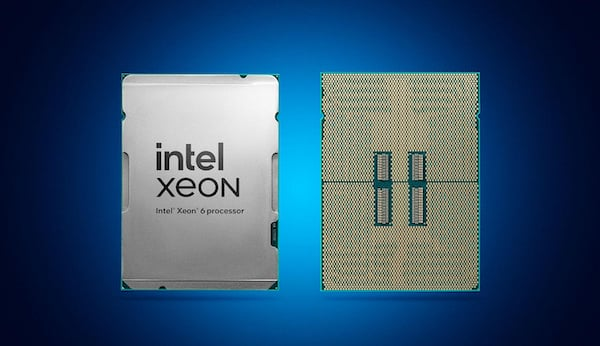
Intel Xeon 6 processor for high-density data center applications.
The new E-core processors promise a three-to-one rack consolidation, allowing up to 4.2x performance per unit of rack space and 2.6x performance per watt. According to Matt Langman, Intel VP and general manager for Intel Xeon 6 processors with P-cores, the Xeon 6 E-core processors will enable the same computation output in a third of the space. That level of efficiency shrinks the physical and carbon footprints of an installation or increases the throughput of a same-size installation.
The ecosystem-compatible P-core is optimized for AI and other high-intensity data center applications. P-core is designed to operate alongside Intel Gaudi AI accelerators. Intel hopes to stack the Xeon 6 P-core/Gaudi combination up against the Nvidia H100 AI large language model (LLM) training architecture.
Advanced Memory Interface
Compute Express Link (CXL) is critical to data center applications, and Xeon 6 was built from the start with it in mind. CXL is a high-capacity CPU-to-device and CPU-to-memory open interconnect specification. It’s built on serial PCI Express (PCIe) interface technology. Intel created the CXL standard consortium in 2019. Competing high-speed data center interconnect standards have since been merged into the CXL specification.
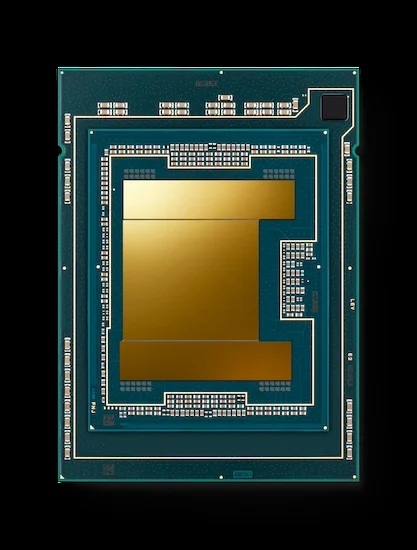
Xeon 6 Efficient-core processor
“We’re trying to achieve greater than 2x over the prior generation Xeon,” said Intel senior fellow Sailesh Kottapalli. “We wanted to make sure that we also provision similar memory bandwidth increase to go with it to support the performance scalability.”
Xeon 6 includes support for CXL I, II, and III for maximum performance and flexibility. The Xeon 6 natively supports 12 channels of memory, both DDR at multi-ranked buffered dual inline memory module (MR-DIM). With CXL III hetero interleave mode, the Xeon adds four more memory channels for an effective 16 channels. This expansion is completely software-transparent.
Chiplets Allow Greater Design Flexibility
The Xeon 6 chip is constructed out of a set of smaller chiplets. One of the advancements that come with the Xeon 6 multi-die architecture is a manufacturing optimization that uses different process nodes for the chiplets based on functional requirements. The way the I/O and compute are partitioned is significant, says Kottapalli.
“We have a partitioning where a lot of the I/O capability utilities are aggregated in a silicon construct, which is optimized on one technology node. The rest of the compute, along with the optimized memory support, is on a different technology node that brings in the most performance as well as power efficiency.”
E-core vs. P-core
As highlighted above, the E-core (code-named Sierra Forest) is focused on space and energy efficiency, while the P-core (code-named Granite Rapids) is targeted at the highest-demand data center applications, such as AI and scalable cloud-native applications.
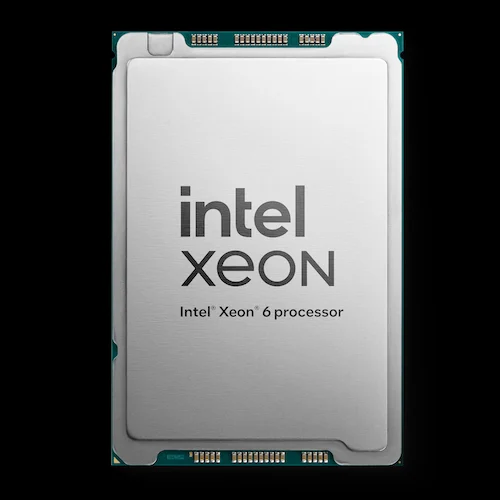
Xeon 6 Performance-core processor.
While the two processors share the same interface architecture, the P-core has additional compute chiplets integrated. The platform is designed with expansion in mind. For I/O, the architecture will allow up to 136 PCIe lanes, and P-core will eventually support up to 128 cores. The E-core processors are available now, and the P-core is projected to be available in Q3 2024.
More on Lunar Lake to Come…
In addition to the Xeon 6 announcement, Intel also unveiled the Lunar Lake x86 AI PC architecture. Intel expects Lunar Lake to reduce system-on-chip (SoC) cost by up to 40% over the previous-generation x86 client architecture.
Lunar Lake enables new performance cores (P-cores) for desktop and high-performance systems and efficient cores (E-cores) for power-constrained applications in the mobile and laptop arena. It includes a fourth-generation neural processing unit (NPU) and Battlemage, an all-new GPU design.
Stay tuned to All About Circuits for more details about the Lunar Lake architecture.
All images used courtesy of Intel.
