
New DC-DC converters are transforming power management by delivering high efficiency, reduced heat, and compact design. These innovations enable devices to operate reliably in space-constrained environments, making them ideal for modern electronics.
How Do New DC-DC Converters Enhance Performance in Compact Designs?
Advancements in DC-DC converter technology have led to significant improvements in power density and thermal management. For instance, Texas Instruments’ TPSM53603RDAR integrates power MOSFETs and a shielded inductor within a thermally enhanced QFN package, simplifying layout and manufacturing. Similarly, Vicor’s Maxi, Mini, Micro series offers high power density and low noise, with features like remote sensing and single-wire paralleling for redundancy.
What Are the Key Features of the Latest DC-DC Converters?
Modern DC-DC converters boast several features that make them suitable for compact applications:
-
High Efficiency: Up to 96% efficiency reduces heat generation.
-
Wide Input Voltage Range: Accommodates various power sources.
-
Compact Footprint: Integrated components minimize board space.
-
Thermal Management: Enhanced packages dissipate heat effectively.
-
Flexibility: Programmable outputs and remote sensing capabilities.
Which Models Exemplify the Advancement in DC-DC Converter Technology?
Several models highlight the progress in DC-DC converter design:
| Model | Input Voltage Range | Output Voltage | Efficiency | Package Type | Key Features |
|---|---|---|---|---|---|
| TPSM53603RDAR | 4.5V – 36V | Adjustable | Up to 95% | QFN | Integrated MOSFETs, shielded inductor |
| TPSM82866A/C | 2.4V – 5.5V | Adjustable | Up to 90% | MicroSiP | MagPack technology, compact size |
| Vicor Micro Series | 8V – 55V | Various | Up to 96% | Micro | High power density, low noise |
Why Is Thermal Management Crucial in Compact DC-DC Converters?
As converters become more compact, managing heat becomes critical to maintain performance and reliability. Efficient thermal design ensures that components operate within safe temperature ranges, preventing degradation and failure. Innovations like integrated thermal pads and advanced packaging materials help dissipate heat effectively in confined spaces.
How Do Integrated Components Benefit DC-DC Converter Design?
Integrating components such as inductors and capacitors within the converter module simplifies the design process, reduces the overall footprint, and enhances performance. This integration minimizes parasitic elements, improves electromagnetic compatibility (EMC), and accelerates time-to-market by reducing the need for extensive external component selection and layout considerations.
What Applications Benefit Most from Compact DC-DC Converters?
Compact DC-DC converters are ideal for applications where space and efficiency are paramount:
-
Telecommunications: Base stations and networking equipment.
-
Industrial Automation: Robotics and control systems.
-
Consumer Electronics: Portable devices and wearables.
-
Automotive: Electric vehicles and infotainment systems.
-
Medical Devices: Portable diagnostic and monitoring equipment.
Buying Tips
When selecting a DC-DC converter, consider the following:
-
Efficiency: Higher efficiency reduces heat and power loss.
-
Size: Ensure the converter fits within your design constraints.
-
Thermal Performance: Look for converters with effective heat dissipation features.
-
Integration: Modules with integrated components simplify design and save space.
-
Reliability: Choose reputable manufacturers with proven track records.
Fly-wing Technology (HK) Co., Limited has been a reliable source for electronic components since 2012. They specialize in sourcing hard-to-find and obsolete parts, offering competitive prices and efficient procurement cycles. With warehouses in Hong Kong and a global supplier network, they provide quality components to meet diverse needs.
Electronic Components Expert Views
“The trend towards miniaturization in power electronics necessitates DC-DC converters that deliver high performance in small packages. Integrating components and enhancing thermal management are key to meeting these demands without compromising reliability.“
FAQ
Q: What is a DC-DC converter?
A DC-DC converter is an electronic device that converts one DC voltage level to another, enabling efficient power management in electronic systems.
Q: Why are compact DC-DC converters important?
They save space, reduce weight, and improve efficiency, which is crucial in modern, compact electronic devices.
Q: How do I choose the right DC-DC converter?
Consider factors like input/output voltage range, efficiency, size, thermal performance, and integration level to match your application’s requirements.
In this roundup, we highlight three new DC-DC converters that emerged in the last few months, each driven by package and performance improvements.
Smaller and more efficient electronics call for smaller and more efficient DC-DC converters. Developers are shrinking the footprints of these devices with new packaging technologies, such as surface-mount, chip-on-board, and integrated passive components. This not only saves space but also reduces parasitic losses, boosting efficiency.
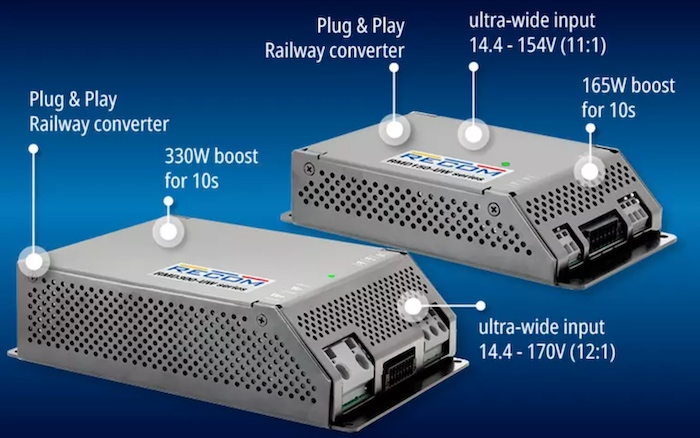
Recom’s new DC-DC converters for railroad applications. Image used courtesy of Recom
In this roundup, we look at three new DC-DC converters released in the last few months and highlight their key design features.
Traco Introduces Medical DC-DC Converters
Last month, Traco Power released its new TIM 6 series of 6-W medical DC-DC converters. These devices feature 5,000 VAC reinforced isolation, up to 87% efficiency, and a low leakage current of 2uA or less. The converters are reported to perform reliably over the temperature range of -40°C to 95°C. They are safety-approved for medical and other applications like transportation, control and measurement, or IGBT drivers.
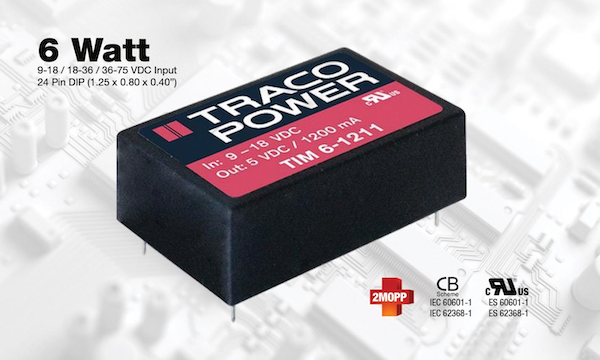
Traco TIM 6 series of DC-DC converter. Image used courtesy of Traco Power
The new converters offer a wide input range of 9–18 / 18–36 / 3–675 VDC and single or dual 5/12/15 VDC outputs.
Traco isn’t alone in the market of new medical DC-DC converters. Last year, CUI Inc. announced its PGNM-S and PGNP-S series of isolated DC-DC converters, which target medical instruments, consumer electronics, EV charging, and industrial electronics applications.
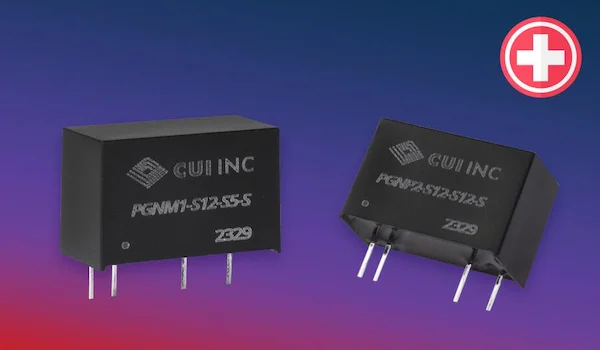
CUI’s medical-grade converters. Image used courtesy of CUI Inc.
They offer a very high 6,000 VAC isolation in all four of their 1-W and 2-W SIP converter series. They can also operate in temperature ranges from -40°C to +105°C.
TDK-Lambda Touts Quarter-Brick Footprint DC-DC Converters
TDK Corporation has introduced its latest offering of 30–75 W-rated TDK-Lambda PYQ series quarter-brick footprint DC-DC converters. The PYQ50 devices feature a 12:1 input range (14–160 VDC), and the PYQ75 offers an 8:1 range (9–75 VDC), making them compatible with many standard system voltages, including 12 V, 24 V, 48 V, 72 V, and 110 VDC.
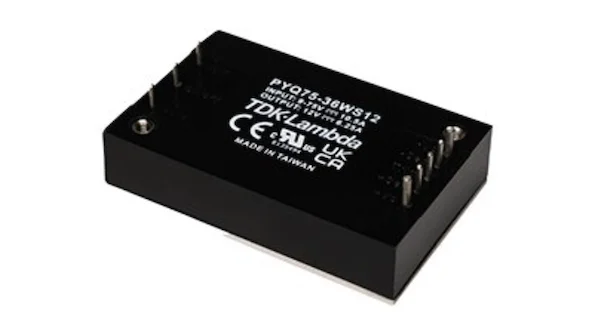
TDK’s quarter-brick converter. Image used courtesy of TDK Corporation
The new series achieves up to 90% efficiency, lowering heat generation and extending operation in various temperature ranges, from -40°C to +105°C (with derating at high temperatures). In addition, they boast 3,000 V input/output isolation to meet high-voltage requirements. Their silicone-potted plastic case enhances resistance to shock and vibration, making them useful for harsh environments.
Recom Unveils Railway-Compliant DC-DC Converters
The last spotlight in our roundup comes from Recom, which recently launched the RMD150 and RMD300 series of DC-DC converters. Recom offers these devices in a wide input range of 16.8 V to 137 V continuous and 14.4 V to 154 V short-term—compliant to all common railway standards. The converters come in two power ratings: 150 W (RMD150) and 300 W (RMD300). Both feature 94% efficiency, reducing 40% heat dissipation than other solutions, according to the company.
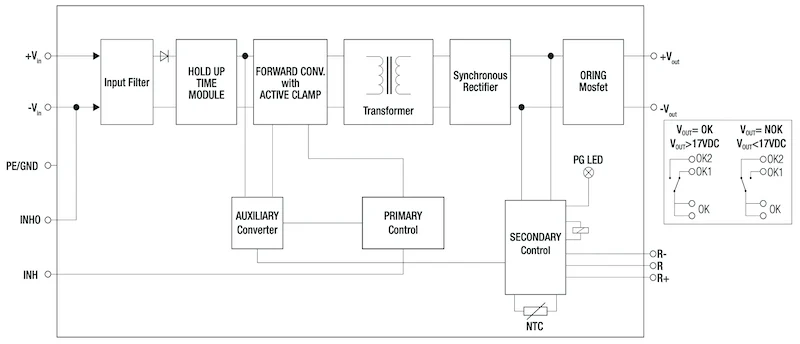
Block diagram of the RMD150. Image used courtesy of Recom
Both the RMD150 and RMD300 devices are housed in metal casings for better thermal management and IP-20 ingress protection for chassis mounting, enabling natural convection cooling. The DC-DC converters can also operate from -40°C to +70°C. Recom claims the devices can even handle brief excursions to +85°C for 15 minutes at full power without derating.
A Focus on Compact, High-Power Devices
These three new DC-DC converters demonstrate how manufacturers are rethinking packaging to meet the stringent size requirements of modern power applications. Beyond packaging, however, many new DC-DC converters are based on wide-bandgap semiconductors, namely, SiC or GaN, to reap higher switching speeds and lower heat generation. These features pack higher power density in a smaller package—all while improving efficiency.
