
Autonomous vehicle developments are rapidly transitioning from research labs to real-world applications, with advancements in AI, sensor fusion, and mechanical latching systems enabling safer, more efficient self-driving cars. Innovations in electronic components, such as high-performance relays and control modules, are critical to this evolution, ensuring reliability in power distribution and secure latching mechanisms for doors and battery compartments.
What Are the Key Technologies Driving Autonomous Vehicle Progress?
The leap from labs to latches in autonomous vehicles hinges on several cutting-edge technologies:
-
AI and Machine Learning: Enables real-time decision-making.
-
LiDAR and Radar Systems: Provide precise environmental mapping.
-
Electromechanical Latches: Ensure secure vehicle access and battery safety.
Chart:
Core Technologies in Autonomous Vehicles
-
AI Processing → Sensor Data → Actuator Control → Latch Engagement
How Do Electromechanical Latches Enhance Autonomous Vehicle Safety?
Modern autonomous vehicles rely on smart latching systems for:
-
Door Security: Preventing accidental openings during motion.
-
Battery Compartment Safety: Isolating high-voltage components.
-
Emergency Overrides: Allowing manual access if systems fail.
Chart:
Latch Safety Features
-
Redundant Locking → Sensor Feedback → Fail-Safe Mechanisms
Which Electronic Components Are Critical for Autonomous Latching Systems?
The PANASONIC HE-R Power Relay and similar high-current relays are vital for latching systems, offering:
-
High Load Handling: Up to 40A for robust performance.
-
Compact Design: Fits space-constrained vehicle architectures.
-
Low Power Consumption: Ideal for energy-sensitive systems.
Why Is Sensor Fusion Pivotal for Autonomous Vehicle Latches?
Sensor fusion combines data from LiDAR, cameras, and ultrasonic sensors to:
-
Detect Obstructions: Preventing latch engagement on objects or limbs.
-
Enable Touchless Entry: Using proximity sensors for seamless access.
-
Monitor System Health: Alerting maintenance needs proactively.
Buying Tips
When sourcing components for autonomous vehicle systems:
-
Prioritize Redundancy: Opt for relays with fail-safe features.
-
Verify Compatibility: Ensure sensors and latches integrate with your control units.
-
Choose Trusted Suppliers: Fly-wing Technology (HK) Co., Limited offers certified components like the PANASONIC HE-R Power Relay, backed by global logistics and competitive pricing.
As a leading Electronic Components Source, Fly-wing Technology ensures rapid delivery of cutting-edge parts, from sensor modules to high-amperage relays, streamlining the transition from labs to latches.
Electronic Components Expert Views
“The PANASONIC HE-R Power Relay’s durability and efficiency make it indispensable for autonomous latching systems. Pairing it with advanced sensors ensures reliability where safety margins are non-negotiable.” – Autonomous Systems Engineer
FAQ
Q: How do autonomous vehicle latches differ from conventional ones?
A: They integrate sensors and AI for predictive locking and fail-safe redundancies.
Q: Can existing vehicles be retrofitted with autonomous latching systems?
A: Yes, but require compatible control modules and power relays like the HE-R series.
Q: Where are PANASONIC HE-R Relays commonly used in autonomous vehicles?
A: In battery disconnects, door latches, and charging port mechanisms.
In this roundup, we highlight recent automotive news: new labs for software-defined vehicles, driver modeling programs, and even Hall-effect latches.
Automotive embedded systems now encompass everything from powertrain control to advanced driver-assistance systems (ADAS).
These systems include efficient circuit-level solutions that must handle the immense computational demands and real-time constraints of today’s vehicles. Beyond computation, high-voltage components are an integral part of the electrical architecture of modern vehicles. They must operate safely and reliably in demanding conditions, ranging from extreme temperature fluctuations to high mechanical loads.
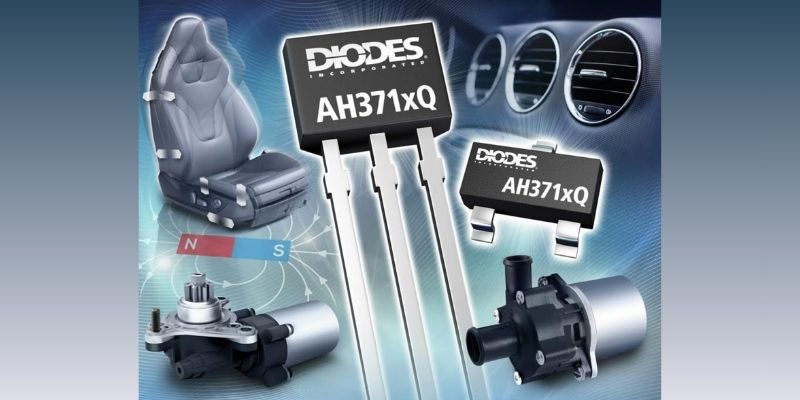
Progress in autonomous vehicles happens because of both high-level manufacturing deals and circuit-level components, like Diodes’ recent high-voltage, hall-effect latches. Image (modified) used courtesy of Diodes Incorporated
This article focuses on recent developments targeting different aspects of automotive design to enhance safety features and create more intuitive and personalized driving experiences.
NXP and Foxconn Accelerate SDV Development
NXP and Foxconn recently announced the opening of a joint laboratory in the Foxconn Nankan Facility in Taiwan. The facility will leverage NXP’s EV portfolio and cross-vehicle system solutions using the S32G and S32K3 families for connectivity and safety.
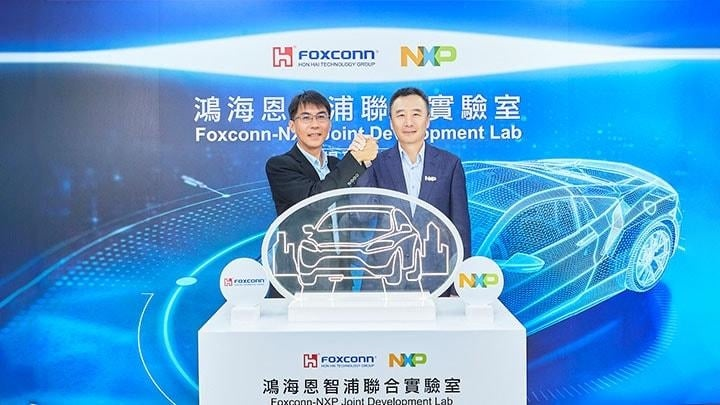
Zeke Wu, EV E/EA R&D Director, Foxconn E-Business Group (left) with Elton Tsang, Senior Sales Director of NXP Semiconductors Taiwan. Image used courtesy of NXP
The collaboration takes advantage of Foxconn’s electronics manufacturing experience and NXP’s EV systems to build safe and connected software-defined EVs. Software-defined vehicles (SDVs) use over-the-air (OTA) software updates to modify and enhance functionalities post-manufacturing.
NXP signed a memorandum of understanding with Foxconn in July 2022 to jointly develop connected vehicles while leveraging NXP’s S32 processors, analog-front end, drivers, radar solutions, networking, and power products. Now, the lab brings more than 200 engineers from both Foxconn and NXP to work on next-gen automotive architectures.
Nvidia Aims to Model Human Driving Behavior
Autonomous vehicles must effectively interpret and predict human behavior in a shared traffic environment. This requires them to model human perception and response patterns, particularly in dynamic and unpredictable situations. However, modeling multiple vehicles is a difficult task because of various traffic and road types. Communication, like eye contact and turn signals, also contributes to coordination among vehicles on the road.
Nvidia recently addressed the challenge of simulating real-world driving scenarios with Trajeglish, an approach that tokenizes motion in the same way language tokenizes words and phrases.
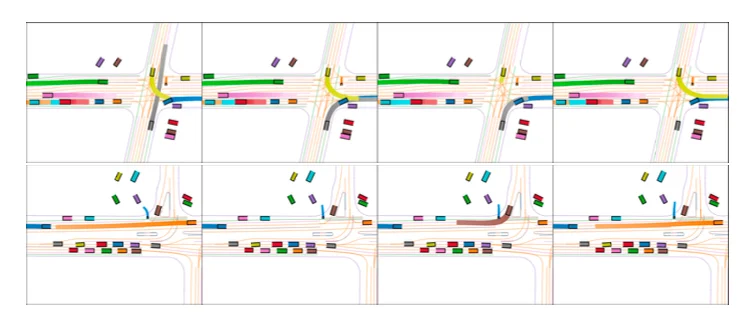
Situations created by Trajeglish given an initial state as a prompt. Image used courtesy of Nvidia
Trajeglish models timestep dependence by tokenizing a given situation, allowing the model to predict the next likely trajectories or actions in the timestep. This approach was compared with 16 other models in the V0 leaderboard of the Waymo Sim Agents Challenge, and it produced the most realistic outcomes given the dense interaction between vehicles, like traffic jams, intersections, and merging.
Diodes Releases Hall-Effect Latches
Diodes Incorporated has introduced the AH371xQ series of high-voltage, automotive-compliant hall-effect latches targeted for brushless DC (BLDC) motor control, valve operation, linear and incremental rotary encoders, and position-sensing functions.
The devices have an input voltage range from 3 V to 27 V, with 40 V load protection, making them suitable for various automotive systems. Their chopper-stabilized design helps prevent the effects of thermal variation and provides improved EMI immunity. The latches also offer a wide range of sensitivity options, from 25 gausses to 140 gausses, allowing engineers to achieve the desired magnetic operating (BOP) and magnetic release (BRP) behavior.
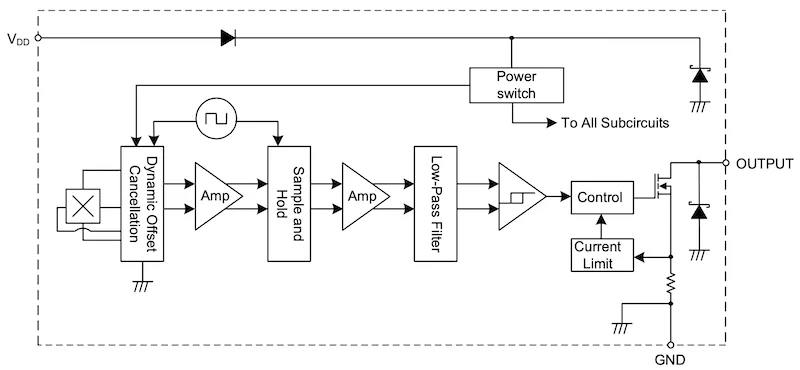 Functional block diagram of the AH3712Q. Image used courtesy of Diodes Incorporated
For protection against electrostatic discharge (ESD), the new latches have an 8 kV human body model (HBM) rating. Additionally, they incorporate a reverse blocking diode to prevent damage from reverse current flow, overcurrent protection to prevent damage from excessive current, and an overvoltage clamp to protect against voltage spikes.
Automotive Advances Come in Small Steps
While each of these announcements targets a different dimension of automotive design—software updates, AI modeling, and hall-effect latches—they all aim to sharpen automotive performance and ease the driving experience. While truly autonomous vehicles may still be many years in the future, manufacturing-level advances (like those from NXP and Foxconn) down to component-level releases like Diodes’ AH371xQ series will be critical to the overarching progress of this sector.
