
Introduction
The traditional power grid was built for one-way electricity flow: from large power plants to homes, businesses, and factories. But that outdated model struggles under today’s demands. Extreme weather events, renewable energy sources, and rising electricity usage call for a smarter solution: the smart power grid.
This next-generation energy system uses two-way communication, automation, and data-driven control to modernize how we generate, distribute, and consume electricity.
According to IEA report, the worldwide electricity consumption rose 2.2% in 2023 and that over 3% more annual increases are predicted between 2023 and 2026, partly due to rising electric vehicles, smart homes, and digital infrastructure.
A smart power grid is not just an improved version of our present electrical grid. It is a smart, networked system capable of monitoring, reacting, and even correcting itself on the fly.
The smart power grid uses two-way communication, grid automation, and real-time data analytics to enable renewable energy integration, improve energy resilience, and support a smoother energy transition.
In this article, we will discuss how smart power grids operate, their technology, challenges and applications. We will also cover how traditional grids differ from smart grids.
What is Smart Grid?
A smart grid refers to a new electricity system that is constructed using high-tech digital solutions and is real-time connected.

In contrast to traditional grids, where energy is only transmitted in one direction with little visibility, smart power grids are monitored and controlled actively through the use of sensors, automation and dynamic information exchange between the only supply and demand sides.
This enables utilities to become more responsive, more efficient, and allow a more resilient and flexible energy system.
In simple terms, smart power grids are electricity networks that are now smarter as our phones, homes, and vehicles.
They no longer focus on providing power but must do so with intelligence. With the development of digital technology, these grids now have the capabilities to monitor, communicate and adjust in real time.
Nowadays, prosumers, those who both generate and consume energy, are setting up solar panels, wind systems, and battery storage grid-directly, and this has brought a whole new range of complexity.
The two-way electricity flow also requires more innovative infrastructure to control and stabilize the system by utilities. The smart grids give grid operators the instruments to achieve demand balance, renewable integration, and improved planning decisions with up-to-date information.
Smart Grid Architecture: Key Components and Layers
Smart power grids are distributed and layered, data-driven. The traditional grids are on a top-down, centralized level, whereas smart grids can be run on real-time data, automation, and control from a centralized power plant to household appliances.
Under this approach, the grid can balance sources of energy and demand, combine various sources of energy and automatically react to faults based on the dynamic decision-making process.
Below are the key architectural components that make up a modern smart power grid:
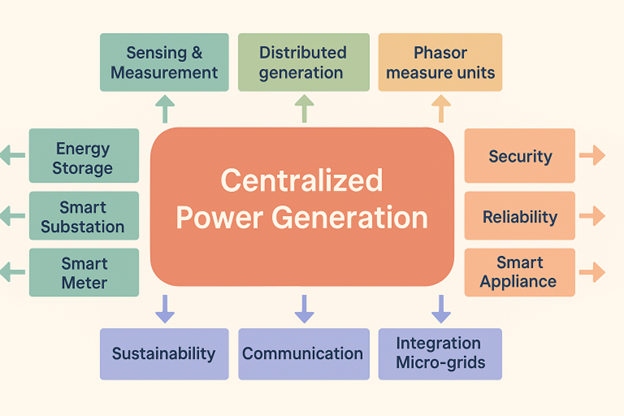
1. Energy Storage Systems
Smart power grids depend on energy storage. By using it, the system can:
- Manage peak demand
- Make renewables more stable
- Improve power quality
- Protect the grid from outages
Different types of energy storage are available depending on the application:
- Electrical: Includes capacitors, supercapacitors, and superconducting magnetic energy storage (SMES), perfect for short-duration, high-power delivery.
- Mechanical: Flywheels, compressed air energy storage (CAES), and pumped hydro store energy for grid balancing.
- Chemical: Includes lithium-ion and metal-air batteries, fuel cells, and thermochemical systems.
- Thermal: Stores excess energy as heat or cold for later use in HVAC systems, industrial processes, or district heating networks.
2. Smart Meters
Smart meters are the interface between end-users and the grid. They are equipped with:
- Two-way communication to transmit energy consumption data to utilities in real time
- Built-in displays (in some models) that allow consumers to monitor their usage and cost
- Automated billing support and the ability to participate in demand response programs
These meters enable precise visibility and control, helping consumers and grid operators. The national grid smart meter rollout in the UK is a prime example of large-scale deployment that empowers consumers with real-time data, enhances outage detection, and enables smarter energy usage patterns across millions of homes.
3. Smart Substations
Substations in a smart grid are no longer passive nodes. They’re active control centres equipped with intelligent systems that manage grid performance in real time.
Core functions include:
- Data acquisition and processing from sensors and meters
- Real-time voltage regulation and fault detection
- Automated switching and protection coordination
- Communication with adjacent substations and central dispatch systems
Smart substations are critical for grid automation, stability, and decentralized control.
4. Distributed Generation (DG)
Smart power grids are built to handle energy sources beyond large power plants.
Distributed generation includes:
- Rooftop solar
- Small-scale wind
- Combined heat and power (CHP) units
- Community-based microgrids
Benefits of DG in smart grid architecture include:
- Lower transmission losses
- Reduced infrastructure costs
- Greater energy independence and resilience
- Faster integration of clean energy sources
As DG systems are located close to where power is used, they reduce the need for long-distance transmission and improve overall efficiency.
5. Phasor Measurement Units (PMUs)
PMUs, also known as synchrophasors, measure electrical waves across the grid and synchronize those measurements using GPS-based timing.
They allow for:
- High-resolution grid monitoring (30–60 times per second)
- Real-time analysis of grid stability and phase angles
- Quick detection of faults and oscillations
- Enhanced transmission congestion management
Devices like these are crucial for wide-area monitoring and data-driven grid operations.
6. Sensing and Measurement Infrastructure
Smart power grids rely on a dense layer of sensors to monitor everything from voltage and current to equipment health and environmental conditions.
These systems:
- Detect faults and maintenance issues early
- Prevent unauthorized usage or energy theft
- Track asset performance and aging
- Enable load forecasting and grid optimization
Sensor data is used to maintain grid stability and drive long-term planning and investment decisions.
7. Smart Appliances and Demand-Side Devices
Smart appliances are equipped with communication modules that let them respond to signals from the grid. For example:
- EV chargers can be scheduled during off-peak hours
- HVAC systems can reduce output during high-demand periods
- Washing machines and dishwashers can shift cycles based on time-of-use pricing
They help reduce peak loads and align consumption with grid capacity, making end users part of grid management.
8. Security Layer
A smart grid’s complexity and connectivity make cybersecurity a top priority.
The architecture must include:
- Intrusion detection systems
- Anomaly detection algorithms
- Secure communication protocols (encryption, authentication)
- Role-based access controls
- Real-time threat monitoring and response
The purpose of security measures is to protect consumer data, ensure system integrity, and prevent service disruptions caused by cyberattacks or unauthorized access.
9. System Reliability and Self-Healing Capabilities
One of the key benefits of smart grid architecture is its ability to identify, isolate, and respond to faults with minimal human intervention.
Built-in features include:
- Self-healing algorithms that automatically reroute power
- Fault detection and location systems
- Redundant communication channels for fail-safe operation
- Historical data logging to improve future reliability metrics
As the grid becomes more complex, these features are essential for ensuring uninterrupted service and maintaining operational resilience.
How Smart Power Grids Work?
Smart power grids apply data, automation, and control to operate the electricity flow.
These are the key ingredients that cause it to work:
Advanced Metering Infrastructure (AMI)
The smart grid uses the smart meters to transmit back and forth between the consumer and the utilities. By installing these meters, you will be in a position to monitor your consumption of electricity in real time.
Consumers would be able to make more informed decisions regarding their usage and times of energy use and utilities could provide consumers with time of use rate structures and quicker outages detection.
Grid Automation and Control Systems
One of the main features of a smart grid is automation. The performance of the grid is monitored by algorithms and control systems.
In case of a problem, the system can identify the problem and correct it in virtually no time, in many cases without human involvement.
This assists in ensuring a steady level of service delivery and lower disruption.
Integrating Renewable Energy into Smart Power Grids
Smart grids harmonize with a range of energy sources. Rooftop solar, wind farms or microgrids can balance demand and supply in real time.
Consequently, intermittent sources, including solar and wind, do not pose a hazard to the grid.
Energy Storage Systems
Energy storage systems serve as buffers that absorb surplus renewable power and release it when demand spikes. This reduces reliance on backup fossil generation and enables deeper penetration of solar and wind.
For example, lithium-ion battery farms in California now regularly discharge during evening peaks when solar declines but demand surges.
Demand Response Programs
Smart power grids enable utilities to bring demand response systems in which consumers are provided the necessary tools and incentives to change their energy use in times of peak demand.
As an example, a heatwave can be used to incentivise users who cut down on usage or transfer to off-peak times.
This takes the pressure off the grid, decreases expenses, and improves total system stability.
How Smart Power Grids Differ from Traditional Grids
Both traditional and smart power grids bring power where necessary. But the way they do and the effectiveness with which they deal with the current energy challenges differ a lot.
The change to a less centralized and more responsive and data-oriented network transforms the way power systems operate drastically.

Here’s a side-by-side comparison of their core differences:
| Feature | Traditional Grid | Smart power Grid |
| Communication | One-way only (utility to consumer) | Two-way (utility and consumer exchange data and energy) |
| Energy Flow | Centralized power generation to end users | Bidirectional, including input from prosumers (e.g., solar) |
| System Visibility | Limited monitoring and feedback | Real-time data through sensors and smart meters |
| Response to Issues | Manual detection and delayed reaction | Automatic detection and fast fault isolation or rerouting |
| Flexibility | Built for centralized, stable supply | Supports decentralized, variable sources (e.g., renewables) |
| Adaptability | Poor adaptation to changing loads or demands | Dynamically balances loads, supports smart devices |
| Efficiency | Higher transmission losses, reactive fixes | Reduced losses, proactive management of power flow |
| Environmental Support | Less supportive of renewables | Designed to integrate solar, wind, and low-carbon sources |
| User Involvement | Passive consumer role | Active participation through demand response and self-generation |
Smart Grid Implementation Challenges: Cost, Security, and Regulation
A smart grid promises to transform the energy industry, however, accompanied with a list of real world challenges such that utilities, regulators, and technology providers need to be cautious in addressing.
Lets talk about each:
Cybersecurity Vulnerabilities
Smart grids are based on a fiber network of interconnected devices, through the protocols of communications, and the cloud-based services which all become potential targets.
Along with data breaches, the larger the digital surface area becomes, the tighter, proactive security is required, including encryption, real-time monitoring, and fast response.
High Upfront Cost
Creation of a smart grid is a costly affair. Utilities need to invest in smart meters, sensors, control systems, data platforms and secure communication infrastructure.
Such capital expenditures can be costly to small or underfunded utilities even when the benefits in the long run end up being more than the expenditure.
Data Privacy
Smart grid systems are able to generate real-time precise data regarding the consumption of energy, in many cases, at the level of individual households.
On the one hand, this information assists in optimizing grid operations, but, on the other hand, there is a question of privacy, and the possible misuse of such information.
Utilities should apply transparent information governance frameworks and make sure that consumer data is gathered, saved, and distributed in an accountable manner.
Integration Complexity
Integration can be a problem because several technologies-IoT sensors, distributed renewable sources, etc. can be implemented in substations via CAN buses.
It is with the interoperability standards, powerful software layer, and well-trained personnel, that these systems can be made to work with one another across various grid layers.
Regultural and Policy Hurdles
Regulatory changes usually cannot keep up with technological advances.
The implementation of smart grid should not break the current utility, data protection and energy markets. These could be different across geographies.
Rapid changes in this environment require a high level of cooperation between utilities, regulators, and technology vendors.
Smart Power Grids Applications
Smart grids are not only new infrastructure. It has already changed the way energy is managed in residential, commercial, industrial, and utility settings.
Some of the most effective use cases consist of the following:
Household Energy Management
With a smart power grid, you gain full control over your energy usage. you can track real-time consumption, cut peak-time costs, and even earn incentives for reducing demand.
Using smart meters and online home energy management systems connected, users are able to:
- Track live use of electricity electronically or use home displays
- Determine the appliances that consume lot of energy and change the behavior of use.
- Utilization of shift to off peak hours as per time-of-use pricing
- Make smart devices (such as thermostats, EV chargers, etc.) automatically run during times of low rates
This minimizes the monthly bills and assists in the entire grid stability in the peak demand times. With tools like the national grid smart meter, households can actively monitor their energy consumption, adjust habits to save on bills, and participate in demand response programs that support grid stability.
Optimisation of Industry and Commerce
For large-scale users, such as factories, data centers, and office complexes, smart grids improve reliability and reduce costs of operations.
Benefits include:
- Historical and real time based load forecasting and demand planning
- Automated load shedding at peak time or grid stress occasions
- Combining with on-site generation (e.g. solar panels, gas turbines)
- Financial incentives associated with demand response programs participation
Smart grid analytics are also used to identify inefficiency in heating, ventilating and air conditioning, lights, production lines and long-term energy savings.
Managements of Electric Vehicle (EV) Charging
Smart grids are essential when dealing with an increase in EV usage because they can control the demand on charging without overloading the nearest infrastructure.
Smart charging systems are able:
- Charge at non-peak or high-renewable generation times
- Facilitate vehicle-to-grid or V2G facilities where the EVs can release energy back to the grid
- Arrange locally deployed solar or battery storage (coordination with distributed energy resources-DERs)
- Provide fleet administrators with the capacity to group sizeable quantities of EVs and use intelligent charging algorithms.
This will make it affordable to charge as well as every consumer who will be using it and also aid in balancing demand throughout the grid.
Renewable Energy Integration
Wind and solar are highly predictable renewables, thus smart grids can manipulate their nature to their advantage.
Through sensors, forecasting, and distributed energy resource management systems (DERMS), smart grids can:
- Control real time monitoring on renewable generation
- Predict short-term output by using the weather information
- Variations with the help of battery storage or flexible loads
- Relocate overflow production to adjacent loads or storage systems
This will make the grid stronger and faster to achieve low-carbon energy.
Grid Modernization and Efficiency of Utilities
Smart power grids detect faults instantly through advanced sensors, reducing outages and saving maintenance costs.
Important developments are:
- Automated fault detection and recovery (FDIR): Reduces the impact of outage and speeds up recovery time
- Remote monitoring and diagnostics: Eliminates the requirement of manual inspection and truck rolls
- Advanced distribution management systems (ADMS): Optimize real-time power flows and voltage regulation
- Predictive maintenance tools: Evaluate the state of the transformer, cable condition, and substation conditions so as to avoid failures
This provides reduced cost of maintenance, reduced cases of outages, and a reliable power supply to everyone.
Final Thoughts
A shift to smart grids is a paradigm shift in the generation, distribution and usage of electric power.
Due to the increased demand, increasing Renewable integration and requiring real-time control, smart grids can provide a future-proof solution-one that is more efficient and adaptive and consumer-involved.
As these systems rely on precise sensing, robust communication, and intelligent control, the quality of components used becomes critical.
This is where Flywingtech can support your innovation. Their selection of microcontrollers, sensors, and embedded modules provides the building blocks needed for smart metering, grid automation, energy monitoring, and more.
Discover the Flywingtech family of industrial-grade components right now and cement the future of wiser, scalable energy systems.
Find out more at FlyTechWing.com
Frequently Asked Questions – FAQ
What is a smart power grid?
A smart power grid is a contemporary electricity supply with the implementation of computer-based communication, automation; real-time data to the optimal incorporation of electricity production, distribution, and consumption.
As opposed to the traditional grids, it can manage its own health, react fast to outages and sustain renewable energy and two-way energy flows.
In which line of business is the use of IoT technologies bringing in the application of smart grids?
Energy sector, especially electric utilities and grid operator, stands on the frontline when it comes to the deployment of Smart Grid using IoT technologies.
IoT allows utilities to collect real-time meter, sensor, equipment information to enhance grid operations, fault forecasting and control of distributed energy resources.
Which are the five elements of a smart grid?
The key elements constituting a smart grid are as under:
- Smart Meters: Manage energy consumption on a real-time basis, and enable two-way communication
- Smart Sensors: Measure voltage, current and grid condition at several places
- Two-Way Communication Networks: Enable real time data to be shared among grid and control centers
- Control Systems: Automate responses to faults and grid optimisation
- Data Analytics: Analyze masses of grid information to be used in the forecast, diagnostics, and decisions
These technologies combined allow a grid which can be much more efficient, responsive and scalable than the traditional one.
What is the central aim of a smart grid?
A smart grid has the main aim of improving distribution of electricity power by ensuring efficiency, reliability and sustainability.
It exploits the utilization of digital tools to ease the process of supply and demand management, in addition to integrating renewable energy, fewer outages, and providing consumers with more flexibility to use their energy.
What is the term IoT regarding smart grids?
IoT (Internet of Things) in smart grids is the network of connected devices such as smart meters, sensors, and controllers that gather and pass real-time information.
Such data will give much better control, predictive maintenance, and automation of the entire grid, including power plants and the consumers.
Do the smart grids utilize the internet?
Yes, the smart grids tend to be internet and other communication technology based to relay information between utilities and other grid devices and consumers.
With these relationships, two-way communication is allowed where utilities can remotely operate the system and consumers can get access to their own consumption data, or otherwise, be involved in programs such as demand response.
